BACK YARDS

5%

Pacific Press Publishing Company · Oakland, California · Mar 24, 1898

FromSigns of the Times, Vol. 24, No. 12.

Read the full edition

BACK YARDS.

“But you just ought to see the back yards of some of the houses!” said a young country girl to her sister in telling of the sights seen during her recent visit in the city.
“Why, so many of the houses that look quite nice from the street have the most untidy back yards you ever saw! It’s just horrid!”
And the young girl, used to the scrupulous cleanliness of a farmhouse, with its broad yards, where space was not so important a factor to be considered, went on describing in shocked terms those “horrid” back yards of the city, where, oftimes, a large family, with all their household goods and other accessories, were cramped upon a few square feet of earth, the house itself covering most of the tiny “lot” of ground, and where the same tidiness and order which prevail in the spacious yards of farmhouses and country towns could not be expected.
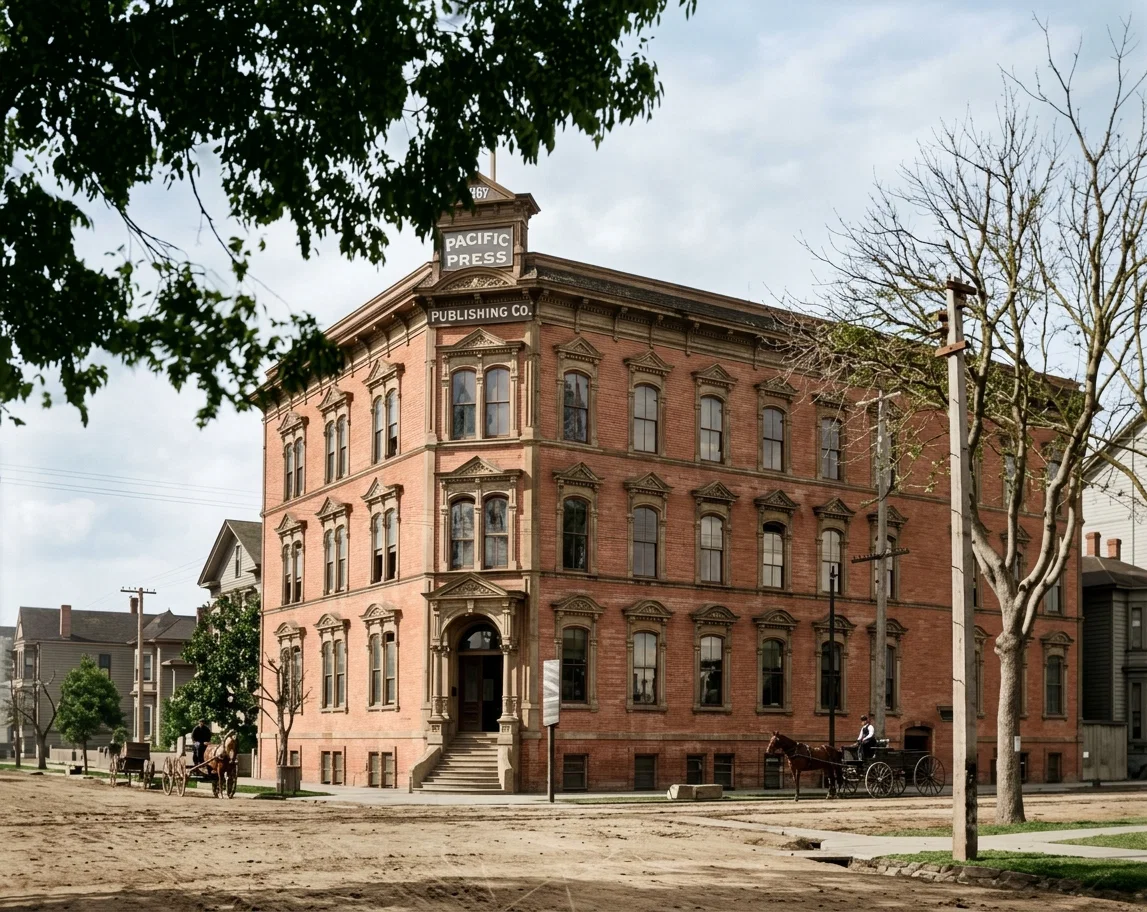
CALIFORNIA SCENERY, No. 12.—OUR HOME.—The above illustration shows the home of the SIGNS OF THE TIMES, corner Twelfth and Castro Streets, Oakland, Cal. The main building was erected in 1887, and is 60x100 feet in lateral dimension. The building to the left, of which only the gable appears in the picture, is the original house, erected in 1876. This building is now partially occupied by the offices of the International Sabbath-school Association, the California Conference, and the California Tract Society; the basement contains two large boilers that furnish steam for the entire institution, and the remainder of the building is used for storage and shipping purposes. The basement of the main building contains two steam engines, an electric light plant, ten power printing presses, two machine book and paper folders, and the counter check book department, with four Kidder web presses. The first floor is occupied by the business offices, book and stationery salesroom, job stock-room, and commercial job printing department, with five presses. The second floor contains the book and paper composition department, and the editorial and proof-reading rooms. The third floor is occupied entirely by the book-binding department. In the rear of the main building is a two-story structure, the first floor of which is occupied by the electrotyping and stereotyping department, and the second floor is devoted to chapel purposes.
“Yes,” said the elder sister at the conclusion of the description, “God made the country and man made the towns, and that shows the difference in their handiwork.”
The talk drifted on to other subjects, for the two girls had much to tell each other after their recent separation; especially had the younger one much to relate of her visit to the city.
Finally their conversation turned upon an acquaintance who, tho a professor of godliness, with a character outwardly fair, was known by the sisters to be a wolf in sheep’s clothing.
“Well, there are back yards to character too,” her mind recurring to the former conversation. “And some people are like the houses in the city. They look very well viewed from the street, but the back yards won’t stand inspection.”
Sadly we must admit this truth. How great the contrast between the phase presented to the world and the “back yards” of some hearts!
And it is sad indeed to think that young people must be introduced so early in life to these unwholesome back yards, and thus have their natural faith in humanity weakened until they too often become gloomy misanthropes who see no good in men but suspect all of dishonesty and hypocrisy.
How different, oftimes, the side presented to the public, to the domestic life of a man; how different the manner of addressing mere acquaintances to that used toward his family! On one side all is jollity and mirth, hail-fellow-well-met with every one, while on the other all is stern words and averted glances.
He is reading the morning paper while at breakfast instead of cheering the tired wife for the day by pleasant conversation.
He pushes the children away as they crowd up to him, eager to tell of victories at school, instead of encouraging and praising them. He cares more for “stock” and “politics” than for the love of his children. He thinks more of the “money question” than of the happiness of his wife, and is more interested, apparently, in the bank failures of the day than in the immortal souls of his family.
Yet he is a popular and influential man in the town. He always goes to church on Sunday with his family, and subscribes to all charitable enterprises.
But we have looked into the back yard.
How different is the side of the young man presented to society and among pure womanhood to that presented at the brothel and the gambling den!
How different is the face of the daughter presented to the tired mother at home to the smiling face presented to other girls’ mothers when she is out calling!
How great a change in the voice of the mother angrily scolding her children to the soft, cooing tones that call them her “darlings” when a visitor is announced!
Will such stand in the last great day?
Their reputation is good, but their character is bad, for “reputation is what men think of us, while character is what God and the angels know of us,” and the all-seeing Eye beholds distinctly the condition of those back yards, and it is by His estimate of them that they shall be judged in the final reckoning.
Let us clean up the back yards of our characters, for as it is from their foul condition that the city pestilence frequently proceeds, so it is often the sins which are unseen by men which destroy the soul in the sight of God; for to Him there is no “secret sin.”—Alice M. Smith, in Pacific Christian.