In view of what we have so far studied on the subject of the atonement, we may here candidly consider a few points of interest, which are vital to the whole matter. Some may have heard it said that the death of Christ was the atonement. It is true that His death was for the purpose of effecting man’s reconciliation with God. Rom. 5:10. But did this complete the work necessary for the blotting out of man’s sins? It must be freely granted that the offering of Christ’s blood was a provision by which men might have this work done, but whether it shall be done or not depends on the will and conduct of those needing the benefit.
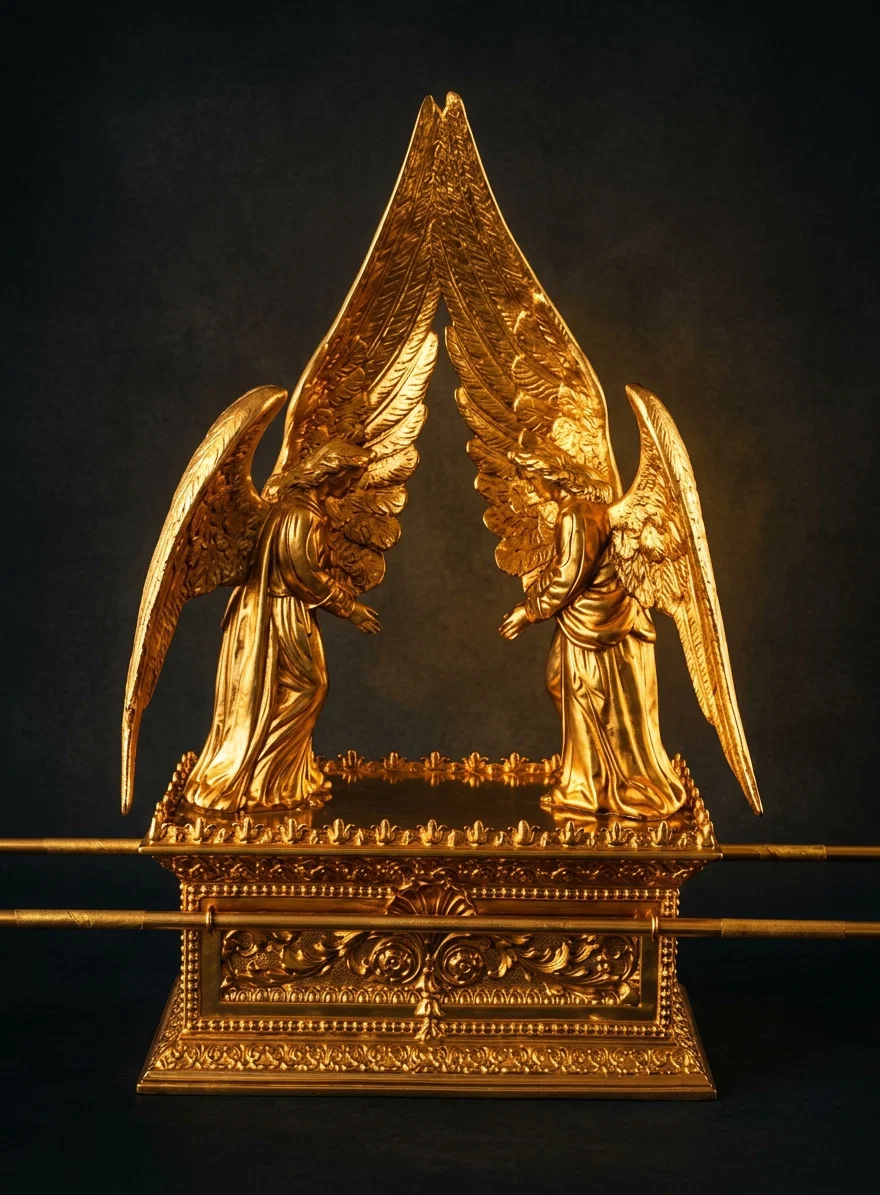
“Ark of the Covenant,” within which were the Tables of the Testimony, the Ten Commandments, and over which was the Mercy-seat. Over the Mercy-seat were the overshadowing Cherubim. Between the Cherubim was the Shekinah, the visible symbol of God’s Presence.
No one can seriously think that men’s sins are removed against their own wills, because that would be to tyrannize over and enslave men, by obliging them to do, and be, what they have no taste for. Were this the way of making atonement for sin, there could be no discrimination, and so all men would alike be saved absolutely. But this would destroy the force of those passages of God’s Word in which are brought to view the final punishment of the wicked.
To hold a belief which makes void any portion of the Bible, begets infidelity toward it in general, and causes hatred of the whole system it advocates.
It is therefore well to settle every question of religious faith on a firm basis. Regarding, as some do, that the death of Christ was to render satisfaction for sin, and that it therefore completed the atonement, brings a ready and decisive conclusion. We are told that Christ tasted “death for every man.” Heb. 2:9. If the death of Christ really rendered complete satisfaction for the sins of all for whom He died, both past and future, and that without the consent of those concerned, it logically follows that every man has actually had satisfaction given for his sins, and must therefore be absolved from them all. This would establish universal salvation at a single bound, and destroy the necessity of any act of faith on the part of men. It would make no difference whatever whether one believed in Christ as an historical being, even; for if His death was in behalf of “every man,” and that death actually rendered satisfaction for every man’s sins, then surely it matters not what one believes, or does, it will be well with him.
But in so momentous a matter as that of life or death in the eternal future, no one should hastily and carelessly settle down upon such a conclusion. There is, however, another consideration worthy of a moment’s thought, which, while not leading to so repulsive a conclusion, will be seen to be just as presumptuous. If the atonement for the sins of the present generation was completed on the cross, satisfaction was rendered for them more than eighteen centuries before they were committed. Could such a thing be possible? Could satisfaction be rendered for a wrong which had not been done, and so was not in existence? It may be suggested that this satisfaction was given in anticipation of what was to be. But this leads to an unavoidable conclusion, which can not be decisive with many; for if the Lord knew, when He died, every person who was to exist, and every sin that every individual of these unborn generations would commit, and then and there made complete satisfaction for them, this was granting indulgences for sin in a wholesale way. The defense may be set up, however, that it was not designed to exempt those who did not repent of their sins, but that since it was known that some would repent, and be saved, it was necessary thus to make an atonement in their behalf.
But this is to relinquish the belief that the death of Christ, which was for every man, comprehended the atonement. For if the atonement was to benefit none but those whom it was known would repent, then surely the death of Christ did not atone for the sins of “every man” for whom He died. This of itself ought to settle the question as to whether or not the death of Christ completed the atonement at the cross. If the atonement was there closed, and only those were included in its provision whom it was known would repent, the doctrine of predestination is established, and the case of every individual was there fixed beyond recall.
But let us look for a better way,—one which affords more hope and consolation. In the death of Christ the iniquity of all was made to meet on Him. Isa. 53:6, margin. That is, with His death He paid the price by which all might be redeemed from the slavery of sin. But if any do not choose to accept the offer of freedom so graciously extended, they may remain in sin, and take its final consequences. The only possible way by which the blood of Christ can avail in behalf of the sinner, is for him to yield himself, with his sins, to Christ. The sins being thus given to Him who purchased them, He performs the atonement work necessary for blotting them out of the “books of remembrance.”
In the typical atonement of the earthly sanctuary, only those sins were remembered by the high priest which had previously, through confession, been removed from the sinner, and conveyed into the sanctuary upon the body of a substitute. That being the true shadow of Christ’s work for the sinner, the atonement He accomplishes in fact, must have been distinctly foreshadowed in the typical sanctuary service. This is well stated by the apostle: “It was therefore necessary that the patterns of things in the heavens should be purified with these [the blood of beasts]; but the heavenly things themselves with better sacrifices than these.” Heb. 9:23.
We have already seen that the earthly tabernacle, called the “patterns of things in the heavens,” was cleansed once each year, at the close of that year’s religious service; that at that time all the sins of the year which had by confession been conveyed into the sanctuary, were taken out by the high priest, and laid on the head of the scapegoat, who, while living, carried these accumulated sins away to an uninhabited region, and there bore them till he died. Those, however, who had not placed their sins in the sanctuary before the close of that day’s service, must carry them themselves, with all the consequences they entailed. As the scapegoat who received the sins from the sanctuary at the close of the atonement ceremony was banished from the camp, so every other one upon whom sin then rested, must also be separated from the Lord’s camp and people, as the closing work of the high priest for His people in that typical cleansing work.
No one can fail to see in the shadowy work of the Jewish high priesthood, the figure of the real day of judgment. As the closing work of the earthly atonement was the putting away of sin from the people of God, so with the heavenly atonement. In that, the closing work of Christ as our high priest must be the final putting away of sin from His people, by separating from them everything and every person tainted with the deadly malady.
The atonement being thus delayed to become the closing work of Christ for the world, every one may receive the full recognition, not only of what he has done personally, whether good or bad, but also of all that has been accomplished through his influence, to the latest moment of probation. This would not be the case were the atonement closed earlier. With such men as Voltaire, Paine, and others of their class, no just sentence could be meted out immediately upon their deaths, for the reason that their influence for evil did not die with them. The same may be said of such men as the Wesleys, and the many missionaries who have sacrificed life to plant the banner of the cross in heathen lands. Those men being dead yet speak, and not till the last generation has lived will their influence for good be computed.
The atonement is therefore really an investigation of the life record of men, to ascertain who are worthy to live forever, and to separate from them all those who must bear their own sins. Up to that time all have opportunity to lay their sins on Christ, who in His own body bears them into the sanctuary above, there to await the time when the accumulated sins of all ages, carried there through confession, shall4finally be blotted out together. With that time past, those who have refused to confess their sins must bear them themselves, even as Satan, the great scapegoat, bears the sins of those who have renounced them and sought refuge in Christ, the divine Sacrifice.