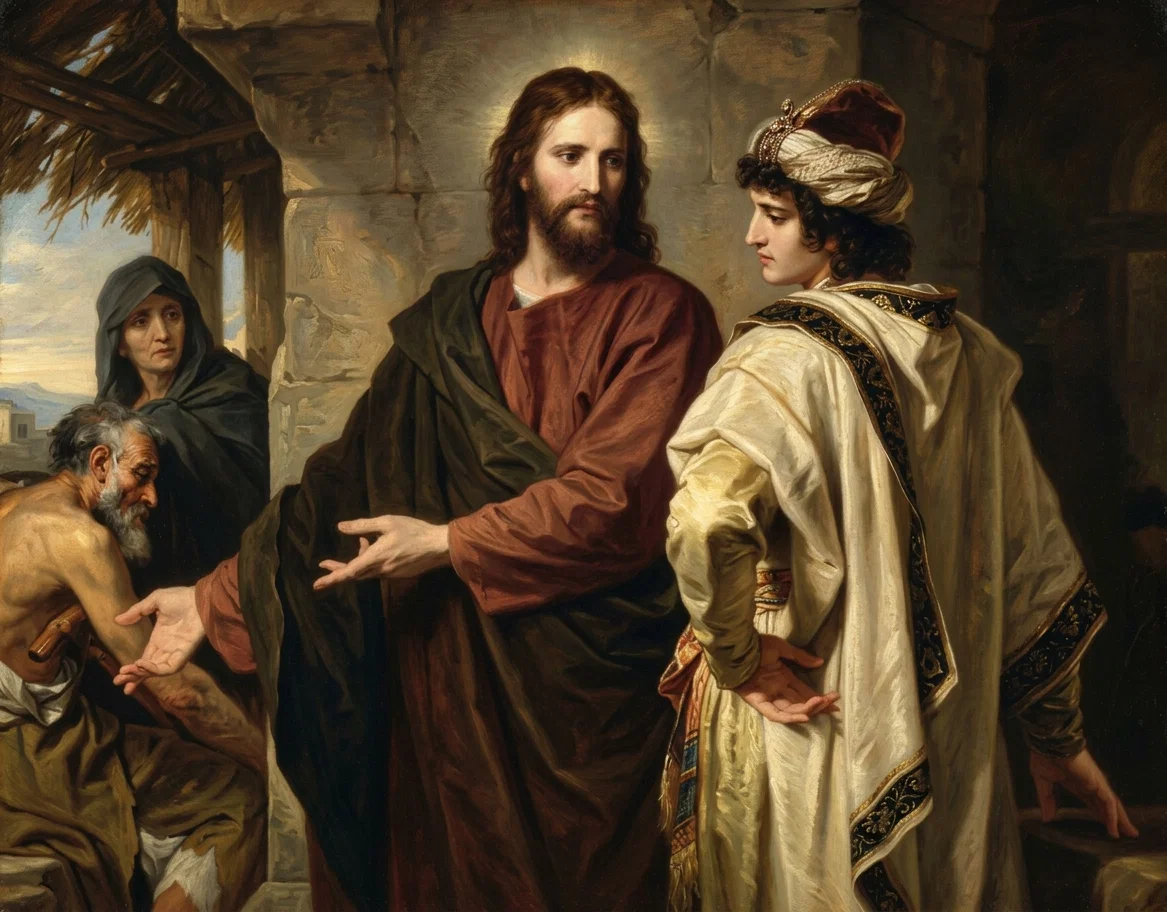
There is found in Matt. 19:16–22, in Mark 10:17–22, in Luke 18:18–23, a brief record of an incident in our Lord’s earth-life which contains practical lessons for every age, but lessons of especial importance for these days of peril. The actor in the scene is representative of the respectable wealth-loving of every age and land. The words of our Lord present eternal truth.
“Go and sell that thou hast, and give to the poor, and thou shalt have treasure in heaven; and come and follow Me.” Matt. 19:21.
Our quotation combines the account in the three Gospels:—
“And when He was gone forth into the way, there came a certain ruler, and kneeled to Him, and asked Him, Good Master, what good thing shall I do, that I may have eternal life? And Jesus said unto Him, Why callest thou Me good? there is none good but One, that is, God; but if thou wilt enter into life, keep the commandments. He saith unto Him, Which? Jesus said, Thou knowest the commandments, Thou shalt do no murder, Thou shalt not commit adultery, Thou shalt not steal, Thou shalt not bear false witness, Honor thy father and thy mother, and, Thou shalt love thy neighbor as thyself. The young man saith unto Him, All these have I kept from my youth up; what lack I yet? And Jesus, beholding him, loved him, and said unto him, If thou wilt be perfect, go and sell that thou hast and give to the poor, and thou shalt have treasure in heaven, and come, follow Me. And he was sad at that saying, and went away grieved; for he had great possessions.”
The Question.—Self-righteous and deceived tho the young ruler was, yet he was sincere in his question. He recognized in our Lord a great teacher; he evidently was impressed by the Spirit of God with a lack in his own heart, which did not assure eternal life, and he longed to live forever. “Good Master, what good thing shall I do?” His character had been wrought out on true Pharisaic principles. It must be a good work, that was true; but he must do the good work.
The Revealing Reply.—Jesus desired to show the young ruler himself and the true source of all goodness. “Why callest thou Me good? there is none good but One, that is, God.” Jesus did not say that He Himself was not good; but He did say that God only was good, inherently and essentially good. Therefore, if Jesus was good, He was God, as assuredly He was, “God with us.” Did the young man really believe this? Jesus does not ask a reply; He wishes the young man to think of the far-reaching import of His searching words. He wished him to learn what He wishes every soul to learn, that all goodness is in God, and that if we are good at all, it must be in God’s goodness. “In Thy borrowed goodness good.” “All have sinned and come short of the glory of God.” The very psalms which the young man had chanted in his service had declared the truth, “There is none that doeth good, no, not one.” Psalms 14 and 53. If he were good, the goodness was not of him, but of God. Had the young man known this, he would have better realized how he owed all to God.
The Conditions of Life.—Jesus sought to2reach his heart by another way: “In the way of righteousness is life” (Prov. 12:28), was a scripture often read in the synagogs. Over and over again God had told the Hebrews that the way of His commandments was the way of life. “Which if a man do, he shall live in them.” Lev. 18:5; Deut. 30:15–19. He merely stated the great truth in other words, “If thou wilt enter into life, keep the commandments.” God’s life is given through His law. Both are eternal and harmonious. The law of man’s continued existence is the law of God’s commandments, the law and life which were in Jesus Christ. The transgression of these commandments is sin; and “sin, when it is finished, bringeth forth death.” James 1:15; Eze. 18:4. The young man by his own question admitted that he did not have eternal life; he was therefore transgressor of God’s eternal law.
The Revealing Reply.—“Which?” As tho he would say: “What commandments have I not kept? Master, you do not know how righteous I am.” Jesus calmly repeats five commandments of the last part of the Decalog, and then sums them all up, including the last precept, in the injunction, “Thou shalt love thy neighbor as thyself.” And the poor, deceived man replied, “All these have I kept from my youth up;” and outwardly, he probably had. He had kept the outward form. No one could bring a charge against him on account of one single overt transgression. “Master, I have kept all these, what more do I lack?” the young man replies. He thought he told the truth. He did not know how deceived he was. He did not know that only those persons keep God’s commandments who love God with all the heart, mind, soul, and strength; that only by God’s Spirit or life could he keep God’s law; and that he could only do this by yielding all by faith to God. Jesus knew all this, and He brings home to the heart of the young man the last searching lesson, a lesson which would try the sincerity and faith of the words, “Good Master,” which would show the young man how much more he loved his riches than God, how little he comprehended the exceeding breadth of God’s commandments, and how little he prized the Saviour’s promise of a better treasure and eternal life.
His Test of Obedience.—“If thou wilt be perfect,” if thou wilt have the perfect life, “go, sell that thou hast, and give to the poor, and thou shalt have treasure in heaven; and come, follow Me.” Jesus was still pressing home the Scriptures in which the young man had been instructed from youth: “He that hath pity upon the poor lendeth unto the Lord; and that which he hath given will He pay him again.” Prov. 19:17. It was God’s own promise repeated in even more precious words. The young man thought that he had kept the commandments; he did not realize that his riches were his idol, that he coveted them and his reputation more than he did to do God’s will. He had kept none of the commandments; all his deeds were wrought in self. The Lord’s test of obedience revealed the selfishness and idolatry of the man; he felt grieved, and went away sorrowful. “How hardly shall they that have riches enter into the kingdom of God.”
Jesus Loved Him.—He saw in him the possibilities of a noble, useful character. He loved and loves every other one whom that young man typified and whose heart is set on money. Because He loved him He wanted to save him, even as He loves and longs to save every soul situated as was that young man. He loves you, dear soul, to whom is intrusted wealth of any sort. He loves you, and therefore He does not want your heart set on earthly riches, which will soon scatter and perish. Rich as a Rothschild tho you may be in this world’s possessions, you can keep it only till you die. Naked you came into the world, naked you go out. You leave all at last, even tho you cling to it with the covetous clutch of the miser while you live. And even before you die, the banks may break, your gilt-edged investments prove worthless, your stocks go down, your speculations prove disastrous; fires may burn your wealth, floods destroy it. And that is all you have. Christ loves you, and would give you a better treasure. He would give it in the best way. He would unite you with Himself in a holy partnership of helpfulness. “Mi-sery is mis-ery.” Holding all, you die and lose it all. Giving all, you place it in the bank of God, which can never fail, and you get it all again for all eternity, and glorified, multiplied a myriad-fold. Your buildings here will decay with age and crumble under the earthquake shock; there they will be the mansions that last forever, that are garnished with the gems of God. Here your land will succeed to another at your death, or will be taken by creditor or enemy while you live; there “the kingdom shall not be left to other people,” for you shall live forever. The glitter of your hoarded gold here will tarnish; there it will shine in immortal eyes to all eternity. Sell, and give to the poor. They are God’s representatives in need, in order to draw out the sympathies of your heart and test your loyalty to God. Christ identifies Himself with every one of them; whatever you do for each and to each is done for Him. O, do you not see Him and hear Him in the maimed, the halt, the blind, the crippled, the hungry, the homeless, the houseless, the “ragged, bestial beggars” which throng the cities? Some of them seem not human, but give to them for Christ’s sake. He can recreate them. He knocks at your door in need. Turn Him not away empty-handed. Many are working almost despairingly to help the multitudes in our great cities; sell, and give, and co-operate with Christ. Join partnership with a firm that never failed. Place your treasure in heaven, in a bank that can never break. O, work with Christ, and share His eternal joy! Heb. 12:2; Matt. 25:34–40.