“In the third year of the reign of King Belshazzar a vision appeared unto me, even unto me Daniel, after that which appeared unto me at the first.” Dan. 8:1.
This vision was given two years later than the vision described in the seventh chapter. The second verse says that the prophet was at Shushan, “in the palace.” Shushan was one of the capitals of Babylon, being “in the province of Elam.” In the vision the prophet seemed to be “by the river of Ulai,” and he tells what he saw, in the following language:—
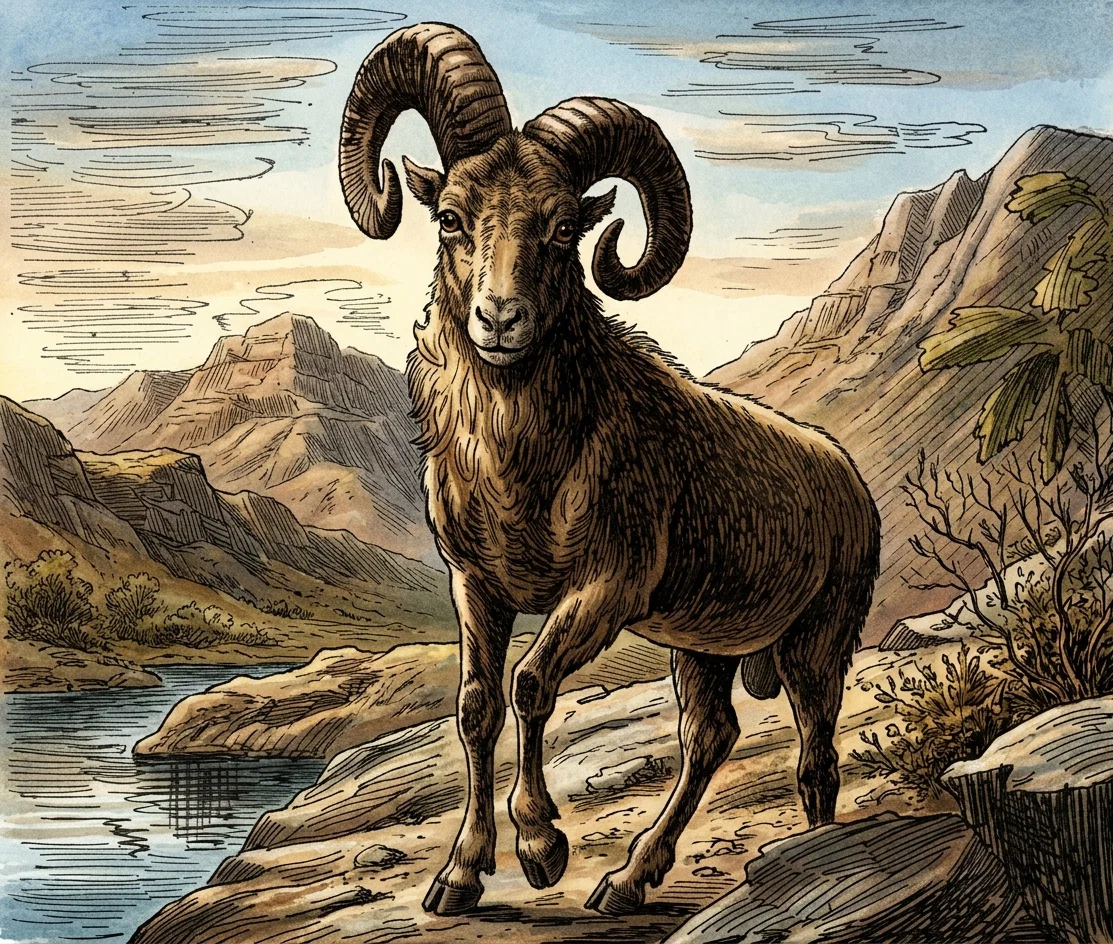
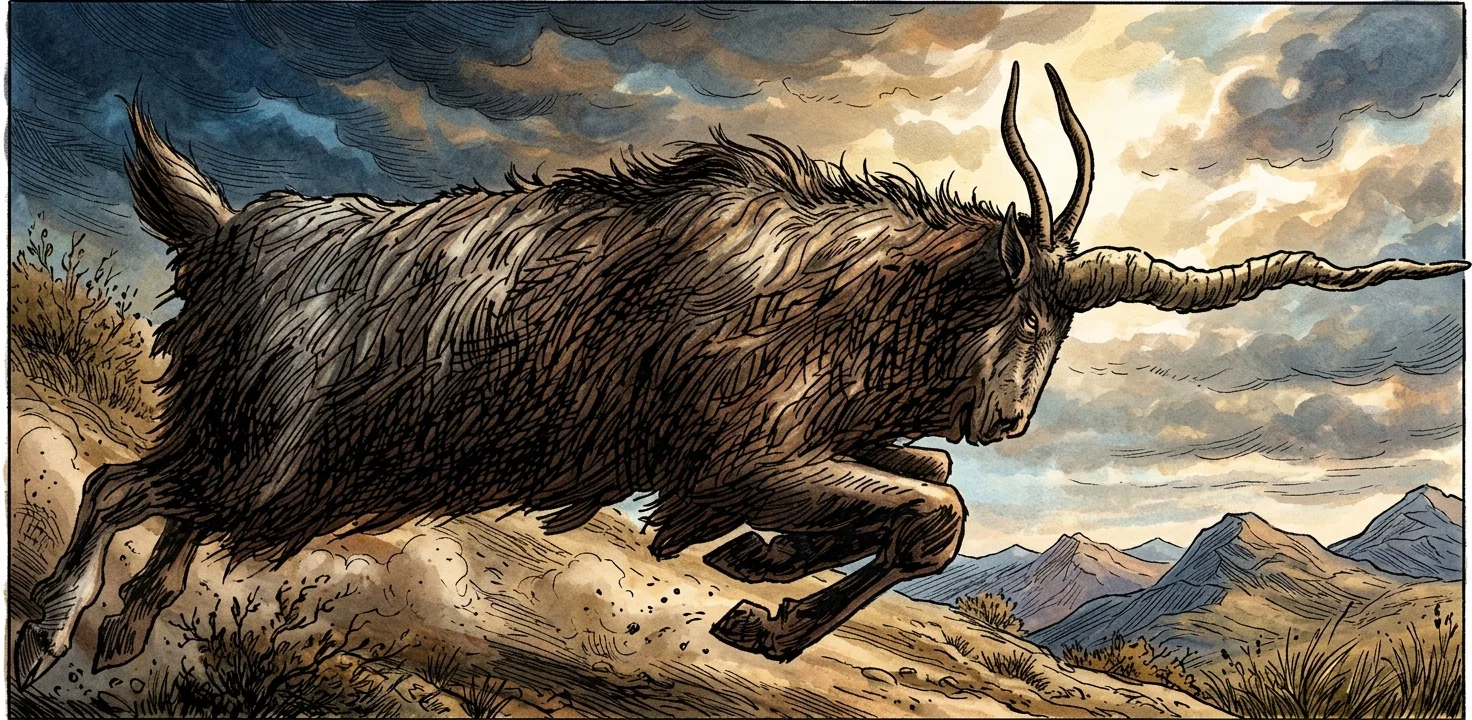
“Then I lifted up mine eyes, and saw, and, behold, there stood before the river a ram which had two horns; and the two horns were high; but one was higher than the other, and the higher came up last. I saw the ram pushing westward, and northward,5and southward; so that no beasts might stand before him, neither was there any that could deliver out of his hand; but he did according to his will, and became great. And as I was considering, behold, an he goat came from the west on the face of the whole earth, and touched not the ground; and the goat had a notable horn between his eyes. And he came to the ram that had two horns, which I had seen standing before the river, and ran unto him in the fury of his power. And I saw him come close unto the ram, and he was moved with choler against him, and smote the ram, and brake his two horns; and there was no power in the ram to stand before him, but he cast him down to the ground, and stamped upon him; and there was none that could deliver the ram out of his hand. Therefore the he goat waxed very great; and when he was strong, the great horn was broken; and for it came up four notable ones toward the four winds of heaven. And out of one of them came forth a little horn, which waxed exceeding great, toward the south, and toward the east, and toward the pleasant land. And it waxed great, even to the host of heaven; and it cast down some of the host and of the stars to the ground, and stamped upon them. Yea, he magnified himself even to the prince of the host, and by him the daily sacrifice was taken away, and the place of his sanctuary was cast down. And an host was given him against the daily sacrifice by reason of transgression, and it cast down the truth to the ground; and it practised, and prospered.” Verses 3-12.
As the beasts of the previous vision stood for kingdoms, it would be but natural to suppose that the beasts of this chapter have a like import. But we are not shut up to conjecture, or even to the facts of history, in discovering the meaning of the ram and goat. Daniel was plainly told that—
“The ram which thou sawest having two horns are the kings of Media and Persia. And the rough goat is the king of Grecia; and the great horn that is between his eyes is the first king.” Verses 20, 21.
But why is not Babylon mentioned in the vision, as in the vision of the seventh chapter and in the dream of chapter 2?—Because this last vision was given to Daniel in the last year of the reign of the last king of Babylon. It was about to drop into the past, therefore could not well be the subject of a vision concerning the future. The prophecy began with the new kingdom just coming on the scene of action. The two horns of the ram, one higher than the other, the higher coming up last, have the same significance as the bear of the seventh chapter, which lifted itself on one side; thus was indicated, what history afterward verified, that the Persian element in the kingdom became predominant.
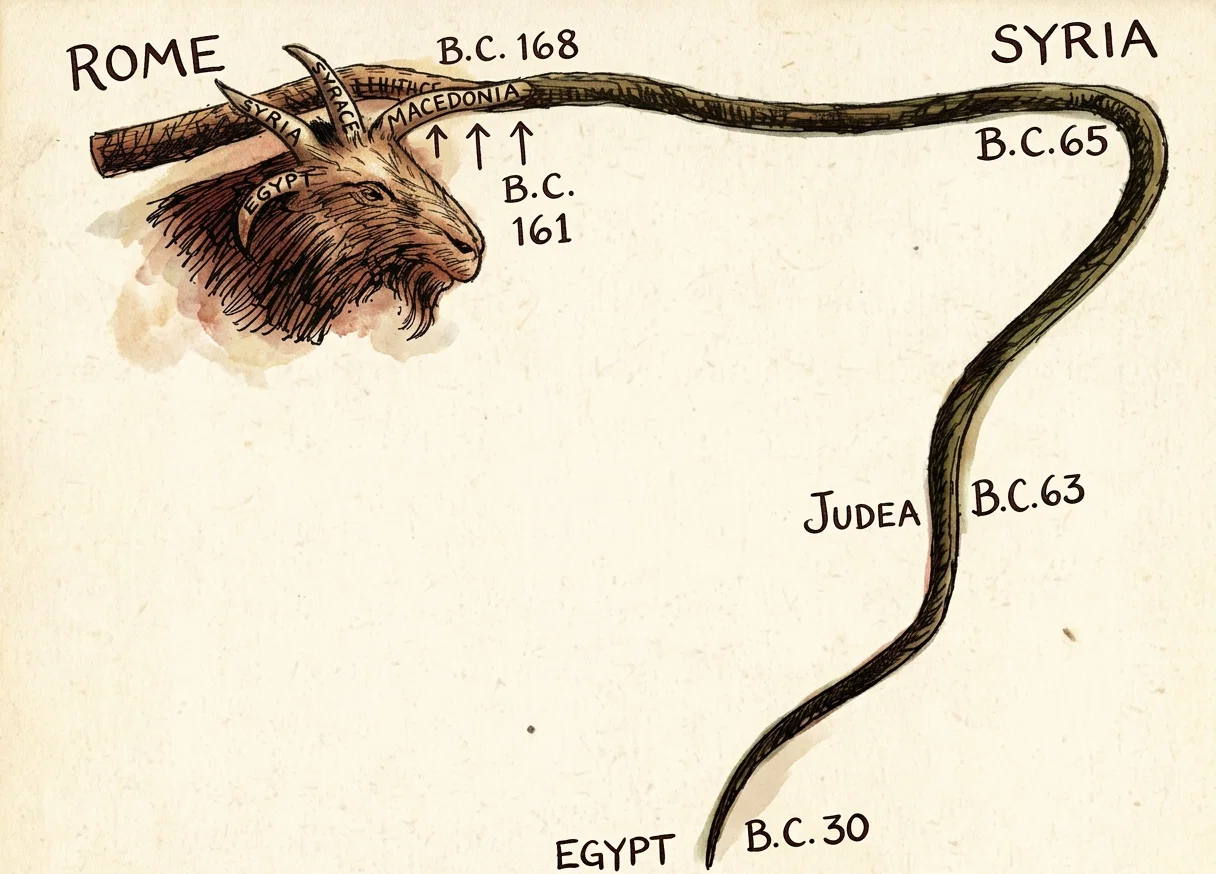
The notable horn of the goat was Alexander the Great, the “first king” of the Grecian Empire. The breaking off of this horn was fulfilled in the death of Alexander, and the four horns which arose in its place were the counterpart of the four heads of the leopard of the seventh chapter. The kingdom, tho still reckoned as a unit, was (after a brief pretension on the part of Alexander’s brother and two sons) governed by four generals of the army. Seleucus ruled over Syria and Babylon in the east; Lysimachus, in Asia Minor and the north; Ptolemy, in Egypt on the south, and Cassander, in the European or western part of the kingdom.
Out of one of the horns there “came forth a little horn, which waxed exceeding great.” It is said of the ram (Medo-Persia), that he “became great;” of the goat (Grecia), that he “waxed very great,” and of this little horn, that it “waxed exceeding great.” Inasmuch as it waxed exceeding great in all parts of the then dominant kingdom, we conclude that it conquered that kingdom. What power did so with Grecia? As with the iron kingdom in Nebuchadnezzar’s dream-image, and the “fourth beast” in Daniel’s former vision, there is no power but Rome whose history meets the prophecy. Rome attacked the goat (Grecia) in its European or western “horn,” and continued its conquests until it was victorious everywhere.
This “little horn” is not identical with the “little horn” of the seventh chapter. It includes the work of that “little horn,” but it is the same as the entire “fourth beast” of chapter 7, with its “little horn” and all. It is Rome in both its pagan and papal phases. This point should be noted particularly: In the seventh chapter Rome is treated as two powers, civil and ecclesiastical, the “little horn” being exclusively ecclesiastical; but in the eighth chapter Rome is treated as a unit; whatever is done, whether of a secular or religious nature, is done by that power as a whole.
With this light before us, it is not difficult to understand the meaning of the work ascribed to this power. “It waxed great, even to [margin, ‘against’] the host of heaven [the people of God]; and it cast down some of the host and of the stars [prophets and apostles] to the ground, and stamped upon them.” It put them to death, and tried to stamp out their influence. “Yea, he magnified himself even to the Prince of the host.” Jesus Christ is the “Prince of the host,” the “Lord of hosts,” and He was crucified by the authority of the Roman Government. No other power on earth at that time had authority to execute the death penalty. All this was done while Rome was yet pagan in religion.
“By him [margin, ‘from him’] the daily sacrifice was taken away, and the place of his sanctuary was cast down.” It was the pagan religion and its services that were practically taken away when Rome, by imperial decree, became (nominally) Christian. How was the place of his sanctuary cast down? “An host was given him against the daily sacrifice [paganism] by reason of transgression, and it cast down the truth to the ground; and it practised, and prospered.” All the way through the recital of this vision the pronouns “it” and “he” are used interchangeably when referring to the same power. Moreover, we have the same power warring against itself. The host that was given him is not the “host of heaven,” previously mentioned. The host that politically defeated and seized portions of the empire, dividing it into different kingdoms, were hosts of barbarians. But these were brought under the influence of the church and used against the pagan religion. Through the intrigues of the bishops of Rome, the church gained power, while the political power of the empire waned.
Whatever was done by either the church or the State was done by the “little horn” power, for it stands for both. It not only took away the daily (or continual) desolations of paganism, but, having done so, it did worse under the guise of Christianity than paganism had done; it “cast down the truth to the ground; and it practised, and prospered.” It was the Church of Rome that did this; it was the ecclesiastical feature of this little horn power—the feature which corresponds to the little horn of chapter 7—that “prospered,” while the political phase of the empire lost power.
The angel Gabriel said to Daniel, “I will make thee know what shall be in the last end of the indignation; for at the time appointed the end shall be.” Verse 19. Then follows the explanation of the symbols of the ram and the goat, as before noted, and then a repetition of what should come after the goat, or Grecian Kingdom: “And in the latter time of their kingdom, when the transgressors are come to the full, a king of fierce countenance, and understanding dark sentences, shall stand up.” Verse 23. God in His long-suffering mercy does not overthrow nations or peoples until their iniquity is full—till there is no more hope of good from them. See Gen. 15:16; Dan. 5:17–28; Matt. 23:29–39; 1 Thess. 2:14–16; 2 Peter 3:9, 10. Grecia was no exception to the rule.
The description, “a king of fierce countenance,” agrees well with that of the “fourth beast” of the seventh chapter, which was “dreadful and terrible, and strong exceedingly.” A power “understanding dark sentences” is well exemplified in Rome. This part of the book of Daniel was written in Hebrew, primarily for the Hebrew people, to whom the Latin language was then unknown; much of the Roman Church services are unintelligible to the people, and ambiguity is a characteristic of much of her literature. Continuing, the angel said, “And his power shall be mighty, but not by his own power.” Verse 24. “There is no power but of God.” Rom. 13:1. “The Most High ruleth in the kingdom of men, and giveth it to whomsoever He will, and setteth up over it the basest of men.” Dan. 4:17. “He removeth kings, and setteth up kings.” Chap. 2:21.
“And he shall destroy wonderfully, and shall prosper, and practise, and shall destroy the mighty and the holy people.” Verse 24. Of this power, as symbolized by the “exceeding dreadful” beast in chapter 7, it is said that he should “devour the whole earth,” and should “tread it down, and break it in pieces.” This of course would include the “mighty” as well as the “holy people.” Rome did tread down all opposing armies, and it did destroy the people of God, both Jews and Christians, as no other power ever did.
“And through his policy also he shall cause craft to prosper in his hand; and he shall magnify himself in his heart, and by peace [margin, “prosperity”] shall destroy many; he shall also stand up against the Prince of princes [Christ and His law]; but he shall be broken without hand.” Verse 25. All these specifications apply to Rome, and are consonant with other scriptures, especially with chapter 7:25, 26; 2:34, and 2 Thess. 2:7, 8. That this prophecy dealt with matters far in the future, is further shown by verse 26: “And the vision of the evening and the morning which was told is true; wherefore shut thou up the vision; for it shall be for many days.” W. N. G.