MISSIONS IN TURKEY

10%

Pacific Press Publishing Company · Oakland, California · Feb 10, 1898

FromSigns of the Times, Vol. 24, No. 6.

Read the full edition

MISSIONS IN TURKEY.

Few fields have been the object of so much missionary effort on the part of America as Turkey. About the time that the Spirit of the Lord was preparing heralds of the first angel’s message, pioneer missionaries were sent to Turkey by the American Board of Missions, chiefly sustained by the Congregationalists; and while America received new spiritual life from the preaching of the first angel’s message, a spirit of revival attended the efforts of missionaries in Turkey, and a notable work was accomplished. This was doubtless largely due to the outpouring of the Spirit which attended the first message.
But those days of revival in Turkey are far in the past. A notable change has taken place. This is generally felt by the people; and is doubtless due to the fact that missionary effort here has not been connected with the advancing light of the message. This being the case, it might be expected that the preaching of the third angel’s message would be attended with greater power than that of the ordinary missionary; and that is precisely so. Whenever the message is preached, new life is manifested. Said a missionary to me in speaking of a visit of one of our workers to his town, “Your worker did at least one good thing for our people, he stirred them all up to study the Bible as they had not done before.” And as the people examine the Word, they are quickened by it.
The chief effort of missionaries in Turkey is in the line of education; and as much of the instruction is in English, a large number of the students learn this language, which may be termed the mother tongue of the message. This is a factor of no small importance in connection with our work. There are now 170 American missionaries in Turkey. As a result of some 75 years’ work, there are now 125 churches, with a membership of 12,000. In the various schools, there are over 20,000 pupils.
While the Congregationalists confine their efforts largely to Asia Minor, and Turkey in Europe, the Presbyterians occupy Syria and Palestine as their field, with headquarters at Beirût. This city, the chief port and commercial center of Syria, is situated on an elevated peninsula several miles in length, about the middle of the Lebanon range, north and south, and has a population of 100,000, consisting of Moslems and Christians of almost every creedand shade of creed. This city is pre-eminently an educational center, there being here 103 schools, with 561 teachers and 15,473 pupils. Deducting the 24 Mohammedan and 6 Jewish schools, the remaining 73 represent 12 shades of Christian belief.
Connected with the American mission in Syria are 39 American workers, 16 men and 23 women, who operate from five centers, Beirût, Tripoli, Abeih, Zahleh, and Sidon. The result of 70 years’ work is 28 churches, with 2,247 members. The population being about 2,000,000, there is but one Protestant to a thousand of the population. Besides the work of Presbyterians, there are other smaller agencies in the field, such as Reformed Presbyterians, Irish Presbyterians, Scotch Free Church, etc.
The language of this field is Arabic. This language is spoken almost wholly from the throat, and reminds one of the bleating of a sheep. The missionaries complain that Sunday is not kept as it should be, as it is difficult to convince the people of the sacredness of the day; for the name for Saturday in the Arabic is Sabbath, the same word as is used in the fourth commandment, and are not clear as to what Sunday has to do with it. The message will without difficulty clear up their minds on this subject. There is no place in the world where there is more confusion in regard to a day of worship than in Syria. The Druzes worship on Thursday, the Mohammedans on Friday, the Jews on Sabbath, and the Christians on Sunday. None of them keep a rest day as they should; and nothing but the third angel’s message will set them right.
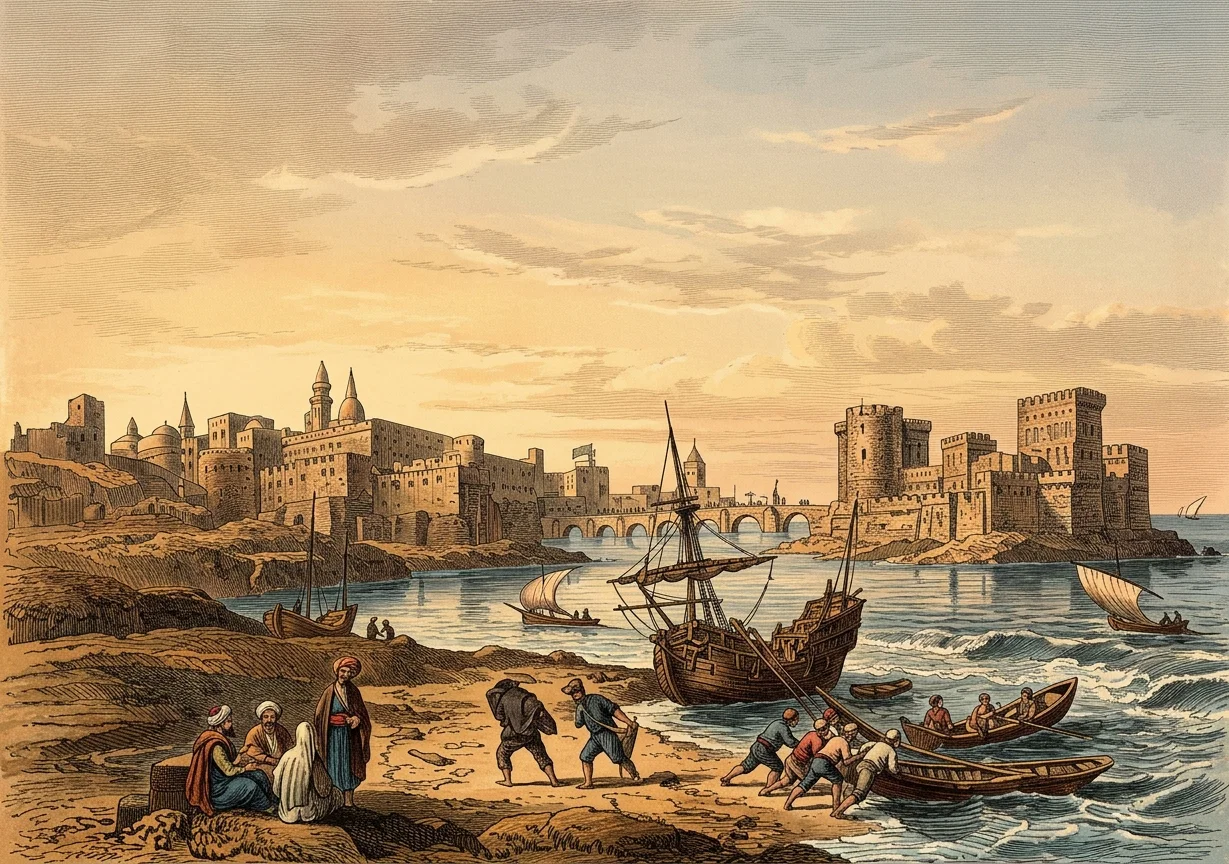
SIDON (modern name “Saida,” Hebrew, “Zidon,” meaning a fishery) is one of the most ancient cities of the world. See Gen. 10:15. It is situated on the west coast of Syria, between Lebanon and the sea, 123 miles northwest of Jerusalem. In Joshua’s time it was “Great Zidon,” probably the metropolis of Phenicia. Joshua 19:28. From here came those who helped to build the temple (1 Kings 5:6), and hence came the abominations of sun-worship to corrupt Israel (1 Kings 11:5, 33). It was probably visited by our Lord. Matt. 15:21; Luke 6:17. The ancient city was several times destroyed. Its population is about 10,000, of which 7,000 are Moslem. The city is but a shadow of its former greatness in wealth, manufactures, and commerce. The American Presbyterian Board has there a flourishing mission.
The truth has entered northern Syria, having passed what the ancient warriors called the Gate of Syria, and may it now speedily spread over the whole country, that once more the mountains of Lebanon may resound with the everlasting Gospel! H. P. H.
Beirût, Syria, January 2.