THEODORE LANCASTER

5%

Pacific Press Publishing Company · Oakland, California · Feb 10, 1898

FromSigns of the Times, Vol. 24, No. 6.

Read the full edition

THEODORE LANCASTER.

(Concluded.)
Poor Abbie Lancaster! She went home an' saw them lay her precious baby in the grave, as she stood alone as droopin' as the willer that grew near by, an' then returned to their desolate home. It had been lonely for her an' her little one without the lovin' protection of her husband, but now the silent, neglected place seemed frightful to her as the days dragged by. She would cook, but couldn't eat alone. She slept little, an' then only to dream of prison bars an' baby cries, an' start awake with empty arms. Theodore wrote a pitiful letter to their home folks, an' so her mother went down to comfort her what she could; but my! it didn't do a bit of good towards savin' her. She just dwindled down weaker an' sadder till she couldn't walk. She tried to eat an' sleep, but when she forced down food, it didn't do her no sort of good, an' 'peared like there was no sleep fur her.
They'd called a doctor, an' her mother would tell her about things back here to Indiany, an' try every way to cheer her up, an' she'd listen an' smile, but whenever she'd leave the room, Mis Lancaster said her mother'd hear her moan and cry, “O God, my baby, my husband!” After a few weeks the sweet, broken-hearted young wife found rest in the grave; brain fever, the doctor called it. God is merciful, an' so He give “His beloved sleep.”
All this time she had ben slippin' away frum him, they still kept her husband in jail, an' only let him out in time to meet them takin' her to the cemetery.
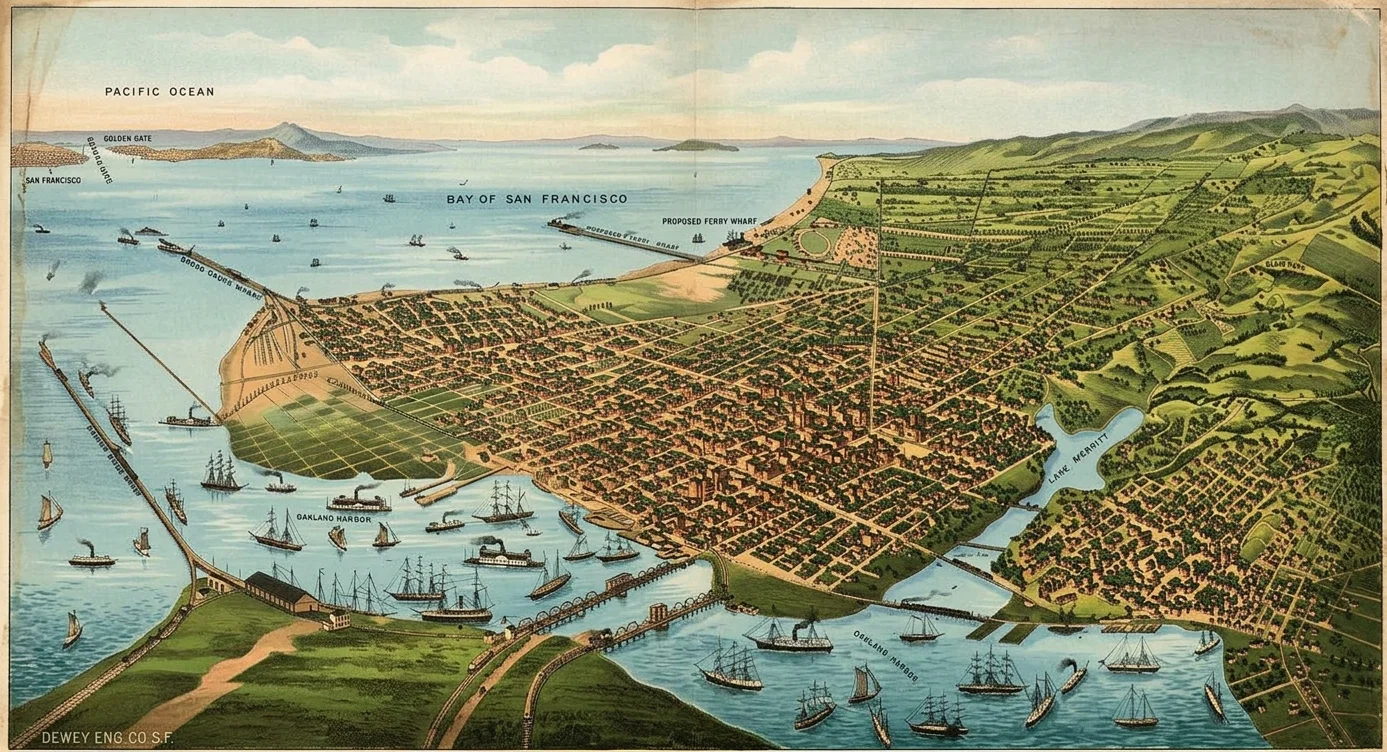
CALIFORNIA SCENERY, No. 6.—The above bird's-eye view is an illustration of the home city of the “Signs of the Times.” On the left of the picture and west of the city is a corner of San Francisco, and the “Golden Gate,” leading out from the harbor to the broad Pacific Ocean. Oakland is much more thickly populated on the north and extends farther on the east than is shown by the illustration. The office of the “Signs of the Times” is situate at a point one and seven-eighths inches from the bottom of the picture and three and nine-sixteenths from the right.
Well, the poor man sold his stock an' crop fur next to nothin', an' come back with his wife's mother, an' all his an' her folks is a tryin' to git him to not grieve himself clear down like she did.
After he'd come away, that very senator that had got him to go down there (an' if you'll believe it he's kin of Davy Crockett's, Mis Lancaster says), he saw how mean and unprincipled human natur is if it's got any chanct to overbear, downtread, an' act the tyrant. When they wus legislatin', he tole about Theodore bein' jailed an' lots of other seventh-day folks, too, fur paintin', an' diggin' a mess of pertaters an' sich, that wouldn't disturb nobody that wus busy tendin' to their own Sunday-keepin'. He showed 'em how they wus egactly like the persecutors of Eurip, an' like the Puritans to the Baptists an' Quakers, a-burnin' an' torturin' 'em fur their religion. I read his speech that Mis Lancaster had along, cut out of a Arkansas paper. It wus downright solid sense the whole way through, an' the most of them ones that makes the laws had wit enough to see it, so they put it onto their books agin that seventh-day folks wus free to worship when they liked an' to work on Sundays too.
Me an' Baker, we went to work an' treated that young man jist as well as we knowed how, an' kept them frum goin' three or four days, an' livened him up as much as we could, which wusn't a gray deal—an' then they went on to their relations in Bloomfield fur a spell.
The very next week after they wus here Parson Jones had a man to preach in our meetin'-house one night on “Sabbath Observin'.” He wus right in fur havin' the name of God put into the Constitution an' the strictest kind of Sunday laws made, so that no work would be done Sunday an' everybody could go to church. He said the poor workin'-men didn't hev no time to see their families nur keep the commandments; an' tole how people go picknickin' Sunday, play baseball, read Sunday papers, an' ride on the cars; an' how the preachers couldn't git their members out to church fur readin' the papers theirselves, but he said, too, that a man that wouldn't work a-Sunday wus shore of a stiddy job, fur they knowed he had a conscience.
An' then he rolled up his sleeves, as it were, an' paced up an' down that pulpit fur nearly half a hour tellin' about seventh-day folks workin' agin' the National Deformers that he belongs to. He called 'em monymanyacs, proselyters, an' fanatics—stuff that anybody had orter know shouldn't be spit out into no meetin'-house anyways. But my! I can't begin to tell all he said, nor don't want to, but while he wus yellin' an' prancin' I thought of Theodore Lancaster an' them other men in Arkansas, an' I see right away that the devil wus leadin' that man to think he knowed it all, an' to feel it wus his juty to make everybody else do jist as he thought they had orto whether they thought 'twus right or wrong.
He's in fur settin' the Ten Commandments right up fur the law of the land, and layin' the penalties onto anybody that don't keep 'em jist as they think they'd orto—whatever religion or no religion.
Well, now, look here, they ain't nobody in this hull United States that wouldn't ruther see every man, woman, an' child that lives under the flag a-keepin' every one of them commandments right along, not anybody. But say, you know 'swell's me, that is if you're aChristian, that it hain't a-goin' to do no good nur be acceptable obejance to God fur you an' me to make 'em purtend to keep 'em. We've got to make people leave one another an' their property alone, that's what the government's fur, an' it's all right to 'tend to murderers, polygamists, thieves, an' sich that comes between feller-bein's and feller-bein's, but that ain't because it's in God's law, fur if we wus carryin' out His way of lookin' at things, we'd have to know as much as Him, or be guided by Him direct, as Israel wus, an' be so we could tell when a man hated his brother an' hang him, fur God says he's a murderer; an' when folks broke the seventh commandment in vile thoughts an' punish them an' when enybody—yes eny'bod'y, Parson Jones or who not—coveted the least thing of somebody else to put 'em smack through fur it. But we hain't got quite so knowin' as that, an' so we can't set ourselves up to makin' people do thus an' so because we believe they had orto. We can persuade 'em, an' show 'em, an' teach 'em the way we think's right, an' if they believe it, an' do it, all right, an' if they don't, all right, an' them an' God fur it in the jedgment.
They hain't nobody in this country but what kin keep Sunday if they want to, fur our laws don't allow nobody to disturb 'em onto their own premises, an' no lawful meetin' kin be broke up Sunday nur no other day. If their business calls them to work a Sunday, they kin drop it an' do somethin' else. They's lots of good land in this country needin' work. Another thing I thought when that National Deformer wus goin' on an' urgin' laws of how we're told in the Bible that man looketh on the outward appearance but the Lord on the heart; an' you know as well as me that lots of the folks that purtend to be Christians now, hain't, an' it would be pure tomfoolery to git a lot more of 'em at it. That's jist what they'll do if they let the preachers git to runnin' this country. Frum the man that wants office to the sneak that wants to steal, they'll all purtend to be mighty pious if it's a-goin' to pay.
As fur as church-members readin' newspapers an' preachers ridin' on cars on Sunday is concerned, they probable wouldn't do it if they didn't want to, an' if they do an' at the same time purtend to keep the day, their own churches an' not the police kin manage 'em if they see fit. An' if people hain't got no conscience to keep the day right, an' want to go on a picnic an' play baseball, it won't hurt 'em half as much as settin' back of the blinds readin' novels, or sneakin' into a saloon or barn to gamble an' drink, as they likely would.
An' there's another thing; if they set the commandments up fur our government law, what they goin' to do about the one that's about the Sabbath, a-sayin' that it's the seventh day of the week, an' the reason of keepin' it because God rested after He'd made the world? They've got queer idees fur sure. 'Spect they'd be tryin' to change it.
Fur my part an' Baker's we're a-goin' to do all we kin to convict people of their wrongdoin's an' show 'em where they're sinnin', an' help 'em to do right. We kin do this by talkin' to our neighbors, an' brethren, an' sisters, an' by savin' all we kin frum the farm to put right into the missionary box. My chickens an' turkeys an' blackberries brings in right smart, besides the money I'm gittin' to the creamery every week right along now, an' I hain't a-goin' to say nothin' to Baker about that plush cheer an' hangin' lamp I want powerful bad fur the parlor, fur I know I'd jist put 'em in there an' not havin' much company they'd not be doin' half the good that that money would to the cause of Christ.
This talkin' about Theodore Lancaster has set me to thinkin', an' me an' Baker's both a-readin' the Testament through frum end to end to find out all we kin about the Sabbath, fur—would you believe it?—Mis Lancaster says that Christ never changed the day to Sunday nur tol' the apostles to, but that 'twas done later by the Catholics, an' we're a-goin' to find out all about it fur ourselves straight frum the Bible, me an' Baker is, an' if what she says is so, that men, little, puny specks in God's universe, has ben a-tryin' to tamper with His law that He wrote with His own finger, we'll obey Him rather than them, or I'm powerful mistaken on what principles we're a-standin', me an' Baker.
PRISCILLA ANN BAKER.