There is one more symbol in this chapter, which was not considered last week, namely, “two thousand and three hundred days.” The vision closes with verses 13, 14:—
“Then I heard one saint speaking, and another saint said unto that certain saint which spake, How long shall be the vision concerning the daily sacrifice, and the transgression of desolation, to give both the sanctuary and the host to be trodden underfoot? And he said unto me, Unto two thousand and three hundred days; then shall the sanctuary be cleansed.”
These two “saints,” or holy beings, are in some way connected with the giving of the vision to Daniel, for the question is concerning the length of time covered by it. The question is evidently asked for Daniel’s information, for the answer is directed to him instead of to the one who made the inquiry. The parallel is in verse 16: “And I heard a man’s voice between the banks of Ulai, which called, and said, Gabriel, make this man to understand the vision.”
On verse 14 two questions arise: (1) What is meant by the cleansing of the sanctuary? (2) What time is included in the “two thousand and three hundred days”? In the religious services of the Jewish Church, the day of atonement was observed once every year, on the tenth day of the seventh month. See Lev. 23:26–32. For the atonement service in detail see Leviticus 16. It is here shown that the high priest made an atonement for himself, for the people, and for the sanctuary; that all the sins that had been confessed during the year before the mercy-seat, were ceremonially or typically carried out and laid on the head of the scapegoat, and the goat was then taken away into the wilderness and abandoned. This was the closing of the yearly round of service; thus every year the Gospel plan was carried out in type, ending with the final act of atonement, the taking away of the sins of the penitent, and the condemnation of the wicked. In this way the sanctuary was cleansed typically, by the blood of the sacrificial goat, the type of Christ, the sinner’s substitute. That all this was typical of the final judgment work, is shown by Lev. 23:29: “For whatsoever soul it be that shall not be afflicted in that same day, he shall be cut off from among his people.”
But it could not have been the cleansing of the earthly sanctuary to which the angel called Daniel’s attention, for that typical day of atonement can not in any way be made to fit the prophecy. It has been shown in former articles that a prophetic day stands for an ordinary year, which carries the fulfilment of the prophecy away beyond that typical dispensation. Moreover, we are dealing with a prophetic vision which was “for many days” (verse 26), or for a long time.
Then what sanctuary could have been contemplated in the vision?—It could have been no other than the sanctuary in heaven, of which the earthly structure was a type. Christ is our “High Priest, who is set on the right hand of the throne of the Majesty in the heavens; a minister of the sanctuary, and of the true tabernacle, which the Lord pitched, and not man.” Heb. 8:1, 2. “For if He were on earth, He should not be a priest, seeing that there are priests that offer gifts according to the law; who serve unto the example and shadow of heavenly things, as Moses was admonished of God when5he was about to make the tabernacle; for, See, saith He, that thou make all things according to the pattern showed to thee in the mount.” Heb. 8:4, 5. Jesus could not be a priest on earth for the reason that he was not of the tribe of Levi, but of Judah. See Heb. 7:11–17. As the tabernacle on earth was typical of that in heaven, so also were the services, and there must come a time for the day of atonement, or cleansing of the sanctuary, in the heavenly tabernacle, according to the type in the earthly. Clearly this antitypical work, the judgment, is the point to which the prophetic period of “two thousand and three hundred days” reaches.
This fact will be further elicited as we consider the time symbol. It must be noted that while the angel was explaining the vision to Daniel, the prophet “fainted, and was sick certain days.” Dan. 8:27. Of course the explanation had to cease for the time being, but the Lord’s messenger came again to finish his mission. In the ninth chapter we have the record of Gabriel’s return. The prophet was studying and praying about the matter of his people’s return to Jerusalem, the time of the captivity foretold by Jeremiah (seventy years) having almost expired. Of the return of Gabriel Daniel says:—
“And whiles I was speaking, and praying, and confessing my sin and the sin of my people Israel, and presenting my supplication before the Lord my God for the holy mountain of my God; yea, whiles I was speaking in prayer, even the man Gabriel, whom I had seen in the vision at the beginning, being caused to fly swiftly, touched me about the time of the evening oblation. And he informed me, and talked with me, and said, O Daniel, I am now come forth to give thee skill and understanding. At the beginning of thy supplications the commandment came forth, and I am come to show thee; for thou art greatly beloved; therefore understand the matter, and consider the vision.” Dan. 9:20–23.
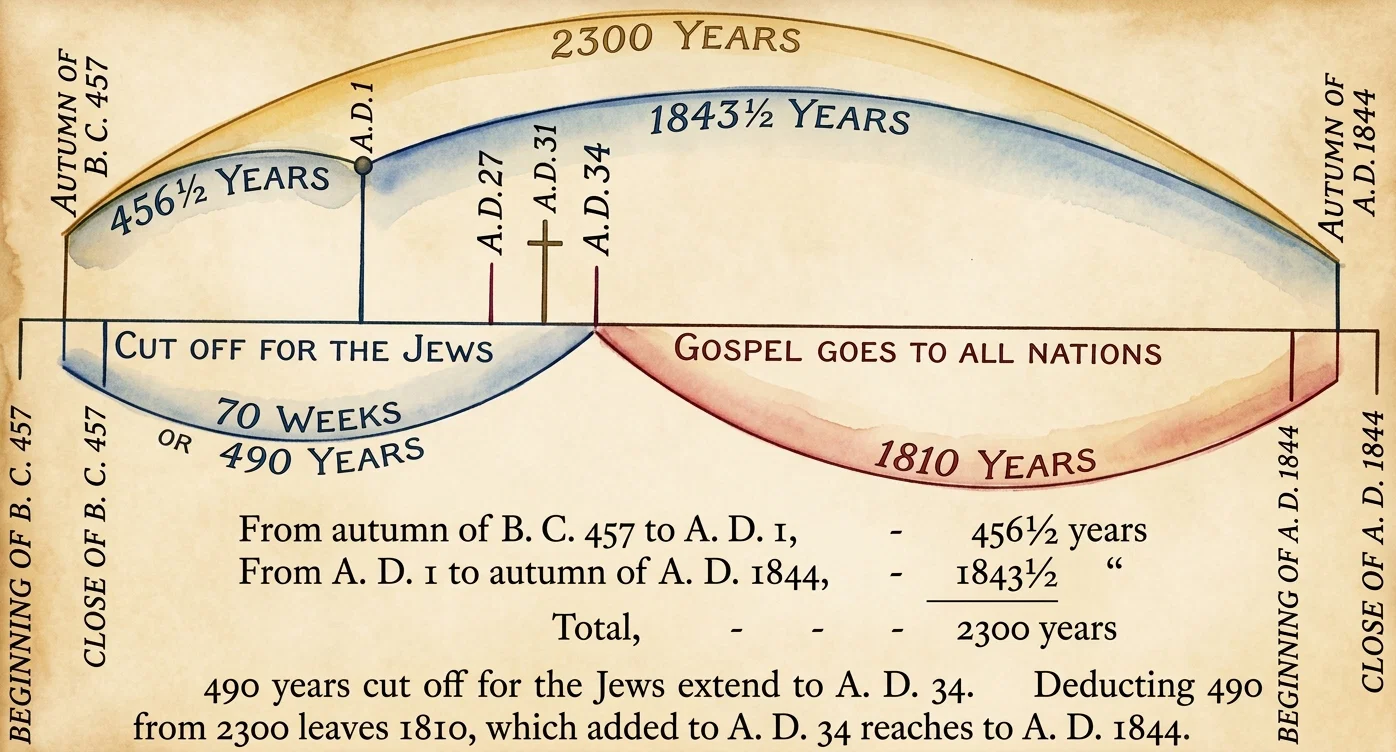
No. 4. DIAGRAM OF THE 2300 DAYS. (Symbolic Time.)
Thus the explanation of the vision was resumed just where it had been interrupted by the prophet’s fainting. Referring again to the time, the “two thousand and three hundred days,” the angel said:—
“Seventy weeks are determined upon thy people and upon thy holy city, to finish the transgression, and to make an end of sins, and to make reconciliation for iniquity, and to bring in everlasting righteousness, and to seal up the vision and prophecy, and to anoint the Most Holy. Know therefore and understand, that from the going forth of the commandment to restore and to build Jerusalem unto the Messiah the Prince shall be seven weeks, and threescore and two weeks; the street shall be built again, and the wall, even in troublous times. And after threescore and two weeks shall Messiah be cut off, but not for Himself; and the people of the prince that shall come shall destroy the city and the sanctuary; and the end thereof shall be with a flood, and unto the end of the war desolations are determined. And He shall confirm the covenant with many for one week; and in the midst of the week He shall cause the sacrifice and the oblation to cease, and for the overspreading of abominations He shall make it desolate, even until the consummation, and that determined shall be poured upon the desolate.” Verses 24–27.
We are here informed that seventy weeks—490 days, or years—were allotted especially to the Jewish people, which would include the time that the Gospel was preached particularly to them by Christ and His apostles. We are also given the point from which the time was to be reckoned,—“from the going forth of the commandment to restore and to build Jerusalem.” There were three decrees concerning this work,—one by Cyrus (Ezra 1), one by Darius (chapter 6), and one by Artaxerxes (chapter 7). The latter being final, its date (B.C. 457) would constitute the conclusion of the commandment. Furthermore, the first two decrees pertained especially to the temple, while the last one included the secular government of the country, thus becoming an essential element in the restoration.
Therefore the “two thousand and three hundred days” began in the year B.C. 457, and the details as given by the angel to Daniel further confirm its correctness. From the going forth of this commandment to the time of Messiah the Prince was “seven weeks and threescore and two weeks,” or sixty-nine weeks—483 days, or years. The “seven weeks,” forty-nine years, was occupied in building the temple, the city, and the wall, “even in troublous times.” This brings us to B.C. 408. Then the sixty-two weeks, 434 years, carries us into A.D. 27, remembering that part of the first year had expired when the commandment went forth. In this year we find Messiah the Prince baptized and anointed by the Holy Spirit. “He shall confirm the covenant with many for one week; and in the midst of the week He shall cause the sacrifice and the oblation to cease.” Jesus preached three years and a half, just half of a prophetic week, and then, at His crucifixion, the typical services were annulled. The sacrifice to which they pointed was made on the cross, and the real mediatorial service of which they were a shadow, was begun when our High Priest ascended to heaven. During the other half of this “week,” the work was continued by the apostles while they preached the Gospel to the Jews only.
Thus the “seventy weeks” of the prophecy are made sure, and marked by well-authenticated events at the beginning and at the end. Therefore the question of the remainder of the time is only a matter of simple addition. The “seventy weeks,” or 490 years, reaches to A.D. 34. Then there are 1,810 of the 2,300 days, or years, to be added to that, which brings us to 1844. What was to take place then?—“Then shall the sanctuary be cleansed.” In other words, as has been shown by comparison of antitype with type, the final judgment work began at that time. Since then we have been in the solemn “day of atonement.” When our High Priest shall have ended that work, He will lay aside His priestly robes, be crowned a King, and come to execute, or carry out, the decrees of the judgment.
We are nearing the time, and when “the great day of His wrath is come,” “who shall be able to stand?” Rev. 6:17. “Who shall ascend into the hill of the Lord? or who shall stand in His holy place? He that hath clean hands, and a pure heart.” Ps. 24:3, 4.