One thousand years before the great and gentle Jesus walked the earth, the royal psalmist had sung:
“Thy right hand hath holden me up,
And Thy gentleness hath made me great.”
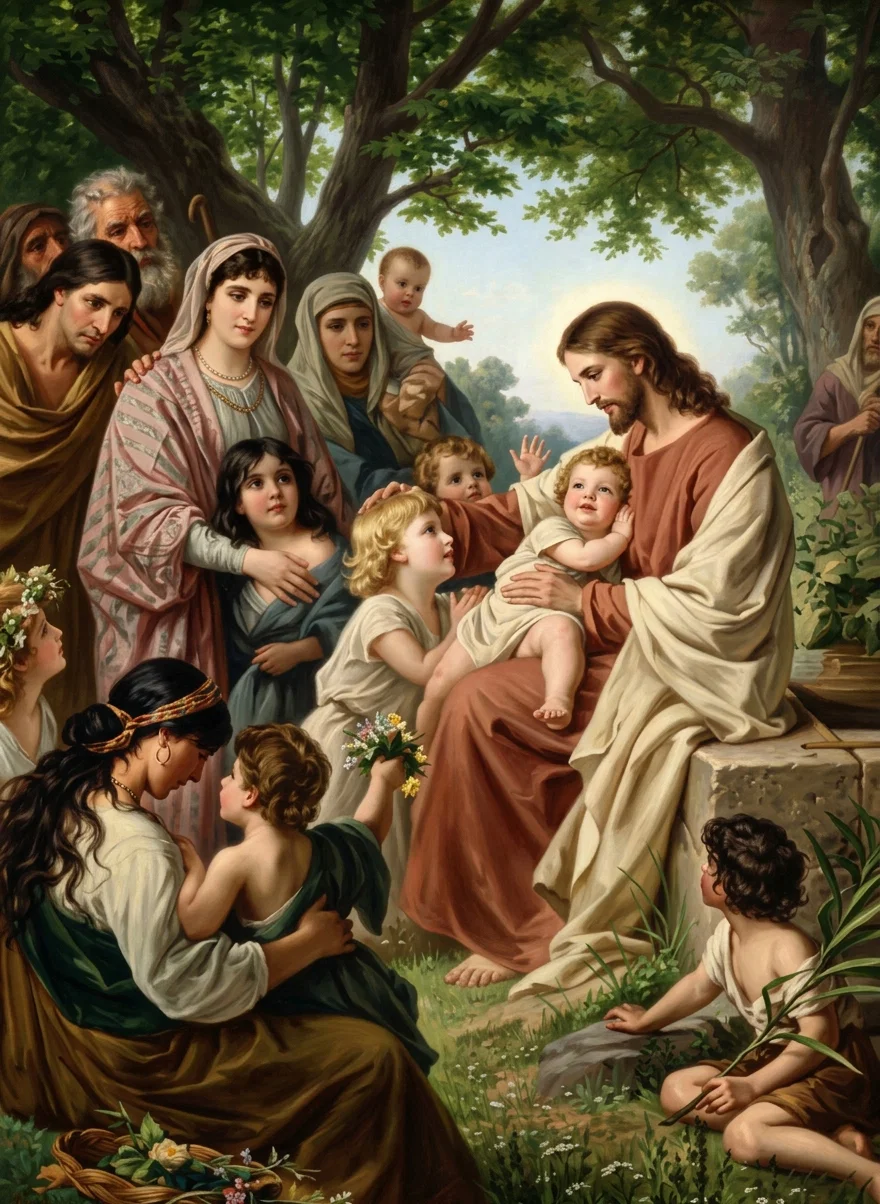
“And they brought young children to Him, that He should touch them; and His disciples rebuked those that brought them. But when Jesus saw it, He was much displeased, and said unto them, Suffer the little children to come unto Me, and forbid them not; for of such is the kingdom of God. . . . And He took them up in His arms, put His hands upon them, and blessed them.” Mark 10:13-16.
David learned the need and worth and beauty of gentleness in dealing with the tender lambs and the weak and sickly of the flock. True greatness in character must include gentleness.
What Is Greatness?
—It is often considered as synonymous with massiveness, volume, strength, power. We speak of great rivers, great mountains, great empires, great multitudes, great oceans, thinking alone of their extent and magnitude. But the greatness also includes the littleness. The great rivers are made up from the little rills, the many feeders all along its way; the great mountains are composed of tiny grains of sand; the great empires are made up of states and cities and towns and farms; the great multitudes are but the aggregate of many little units; and the great oceans are made up of “little drops of water, little grains of sand.” Greatness means not only length and breadth and height, but comprehensiveness. So must character be great in its grasp of both minima and maxima, the small as well as the large; for “he that is faithful in that which is least is faithful also in much; and he that is unjust in the least is unjust also in much.” Luke 16:10. God’s greatness not only created the mighty suns and constellations, and upholds and ballasts them in their course, but it numbers the hairs of our heads, and notes the fall of a sparrow. His greatness comprehends the infinitely large as well as the infinitesimally small. The great Master is equally at home in all parts of His universe, in all phases of His creation. Surely He is the Being whom alone we can implicitly trust.
What Is Gentleness?—Gentleness is mildness in disposition and manner; kindness; graciousness; it is being considerate of others’ feelings. It is that quality of mind or heart which will lead one to treat others as he would desire to be treated. It is the Golden Rule in manner. It never overrides the poor, the weak, the timid, the outcast. Rather it invites and inspires their confidence, and leads them to hope and strive for the better. Only the truly great can be truly gentle; for only the great mind can comprehend the great, broad need of gentleness.
The Greatness of the Son of God before He came to this world is fully revealed in the Word. He was, with the Father, Creator and Upholder of all things. When upon earth, He wrought mightier miracles than earth had ever seen. He taught truths so wonderful, vast, and sublime that the plummet of mortal minds has never fathomed their depths, nor exhausted their sublimity. He lived a life which has been the admiration of even those who would not yield to its power.
The Gentleness of the Son of God equals His greatness. Only those avoided Him who hated the purity of His teaching and the blamelessness of His life. All others sought Him, and were received by Him with divine gentleness. “The common people,” cursed and cowed by priest and ruler, “heard Him gladly.” The poor, vile sinner, anxious for cleansing, came to Him and was not condemned. The poor, the leprous, the blind, the halt, the lame, the down-trodden and oppressed, considered as under the curse by proud Pharisee and hypocritical priest, came to Him and found riches, and cleansing, and sight, and healing, and liberty, and blessing. Woman, considered as of little worth by Pharisaical tradition, could come to Christ and find a friend. Mothers, poor, worn, weary, and well-nigh114hopeless, could come to Jesus with the heaviest, and yet most precious burdens, their children, and find a gentle sympathizer yet mighty helper.
The Little Children.—The little children found a place in His heart and life. The instinctive purity and acute intuition of innocent childhood saw in Him one whose love surpassed that of both father and mother. Small-hearted disciples rebuked the parents for bringing them, even as small-hearted men and women, and sometimes faithless fathers and mothers, hold them back from coming to the Lord and following in His footsteps now, but the gentle Master answered, “Suffer little children, and forbid them not, to come unto Me.” The children do not need urging; all they need is to be shown the Master; and then suffer them to come, let them come; “for of such is the kingdom of heaven.” Matt. 19:13–15. Their open, trusting hearts receive its teachings without doubt. And even as they came, “He took them up in His arms, put His hands upon them, and blessed them.” Mark 10:16. And not infrequently may we believe were such scenes enacted as are shown in our beautiful accompanying illustration.
Lessons.—There are three important lessons that we may draw from the simple record, and carry them with us all through life.
1. The Great Gentleness of Jesus.—Never was there a greater character; never was there greater gentleness. He has left every one of His children here as His witnesses, His representatives, to witness by their life His character, to represent Him in their character. Truly in this harsh, unfeeling, grating age there is sufficient need. Yet it is possible to live as did the Master. His heart was attuned by the Spirit of God, its chords unswept by the fierce and ungracious discords of earth. His heart-strings were ever breathing out their heaven-born melody of gentleness, purity, and truth to the trivial, fearful, needy ones on every side. Not rudeness, not roughness, not harshness, not loudness, make us great, but the greatness of Christ’s indwelling presence. “Thy gentleness hath made me great.”
2. Receiving as a Little Child.—So must we come to God; the little child becomes our teacher; or God teaches through the child. Just as the little ones come with trusting confidence to the true and tender mother or father, so let us go to Him whose love is stronger than that of a father, and tenderer and more devoted and more lasting than that of a mother. Of the mothers the Lord says, “Yea, they may forget, yet will I not forget thee.” O soul, poor and oppressed, timid and friendless and orphaned, there is one Heart ready to receive you; the arms of One are open to embrace you; and He says to all those who, by rebuke or suggestion, would hinder your coming, “Suffer them to come unto Me, and forbid them not.” Come as a little child. No trust or confidence in God can ever be exercised in vain or be betrayed by Him who welcomes you.
3. Receiving Children.—There is yet another lesson impliedly taught here, and directly elsewhere. The Master received the little ones. He says to His children, to all fathers and mothers, to every servant of God, “Whoso shall receive one such little child in My name receiveth Me.” Father, mother, have you so welcomed the children which you have begotten and born? Did you receive each one in the name of the Master, seeing beyond the little bundle of innocent, undeveloped humanity the image, the great character, of the blessed Christ, which you by divine grace were to be so largely instrumental in developing? If you have not done this, and it is not now too late, let us beseech you to receive them now in Christ’s name, consecrate them to Him, train them for Him for all eternity. Teachers, receive the children intrusted to your care in Christ’s name. Never break the sweet child confidence by harsh, unholy reproof or base untruth. Let the threads of wool which you weave into the warp of his character be those of Christ’s righteousness, which will endure for all eternity. And, minister of God, “whoso receiveth one such little child in My name,” says the Master, “receiveth Me.” Let your whole life breathe out such fragrance and confidence that the timid, trusting ones will come even as they came to Christ, and know that they will not be repulsed.
May God forgive us for our rudeness and harshness and ungraciousness, and may our hearts be so responsive to His gentleness that every chord of our nature shall come into perfect harmony with the greatest, the gentlest, and the best Master in the universe, whose gentleness will make truly great every soul which is yielded to Him. He is the same today as in the past. He is “Jesus Christ, the same yesterday, and to-day, and forever.”