THEODORE LANCASTER

6%

Pacific Press Publishing Company · Oakland, California · Feb 3, 1898

FromSigns of the Times, Vol. 24, No. 5.

Read the full edition

THEODORE LANCASTER.

I was just settin' sponge one evenin' when I heard a deep solemn “whoa!” out to the front gate, an' steppin' to the bay winder I see a top carriage a-standin' out there with a nice-lookin', tired-appearin' old lady an' a young man that looked tireder than her. They didn't git out but looked inquirin' like toward the house, so I went out onto the porch and told 'em good-evenin'. They said so 'twas an' wanted to know if Felix Baker lived here. I was agreeable to that an' invited 'em right in, goin' out to open the gate myself, fur if there's one thing I do like when I go anywheres it's to have folks make me welcome, so I always meet 'em if I sees 'em an' kin. If you'll believe me I went that time no more knowin' who I was to fetch in than you do, but when I see her clost it just flashed acrost me that the lady was old Mis Lancaster from Walnut Hills that I had knowed a long time an' used to visit with when we wus a passel of girls together, but now only onct in a while. She's one of the kindest bodies you ever see, with a plump, neat form, in a plain black grosgrain silk (they own a section), an' wavy, nearly white hair a-crownin' as handsome, wholesome a face as you ever looked into.
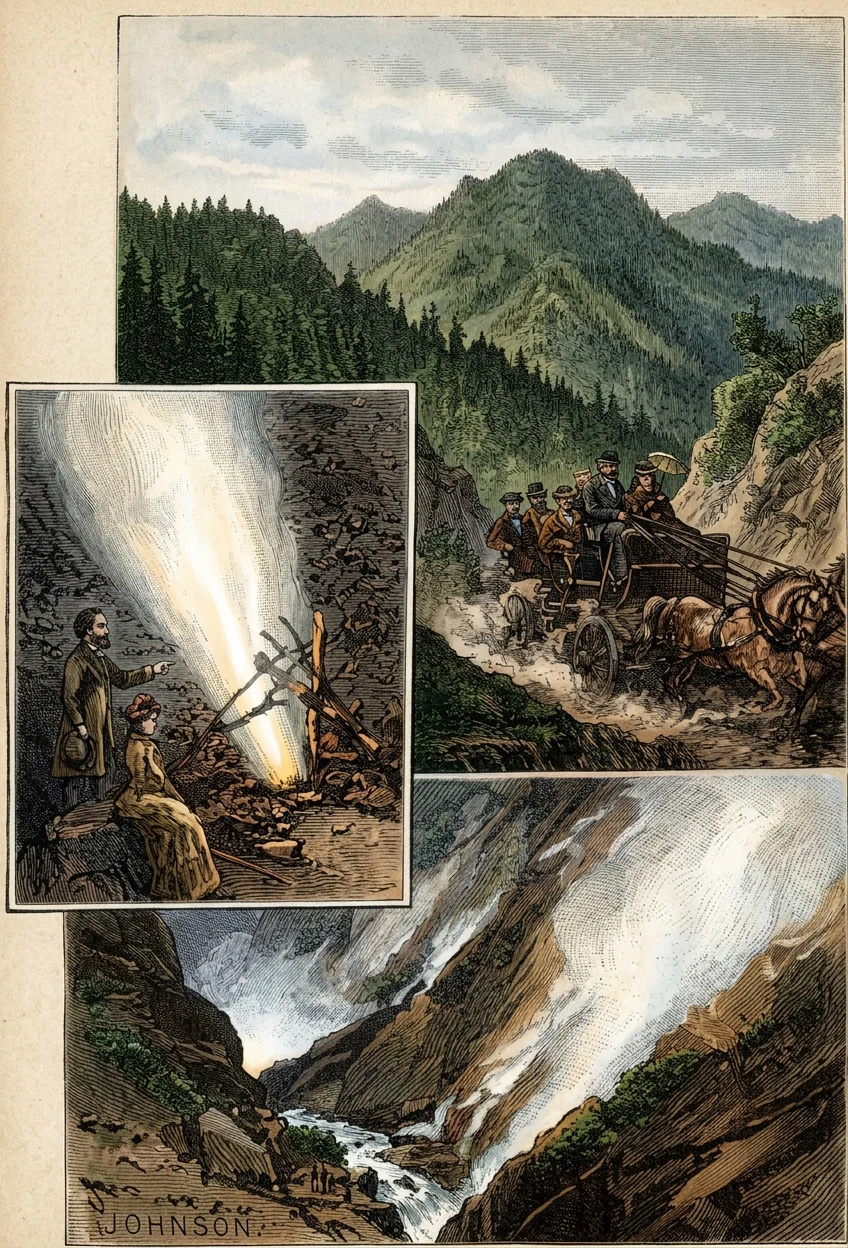
CALIFORNIA SCENERY. NO. 5.—
The Geysers, in Sonoma County, are about one hundred miles north of San Francisco, in the Mayacamas Mountains, 1,700 feet above sea level. One writer says: “Imagine a clear,
CALIFORNIA SCENERY. NO. 5.— The Geysers, in Sonoma County, are about one hundred miles north of San Francisco, in the Mayacamas Mountains, 1,700 feet above sea level. One writer says: “Imagine a clear,
The young man was her son; an' after we had had a hearty hand-shakin' I tole him to drive on around to the barn where Baker was, an' brought her into the house. She belongs to the Seventh-day Baptist Church up in the other township, a-keepin' of Saturday for Sabbath, but that never hurt her none, fur she lived up to that an' all the graces besides right along, an' all her neighbors will tell you so as well's me, I ventur'.
I set her into Baker's big rockin'-cheer, an' between her askin' me this an' me askin' her that an' answerin' backwards and forwards I found time to git up a decent supper, fur the fire wusn't out yit an' only needed a few poplar chips, an' I had jell an' blackberries an' blue-monge, besides my warm victuals an' bread, good enough fur inybody. So when the men got in (they'd washed first) an' Baker an' her had spoke conjual, I told 'em to set up an' partake, fur I knowed they wus powerful hungry. Ridin' fifteen miles will make inybody hungry unless they're worryin' about somethin'. But I see to onct that that wus the case with that young man. He's as handsome as his mother only his hair is shinin' black, an' he's slim like, an's got the saddest great black eyes. He took some off every dish I handed him, but my! he didn't know how to 'preciate my cookin', poor feller! an' no wonder, no wonder.
When his mother tol' me, to one side, about his trouble an' all he'd been through, I come nigher feelin' like I did when our little boys both died than I ever hev any other time in my life, only it wus all grief then an' no shame about it. Why, my heart wus melted fur him, an' at the same time shrunk up with shame an' bilin' over with indignation.
Now I'll begin at the beginnin' or you'll never get head or tail of it. As I said before, the Lancasters own a section up beyant Walnut Hills, good yieldin' soil an' medders with some nice open woods pastur'. They had five boys, their only girl dyin' at eight. Two of the oldest ones married, and they built 'em homes on the old place, an' another one lives near, the baby bein' still to home with 'em. But this one, Theodore, he's next the youngest an' the pick of the flock if you could tell which one to pick, he wus that good to the old folks. He got it into his head three or four years ago to go to Arkansas an' git him a big farm where land wus cheap an' the climate mild an' growin'. There wus a senator from there up to Walnut Hills on a visit to his folks, an' he bein' a great han' to talk an' tell all about Arkansas got Theodore, as I said, into a notion of emigratin' right down there.
Well, he wus engaged to a sweet, rosy, intelligent young woman named Abbie Willis, an' so they married to onct. We wus to the weddin', Baker an' me, an' I told him a-comin' home an' he 'lowed it wus so, that a promisin'er-lookin' pair we'd never see jined. The ceremony come off at five o'clock in the evenin', an' all the young people went with 'em in carriages seven miles to the Ohio River, where they got onto a steamboat. That young woman wus as happy as a bird, fur her folks wus to move down in two or three year an' live by 'em if they liked it.
When they got down there, they found the land an' climate right smart like that senator had told 'em an' bragged it wus, an' hevin' ready money furnished 'em, by the time a couple of years had rolled by, they had a pretty little home built with bay an' dormer winders, an' veranders, an' climbin' roses, an' a good barn an' grannery Mis Lancaster said. An' what they thought the most of, a dimpled, bright-eyed little son had been give to 'em. Mis Lancaster told how they'd write about all its little cunnin' ways, an' 'peared 'zif 'twas a perfect delight to 'em. She got a letter from him an' her about that time that she showed me where he says: “Mother, I don't know why God is so good to me. You an' father wus always more than kind to us at home, an' now I have Abbie, the dear, true wife I thought she'd be, an' I know mine's the sweetest baby alive. When I go out to work in the fields, an' hear the birds singin', I look up to the sky and praise God with my whole heart. I haven't a wish except to have you folks an' hers come an' live by us.”
Now, I'll tell you the next word they got from that son, fur you'd never guess it, never. That wus that he wus in jail! Yes, sir, in the county jail among all sorts of burglars, horse-thieves, an' two murderers. “What fur?”—Fur nothin' but tendin' to his own business. As I remarked before, him an' his folks wus Seventh-day Baptists, an' kep' Saturday fur Sabbath, workin' on a Sunday; an' 'twas jist on account of his religion; because some little narrer-minded neighbor happened to see him plowin' corn back on his own farm on a Sunday as he went by to meetin', he felt called on to haul him up before the law. The man as prosecuted him wus a church-member, but he'd never read his Bible much, I'm sure, or he'd thought of Paul askin' us if we have a matter agin' a brother if we dast “to take it to the law before the unbelievers,” an' the Lord sayin', “Not by might nor power, but by My Spirit, saith the Lord.”
It 'peared that a good while ago they had made a Sunday law in Arkansas an' put a claus into it that wus meant to 'low Jews and Seventh-day folks like Lancaster to work Sundays if they didn't disturb nobody else, but a few years ago some of the folks took it into their heads to make Sunday-keepers outen' 'em, an' they ups an' gits the Legislatur' to take that “other day” part out. Some of the big senators wus anxious fur it, but most of 'em jist voted fur it without thinkin' but little of it, an' some thought they'd git “the favor of their constituents,” she said, so the thing went through; an' then 'twas that that overbearin' olefeller that never hed sensed the first letter of the alphabet the Golden Rule's writ with, up 'an tore a God-fearin' man from his young wife an' tender, helpless baby, an' throwed him into jail fur nothin' under the broad heavens except that he didn't understand the Bible like him on this pint.
Don't you try to tell me it wus because of work bein' done on Sunday, fur there wus all the railroad cars an' steamboats a-runnin' an' a-tootin', the rest'rants an' hotels open, the street-cars an' busses a-goin', besides factories an' lots of people that wus fishin', harvestin', berryin', swappin', an' pleasurin'. No, sir, it wus fur nothin' more'n spite because he kep' Saturday; an' I'll prove it by tellin' how only this man an' others that kep' that day like him ever wus tuck up fur Sunday work.
Well, sir, he wus tried, found guilty, fur he didn't deny it, an' fined som'ers about twenty-five dollars, but he refused to pay it because he hadn't done anything wrong. He claimed that he had a right to worship God as he thought best, or not at all if he didn't want to, as fur as the government was concerned; that this is, or should be, a free country, where a man may serve the Lord, or Allah, or Confucius, an' keep Friday, Sunday, Saturday, or no day at all; an' if you'd read what Thomas Jefferson an' James Madison an' Washington hisself said about sich things in some books that father left to me, you'd see he wus right, that is, if you kin see straight. Well, so because he didn't pay what they'd fined him they kep' him in jail right along.
The weather wus powerful hot, an' while he lay there, his crop goin' to waste, an' his stock runnin' hither an' yan, a friend come one day an' tole him his baby wus sick. O, how he wanted to go to him an' hold the little feller in his arms, fur they had told him how that before he wus tuck sick, he'd look up kinder pleadin' like to his mother, and ask, “Where's papa?” An' now his active little feet, an' chubby, lovin' arms were so still, as he lay not knowin' what wus goin' on about him, his little face so white an' pinchin', an' a little wail creepin' out of his pale baby lips now an' agin. But he couldn't go to him; an' the next day the little feller died—an' his father in jail! His wife wus brought right to him, an' the jailer let her in an' shet the door.
PRISCILLA ANN BAKER.
(Concluded next week.)