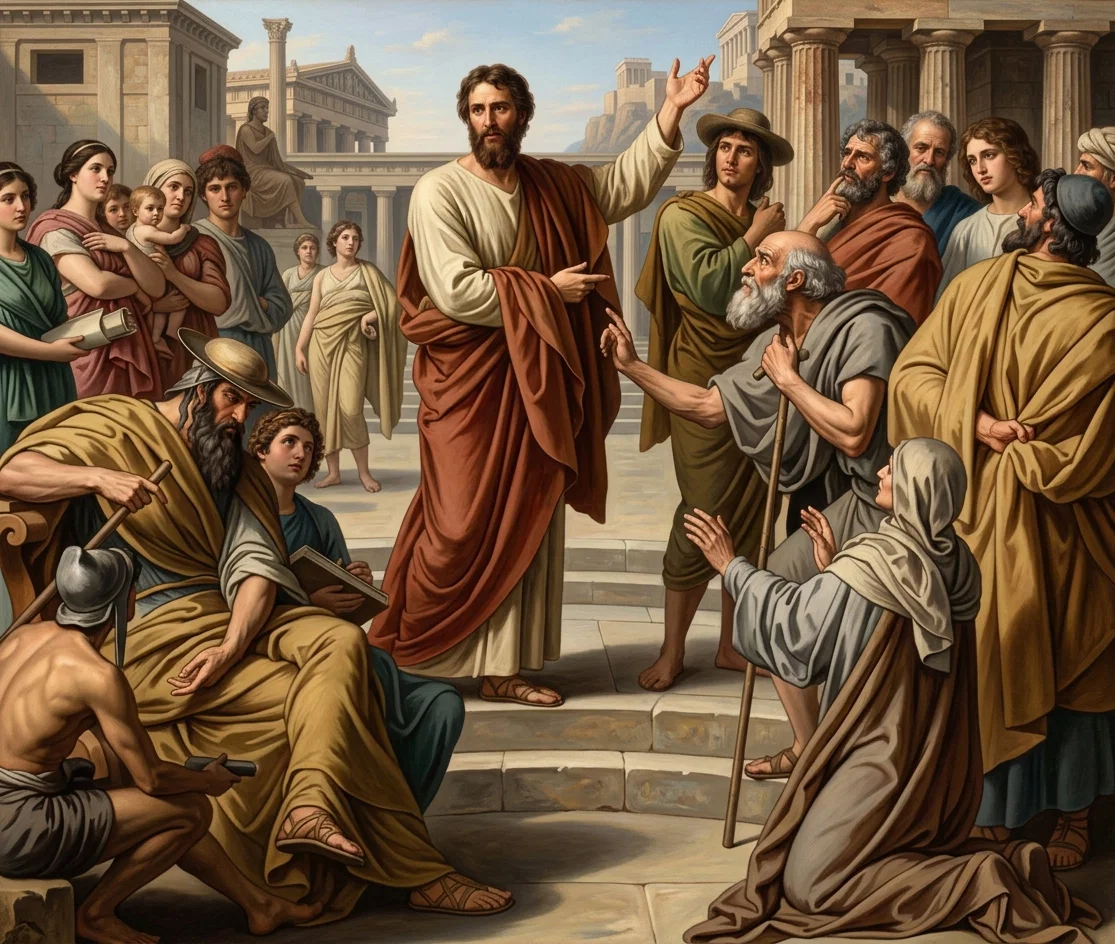
16 “Now while Paul waited for them at Athens, his spirit was 17 provoked within him, as he beheld the city full of idols. So he reasoned in the synagogue with the Jews and the devout persons, and in the market-place every day with them that met with 18 him. And certain also of the Epicurean and Stoic philosophers encountered him. And some said, What would this babbler say? other some, He seemeth to be a setter forth of strange gods; because he preached Jesus and the resurrection. And they took hold of him, and brought him unto the Areopagus, saying, May we know what this new teaching is, which is 20 spoken by thee? For thou bringest certain strange things to our ears; we would know therefore what these things mean. 21 (Now all the Athenians and the strangers sojourning there spent their time in nothing else, but either to tell or to hear 22 some new thing.) And Paul stood in the midst of the Areopagus, and said, “Ye men of Athens, in all things I perceive that ye are somewhat superstitious. For as I passed along, and observed the objects of your worship, I found also an altar with this inscription, TO AN UNKNOWN GOD. What therefore ye worship in ignorance, this set I forth unto you. The God that made the world and all things therein, being Lord of heaven and earth, dwelleth not in temples made with hands; neither is He served by men’s hands, as though He needed anything, seeing He Himself giveth to all life, and breath, and all things; and He made of one every nation of men for to dwell on all the face of the earth, having determined their appointed seasons, and the bounds of their habitation; that they should seek God, if haply they might feel after Him, and find Him, though He is not far from each one of us; for in Him we live, and move, and have our being; as certain even of your own poets have said, For we are also His offspring. Being then the offspring of God, we ought not to think that the Godhead is like unto gold, or silver, or stone, graven by art and device of man. The times of ignorance therefore God overlooked; but now He commandeth men that they should all everywhere repent; inasmuch as He hath appointed a day, in the which He will judge the world in righteousness by the Man whom He hath ordained; whereof He hath given assurance unto all men, in that He hath raised Him from the dead. 32 “Now when they heard of the resurrection of the dead, some mocked; but others said, We will hear thee concerning this yet again. 33 Thus Paul went out from among them. But certain 34 men clave unto him, and believed; among whom also was Dionysius the Areopagite, and a woman named Damaris, and others with them.”
QUESTIONS.
1. Tell how it came to pass that Paul visited Athens.
2. While Paul visited alone at Athens, what did he see? Verse 16.
3. What did he therefore do? Among whom, and where, did he work? Verse 17.
4. Who finally encountered him as he was teaching? How did these philosophers regard him? What idea did some have of his teaching? From what did they conclude this? Verse 18.
5. To what place did they conduct him? What was their object? Verse 19.
6. What did they give as their reason for asking about the new doctrine? Verse 20.
7. Was it real interest to know the truth, or mere idle curiosity, that prompted their action? Verse 21.
8. With what statement did Paul begin his discourse? Verse 22.
9. What had he seen that confirmed this statement? Whom did he say that he had come to disclose? Verse 23.
10. How did he introduce this God to them? What did he say of His dwelling-place? Verse 24.
11. How can He not be worshiped? Why can He not be worshiped in that way? Verse 25.
12. What has He made? How has He made them? Where has He placed them to dwell? What has He determined and appointed? Verse 26.
13. Why has He done all this? If men feel after God, what will be the result? Why? Verse 27.
14. How near is He to every one of us? What had a Greek poet said that was in harmony with the truth that Paul was preaching? Verse 28.
15. Since all men are God’s offspring, what ought they not to think? Verse 29.
16. How did God regard man’s ignorance? Nevertheless, what does He command all men to do? Verse 30.
17. What gives this commandment special force? How will God judge the world? By whom? What assurance has He given of this? To whom has He given it? Verse 31.
18. How did the Athenian philosophers receive the doctrine of the resurrection of the dead? Verse 32.
19. What was the immediate result of this sermon? V. 34.
NOTES AND QUESTIONS.
1. “Too superstitious.” Revised Version, “somewhat superstitious;” margin, “religious.” Nearly all other translations have it, “very religious,” or “greatly devoted to the worship of the gods.” While it is true that all heathen worship is superstitious, we may be sure that the apostle Paul did not begin his discourse with words calculated to arouse the anger of his hearers, and so we may know that the words did not convey to their minds the same idea as the expression, “Ye are in all things too superstitious,” does to ours. The statement, “Ye are very religious,” was the truth, and naturally opened the way for what followed.
2. “If haply they might feel after Him and find Him.” Notice exactly what is said here. Is the doubt implied as to whether men would find the Lord, or as to whether they would feel after Him? If men feel after the Lord, is there any question as to the certainty of their finding Him? What makes it more than sure that they who seek the Lord will find Him? Isa. 65: 1-3.
3. “The times of this ignorance God winked at.” The Revised Version and some others have it, “overlooked,” which is an exactly literal rendering of the Greek. Several translations have it “bore with,” which also expresses the sense. Compare Acts 14: 16 and Heb. 5: 2.