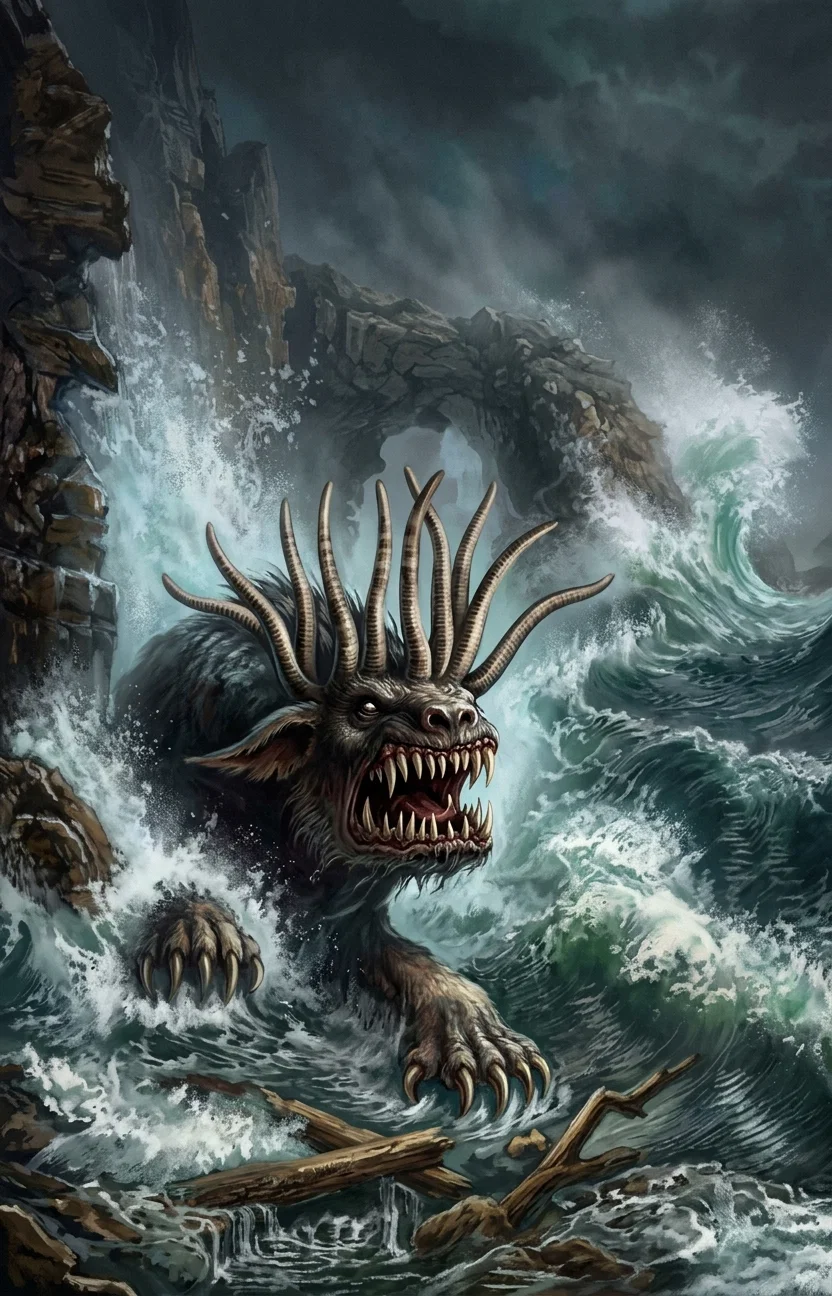
DANIEL was especially anxious about the symbol of the “dreadful and terrible” beast, the fourth in the series presented in the vision of this chapter. He “would know the truth of the fourth beast,” or kingdom, which was to work such havoc in the earth. Following is the answer given to him regarding the meaning of the symbol itself:—
“Thus he said, The fourth beast shall be the fourth kingdom upon earth, which shall be diverse from all kingdoms, and shall devour the whole earth, and shall tread it down, and break it in pieces. And the ten horns out of this kingdom are ten kings that shall arise; and another shall rise after them; and he shall be diverse from the first, and he shall subdue three kings.” Verses 23, 24.
Like the fourth kingdom of chapter 2, this fourth kingdom continues until the everlasting kingdom is set up. See verses 9–14, 26, 27. As the mixture of iron and clay—ingredients that will not cleave together—in the fourth kingdom of the image indicated permanent division, so the ten horns of the fourth beast indicate division. But, as we have previously noted, the Lord tells His prophet more than He told the heathen king. He tells the prophet plainly that this kingdom shall be divided into ten kingdoms. True, He says, “the ten horns out of this kingdom are ten kings that shall arise;” but, that we may not get the idea that these are ten successive kings, the beast-symbol presents the ten horns all at once. Where ten separate kings are reigning all at once, there must be ten kingdoms—another evidence that the term “kings” and “kingdoms” are used interchangeably in these prophecies.
It must be remembered that while Babylon had sway all over the earth, the kingdom proper was comparatively limited. There were other kingdoms, but they were tributary to Babylon and powerless for a time to resist her dominion. This was because “the Most High ruleth in the kingdom of men,” and He had given this universal dominion to the king of Babylon. When Babylon was overthrown, the opposition was started outside of the kingdom proper. The same may be said of Medo-Persia and of Grecia. The immediate territories of these kingdoms were limited, but their universal control was because there was none able to cope with or resist them rather than because they actually occupied all the earth. All other powers admitted their superiority and yielded to the inevitable. But the seat of empire or pre-eminent territory of each was different from that of its predecessor.
So when Rome, the fourth kingdom, rose up against the universal dominion of Grecia, the uprising took place in territory outside the kingdom proper of the predominant power then holding sway over the earth. And when Rome became the dominant power in the earth, and had subdued its predecessor, its territory proper and seat of power was in Europe, west and northwest of the territorial empire of Grecia. While its authority came to be extended over the countries of its predecessors in universal dominion, they are still recognized in the prophecy. “They had their dominion taken away, yet their lives were prolonged for a season and a time.” Persia and Greece are still recognized kingdoms, but of very small consequence. Babylon, tho not known as a kingdom, wields a more extensive influence in the world through its ancient mythology, especially its astro-theology, secret divinations, etc.
In the image of chapter 2 the stone cut out without hands, which represented the kingdom of heaven, smote the image on the feet, at the very end of human empire, but “then was the iron, the clay, the brass, the silver, and the gold, broken to pieces together, . . . and the wind carried them away, that no place was found for them.” And so must it be with the beasts, for this vision of Daniel is the complement of the dream of Nebuchadnezzar.
Reverting to the ten horns, or kingdoms, it is to be noted that they are on the beast itself, and not on any of its dependencies; all human governments of any notable influence have dependencies. The beast stands for the kingdom proper, which included southern Europe west of Greece, central Europe, and Great Britain and Ireland. Then here is where we must look for the ten horns or kingdoms. Has such a condition ever existed in that territory of the Roman Empire? There is no question that the old empire is all broken up both in the kingdom proper and in the territory over which its influence extended, known in history as the Eastern Empire. But the ten horns must be in the Western Empire.
Rome remained intact until the middle of the fourth century, when the breaking up process began. Neither space nor the purpose of this article will permit details of the establishment of the various kingdoms comprising ten at any one time. But others have made brief compilations from history, from which the following is selected because it is the only one that agrees with another important feature of the prophecy yet to be noted. This is all taken from Gibbon’s “Decline and Fall of the Roman Empire,” which was written without reference to the fulfilment of prophecy, and is therefore without bias as to any theory of that character. Here is what is gathered concerning these kingdoms from that eminent authority, showing the time of their attacks on the empire, and the localities and dates of their establishment as permanent powers:—
ALEMANNI, A.D. 351, Swabia, Alsace, and Lorraine. (Gibbon, chap. 10, par. 26; 12: 20; 19: 20; 36: 5; 49: 22.)
FRANKS, A.D. 351, N. E. Gaul. (Id., chap. 19, par. 20; 36: 5.)
BURGUNDIANS, December 31, A.D. 406 (Id., chap. 30, par. 17); in Burgundy A.D. 420 (Id., chap. 31, par. 39).
VANDALS, December 31, A.D. 406 (Id., chap. 30, par. 17); in Spain A.D. 409 (chap. 31, par. 36); in Africa A.D. 429 (chap. 33, par. 35).
SUEVI, December 31, A.D. 406 (Id., chap. 30, par. 17); in Spain, A.D. 409 (chap. 31, par. 36).
VISIGOTHS, A.D. 408 (Id., chap. 31, par. 2, 14); in S. W. Gaul, A.D. 419 (chap. 31, par. 39); in Spain A.D. 467 (chap. 36, par. 22; 38: 2, 29).
OSTROGOTHS, A.D. 453, in Pannonia (Gibbon, chap. 35, par. 16); in Italy A.D. 489, final conquest A.D. 493 (chap. 39, par. 7, 8).
LOMBARDS, A.D. 453 in Pannonia and Norricum, banks of Danube (Weber’s Universal History, sec. 180; Gibbon, chap. 42, par. 2; Encyc. Brit., art. “Lombards”); in Lombardy, A.D. 567–8 (Gibbon, chap. 45, par. 5–7; Machiavelli, History of Florence, chap. 1, 2).
HERULI, A.D. 475–6, in Italy (Gibbon, chap. 36, par. 28–33).
Thus we have unbiased historical authority for the fulfilment of the prophecy. There is no question that Rome was the fourth and last power having universal recognition as the mistress of the world. There is no question that she had the characteristics of the “strength of iron” and the disposition to “break in pieces and bruise.” And here we have the best historical proof that the ten horns feature of the beast has had its fulfilment—that between the years A.D. 451 and 476 the Western Empire of Rome was broken into just ten kingdoms. History records the sequel of prophecy.
This evidence regarding the identity of the kingdoms presaged by the ten horns will be strengthened as we consider the “little horn” that came up among them, in another article.