OUR FATHER’S CARE

5%

Pacific Press Publishing Company · Oakland, California · Jan 20, 1898

FromSigns of the Times, Vol. 24, No. 3.

Read the full edition

OUR FATHER’S CARE

Lesson VI.—Sunday, February 6, 1898.

OUR FATHER’S CARE.

Note.—The present lesson is a most practical and valuable one. Let it be borne in mind while studying it that worry never oils the wheels of anything that makes for our good. It is not only destructive to temporal peace and physical health, but to our spiritual welfare as well. The continual anxious thought fills our bearings with emery dust and wears us out before our time. The scene of the present lesson is on a mountain west of the Sea of Galilee. The time is supposed to be midsummer, A.D. 28. He will teach this lesson best who teaches from experience.

Lesson Scripture, Matt. 6:24-34, R. V.

24 “No man can serve two masters; for either he will hate the one, and love the other; or else he will hold to one, and despise 25 the other. Ye can not serve God and mammon. Therefore I say unto you, Be not anxious for your life, what ye shall eat, or what ye shall drink; nor yet for your body, what ye shall put on. Is not the life more than the food, and the body than the raiment? 26 Behold the birds of the heaven, that they sow not, neither do they reap, nor gather into barns; and your heavenly Father feedeth them. Are not ye of much more value than they? 27 And which of you by being anxious can add one cubit unto his stature? 28 And why are ye anxious concerning raiment? Consider the lilies of the field, how they grow; they toil not, neither do they spin; yet I say unto you, that even Solomon in all his glory was not arrayed like one of these. 30 But if God doth so clothe the grass of the field, which to-day is, and to-morrow is cast into the oven, shall He not much more 31 clothe you, O ye of little faith? Be not therefore anxious, saying, What shall we eat? or, What shall we drink? or, Wherewithal shall we be clothed? 32 For after all these things do the Gentiles seek; for your heavenly Father knoweth that ye have need of all these things. 33 But seek ye first His kingdom, and His righteousness; and all these things shall be added unto you. 34 Be not therefore anxious for the morrow: for the morrow will be anxious for itself. Sufficient unto the day is the evil thereof.”
Golden Text: “He careth for you.” 1 Peter 5:7.

SUGGESTIVE QUESTIONS.

(1) What impossible thing does the Saviour bring to mind in verse 24? (2) What will be the person’s attitude toward the two masters? Same verse. Note 1. (3) What does He say it is impossible to do? Same verse. Note 2. (4) What, therefore, does the Saviour enjoin upon His followers? Verse 25. Note 3. (5) What comparison does the Saviour bring to view in this verse? (6) What illustration does He use to show God’s care for His creatures? Verse 26. (7) What does He say of them? Same verse. (8) Yet how are they provided for? Same verse. (9) What is the object of the comparison made in the last clause of this verse? Note 4. (10) What question does the Saviour ask in regard to the growth of the body? Verse 27. (11) About what other thing should they not take anxious thought? Verse 28. (12) What illustration does He use to show God’s care for the raiment of His creatures? Same verse. Note 5. (13) What does He say of the raiment of the lilies? Verse 29. (14) What assurance may we draw from this fact? Verse 30. (15) What anxious questionings should the Christian refrain from cultivating? Verse 31. (16) Of what class of people were such things a characteristic? Verse 32. (17) What does the Lord know in regard to our needs? Same verse. (18) What does His knowledge of our needs imply? (19) What is it essential that we first seek? Verse 33. Note 6. (20) What will certainly follow such a course? Same verse. (21) How are we to relate ourselves to what will transpire on the morrow? Verse 34. (22) What may we be sure of in relation to the morrow? Same verse. (23) Why should we not bring the troubles and evils of the morrow into to-day? Same verse. Note 7.

NOTES.

1. He will hate the one, and love the other.—The word here translated “the other” does not express simply another person, but another kind of person, of different quality, different character. No one can both love and hate the same thing at the same time, neither can one love at the same time two characters which are diametrically opposed to each other. If we truly love God, we can not at the same time love that which is opposed to God and His work in part or in whole. Likewise we can not love the two qualities of goodness and evil. The love of one necessarily places us in opposition to the other.
2. Mammon.—The Syriac word for wealth or riches.
3. Be not anxious for your life.—This is the true rendering of the thought embodied in the original words of the text. The word “thought” expressed that meaning when the Common Version was translated, but does not do so now. “Thought” at that time meant anxiety, worry. The same remarks apply to verses 27, 28, 31, and 34, where the same difference occurs between the rendering of the Revised and Common Versions.
4. Are not ye of much greater value than they?—The argument is, if God cares so much for these things will He not also care for you who are of much more value than these can possibly be? The Great Teacher is not teaching slothfulness or improvidence by the illustration which He uses. The “fowls of the air” fulfil the mission which God intended, and He provides for them in doing it; but if man, who was created with a different mission and different capabilities, should refuse to do anything for his own maintenance, the Scriptures would at once condemn him. See I Tim. 5:8; Prov. 6:6; 20:4; Heb. 6:12.
5. Consider the lilies.—The fields were full of them at the time of year that the Saviour was speaking. They were all around His hearers, most gorgeous flowers. They were as much more perfect than the decoration of the king as God’s work is superior to man’s. Examine a king’s raiment under a microscope, and it will appear coarse and unfinished; examine this beautiful flower with the same instrument, and its beauty is increased to the eye more than the diameters it is magnified. And yet all this was only for a day or two at the most, while man was destined for eternal existence. How positive we may be, then, of God’s care for us.
6. Seek ye first.—Seeking above all things else the kingdom of God and His righteousness, we will be decked, robed, in that spotless apparel which will admit us within the heavenly gates, even the righteousness of Christ. That will be a more beautiful garment to consider than that in which God robed the flowers of the field; but while seeking that earnestly, we have the assurance of God’s care for our temporal needs.
7. Sufficient unto the day is the evil thereof.—There is plenty of evil in the present day without bringing the supposed evil of the following day into the present, especially when much that we anticipate in our worry never transpires. Worry, in many cases, manufactures evil which would not otherwise exist, and by worrying we suffer from that evil which was created by our own imagination.
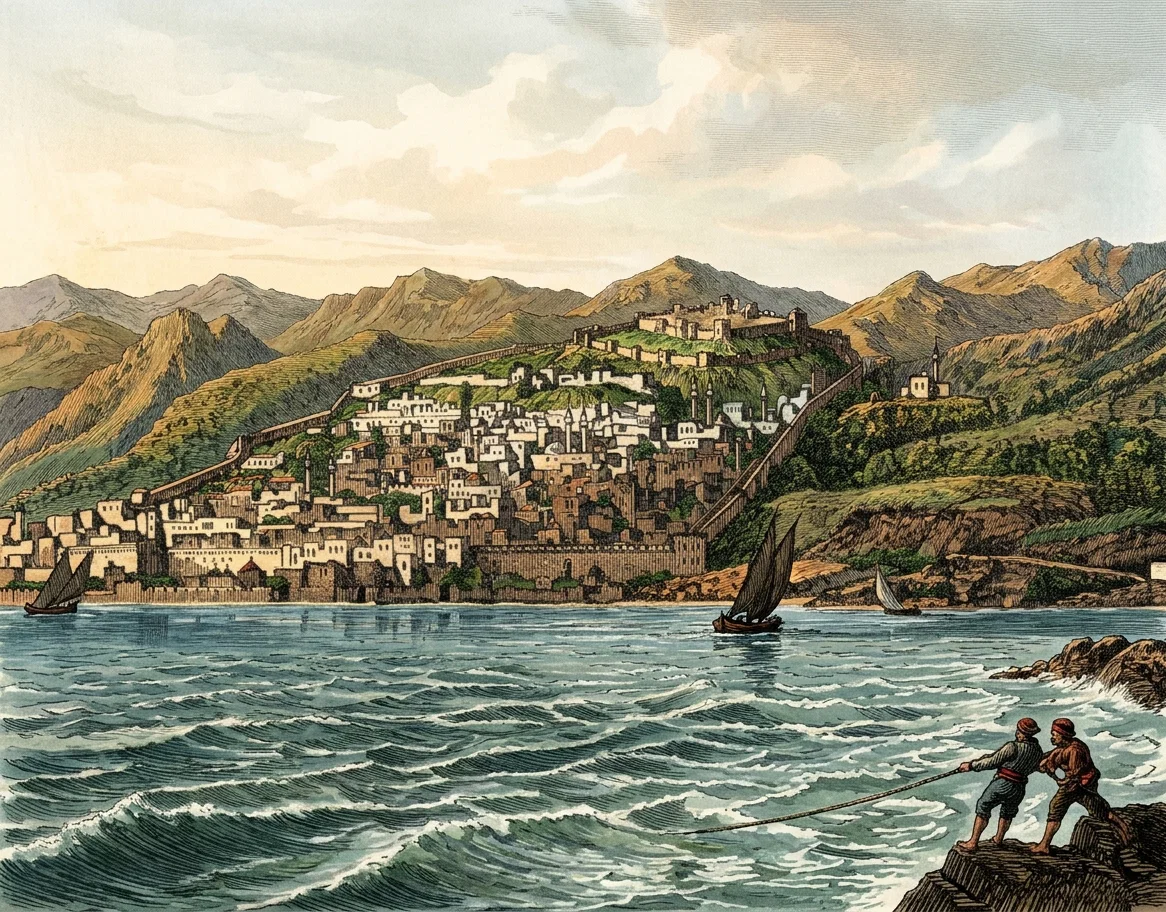
Thessalonica, a city of Macedonia, where the apostles raised up a most interesting church. It was at first called “Thermae” (hot baths), but Cassander rebuilt the city and called it after the name of his wife, Alexander the Great’s sister, Thessalonica. It is now a Turkish town, known by the name Salonika.