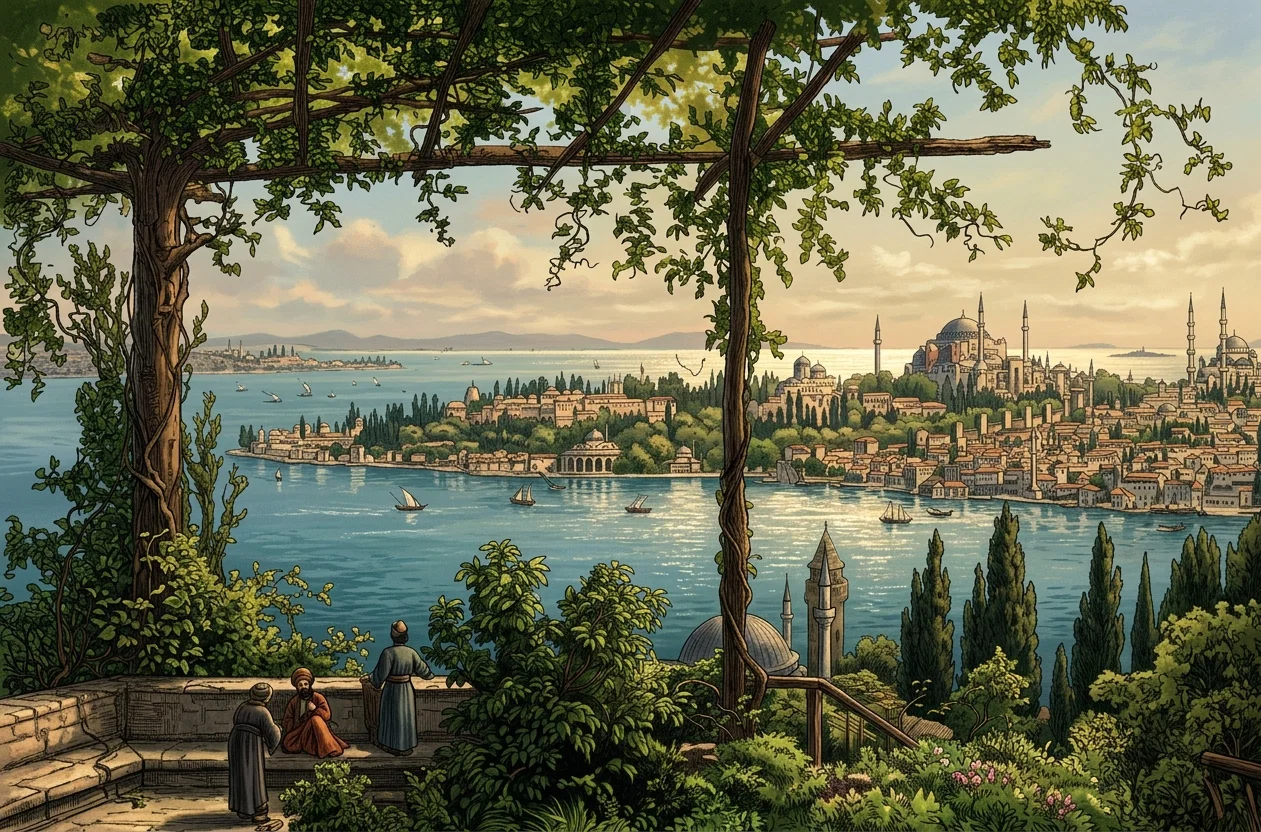
On closing my work in Russia, at Sebastopol, I took a Russian steamer for Constantinople, making the transit of the Black Sea in twenty-four hours. When the weather is at all favorable, the trip down the Bosporus is a delightful one. Through this channel flow all the waters drained into the Black Sea from Asia Minor, a large portion of Russia, Roumania, Bulgaria, Hungary, Austria, and through the Danube a portion of the waters of Germany and the Alps. The Bosporus is about as wide as the Detroit River, and in places several hundred feet deep.
As one nears the Bosporus from the Black Sea, the first objects in sight are the ports on both the European, and Asiatic shores; and from these are villages on both sides till Constantinople, which is situated where the Bosporus empties into the Sea of Marmora, or ancient Propontis. In these villages and on the slopes above them are many villas and summer residences of the wealthy of Constantinople.
About half way down, where the stream is the narrowest, on the European bank, stand the huge towers of the fortress erected by the Mohammedans in 1453, just prior to the taking of Constantinople; and just above these towers are the buildings of Robert College, an American, non-sectarian institution of high educational merit. It is believed that near this point Darius crossed the Bosporus with his army. Among other objects of interest are several palaces of the sultan and ruins of castles dating from the Genoese supremacy.
Approaching the Ottoman capital, the varied domes and slender minarets of the numerous mosques present a most picturesque sight; but on landing, the scene is reversed. The streets are narrow, crooked, illy-paved, and filthy, usually crowded, and often blocked by wretched dogs, some wounded, some half-starved, and others partly eaten by vermin. As most merchandise is moved by Armenian carriers, some parts of the city are crowded by men with huge11boxes, baskets, or bundles on their backs. The heavier objects, as liquor casks, are suspended from poles and carried by two, four, six, or eight men. These usually keep up almost constant shouting to clear the way. Besides this, all kinds of wares are carried open on the arm and sold in the streets, each petit merchant rivaling the rest shouting out his wares. The interest of the scene is heightened not a little by the peculiar and varied dress of the Asiatics.
On landing, it was very noticeable that there had been a thinning out in the city. A few years ago, the streets were more crowded with people and traffic. The Armenian troubles so decreased work in the city that many were obliged to go elsewhere to make a living; and in addition to this, Armenians are quite rigidly excluded from the city. I thought that the war with Greece might lead the government to partly lose sight of the Armenians; but this is by no means the case. The police surveillance is rigid as ever, specially at this time, as it was the anniversary of former outbreaks.
After spending a few days with our church in Constantinople, in company with Brother Baharian, I visited five groups of believers in Nicomedia (Bithynia of the Bible), and had encouraging meetings with them. Chief products of these regions are wine and tobacco, and the people being themselves their best customers, they are much debased by these powerful agents of the enemy. But those embracing the truth have forsaken these evil habits and have completely overcome them, and are become living witnesses of the power of the Gospel to save from the most debasing sins.
A VIEW OF MODERN CONSTANTINOPLE.
While visiting these villages I read the epistles of Paul and was struck with the fact that the evils which he most frequently reproved among the heathen are the prevailing sins to-day. But as then, so to-day the Gospel has power to deliver all who receive it.
Our first meetings were held south of the bay of Nicomedia, in an Armenian village, not far from ancient Nicea, where the memorable church council was held under Constantine, A.D. 325. The creed there adopted is still adhered to by the Armenian church. And as a memorial of those days of sun-worship, all Armenian churches are still built with the altar at the east end, so that in worshiping, the people bow towards the rising sun. It is an interesting fact that even when holding services in private houses, the priests always stand facing the east. The Greeks also follow the same custom. When attending the service of some of our laborers in private rooms, in prayer they were careful to turn towards the east. Thus, like Sunday, this custom is a reminder of the time when in hoary antiquity the pagans worshiped the sun towards the east and dedicated the first day of the week to the sun; and also of the time when, under Constantine, Sunday with other pagan institutions entered the Christian church, opening the gates to the flood of superstition and error which led to the Dark Ages.
But the light of the Gospel which in the great Reformation began to dispel the darkness must increase in brilliancy till Pentecostal days are again experienced and every vestige of darkness is dispersed. We are glad that the light of the Word is shining in consecrated lives in these regions where Constantine and the bishops, the world and the church, began their unscriptural courtships and laid the foundation of the Papacy.
In one of these villages, a Protestant pastor labored in vain many years to turn the people from the excessive use of wine, alcohol, and tobacco; but when preachers of the present truth entered the place, many believed and became total abstainers from all stimulants. This irritated the pastor, who chided those converted, saying: “All these years I have told you not to use wine and you would not obey; but now when preachers of the Sabbath come, you at once obey and forsake all. Why do you listen to them, and not to me?” He saw nothing more than the word of man, and did not recognize the fact that while he was still adhering to pagan errors, the preachers of the Sabbath, having forsaken all human doctrines, had had the power of the “everlasting Gospel,” which saves from sin.
We are glad to be able to close these jottings with the remark that to the praise of the Lord the truth is constantly spreading in these interesting regions. H. P. H.