The various philanthropic enterprises connected with our work have had an almost phenomenal growth in the last few years, and other interests of a similar nature are rapidly springing up on every side, showing clearly that the providence of God is leading His people in this direction. To consider the needs of this branch of the work, study the institutions in successful operation in Chicago (including the Chicago Medical Missionary Training School, only started a couple of months ago, yet having already an enrollment of more than 150) and agree on some general plans of co-operation which would still further facilitate the work, a Medical Missionary Convention was called for December 7–16, and was attended by a large number of representative men.
Among the representatives of the Medical Missionary Board we might mention Drs. J. H. Kellogg, W. H. Riley, A. J. Sanderson, A. N. Loper, D. H. Kress, David Paulson, and A. B. Olsen.
The General Conference was represented by Elders G. A. Irwin, A. T. Jones, N. W. Kauble, J. H. Morrison, A. J. Breed, L. A. Hoopes, A. F. Ballenger, and others.
Some fifteen conference presidents were in attendance, having charge of conferences ranging from the Atlantic states on the east to California on the west and Tennessee on the south.
The convention was formally opened the morning of December 8. The first few days were very profitably spent in studying the general principles that underlie the health and philanthropic work, and seeking divine guidance as to how it could best be carried forward. Many precious seasons were enjoyed. The Lord’s blessing was felt in a very large degree, and all the brethren in attendance knew that the Lord had set His seal to the undertaking.
Several meetings were held daily. Following11are some of the subjects thoroughly discussed: Visiting Nurses’ Work, The Conducting of Medical Missions, Christian Help Work, How to Find Homes for the Homeless, the Holding of Open-air and Cottage Meetings, Self-supporting Missionary Work, etc., etc. Between the meetings the time was fully occupied in visiting the various philanthropic and charitable organizations, and studying their plan of operation. The evenings were devoted to attending the Gospel meetings held at the Star of Hope, Workingmen’s Home, and other missions, and observing the grand work which the Lord is doing there. Some attended the cottage meetings held in different parts of the city, or accompanied the young men who are doing Gospel work in the saloons. These opportunities for seeing in active operation the various organized efforts for alleviating human distress, ministering to the needs of body and soul, and in short carrying on the work begun by the Master when He was upon earth, seemed to be much appreciated by the brethren in attendance at the convention, many of whom themselves had intensely interesting experiences, and left the city with the assurance that some souls had been saved as a result of their work.
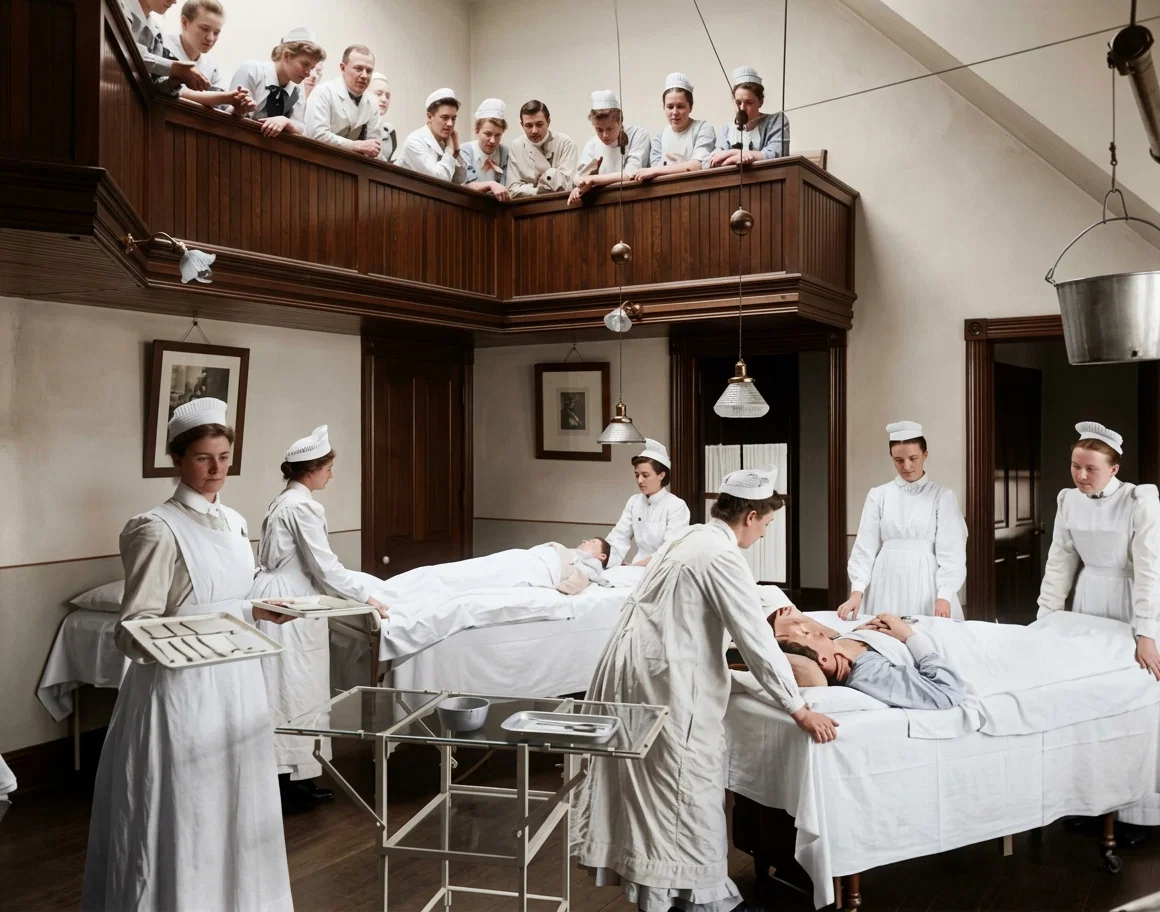
The Medical Missionary and Benevolent Association has the principal part of its college at Battle Creek, Michigan. Here its physicians and skilled nurses are mainly trained. The above is an illustration of the operating-room in its hospital.
Sunday morning, December 12, witnessed the dedication of the building occupied by the Medical Missionary Training School. Mrs. S. M. I. Henry delivered the address, and Elder A. T. Jones offered the dedicatory prayer. Sister Henry dwelt especially upon the thought that this building with its corps of 150 students and workers, was only a window through which the help and succor furnished by the people of God all over the country, could be sent out to the needy, and where the homeless and friendless can stop for a little rest, and then be sent on to Christian homes waiting with open arms to receive them. This same thought was taken up in other meetings of the convention, and it was expressed as the sense of the convention that every Seventh-day Adventist home should be a mission, and every Seventh-day Adventist farm a rescue farm. Surely this will be so when our eyes are opened to the want and wretchedness that there is in the world, and our hearts are made tender by the Spirit of God, so that we begin to feel the same interest in the welfare of others that we do in ourselves.
Sunday afternoon and evening services were held in the Trinity Methodist Church of this city, presided over respectively by Hon. C. C. Bonney, and Dr. William E. Quine, dean of the College of Physicians and Surgeons. The afternoon meeting was in the nature of a conference, the subject being “Methods of Co-operation in Practical Gospel Philanthropic Work.” Friendly Visiting, Deaconess’ Work, King’s Daughters’ Work, Relief of the Unemployed, Cottage Meetings, etc., were discussed in five-minute addresses by Dr. J. H. Kellogg, Miss Clara Morehouse, Mr. W. S. Sadler, and others. The question of holding a general philanthropic congress was considered, and the meeting voted in favor of the idea, and requested the chair to appoint a committee to make the necessary arrangements. The chair appointed Dr. Kellogg and Mr. S. Sherin.
The chief addresses of the evening were delivered by Dr. Kellogg, who took up the subject, “Plans and Purposes of the Medical Missionary Training School and School of Practical Philanthropy,” and by Miss Mary E. McDowell, who discussed the “Field for a School of Philanthropy.”
The remaining days of the convention were filled to overflowing with important business. The great principles which underlie the health-reform movement were studied with an ardor and enthusiasm seldom seen before; and as old prejudices were laid aside, and every heart was set to know the will of God and do it, light came in, and a new luster was shed over this important subject. Monday afternoon an experience meeting was held which lasted five hours, and yet nobody was tired. The sweet Spirit of the Lord was felt to a very large degree, and it was good to be there. Many testified that they had never been present at a meeting where the power of God was so manifest as on this occasion.
With such a complete harmony of sentiment as to principles, there was, of course, not the least difficulty in agreeing upon a basis of co-operation.
The plan of holding schools of health in the conferences, and setting a part of the canvassing force to work in organizing these schools, and introducing our health journal, Good Health, was thoroughly discussed, and met with general approval. Arrangements were also made in a general way for trained nurses and instructors in Christian help work to be sent out from the Sanitarium to engage in laboring among the churches, to organize Christian help work in the churches. As a further means of disseminating the health principles, and awakening a more active interest in working for the poor and fallen, it was proposed to hold institutes or conventions for the laborers, and also amongst the churches. Several of the Conference presidents made arrangements before leaving for nurses to be sent from the Sanitarium to assist in this way, and others expect to hold an institute in the near future. The urgency of the work seemed to impress all, and if the brethren carry back with them the enthusiasm and interest manifested at the convention, as they no doubt will, it will not be long before the churches will be deeply stirred.
The closing meeting, Thursday morning, was a very impressive one. The first part of the meeting was devoted to summing up a few of the most important principles to be observed in carrying on the work. Dr. Kellogg dwelt especially upon the need of seeking divine guidance at every step, and never trying to carry things through by sheer force of human planning. He also emphasized the importance of beginning small and letting the enterprise grow as the Lord blessed it. This brings the work within the reach of every individual Sabbath-keeper, every company, and every church. All can do something, if it isn’t more than coming together once a week to patch up old clothes and distribute them to the poor. As an instance of the many calls for Christian homes, it was stated that twenty persons had called at the school the day previous, and they were coming that way all the time. If the school should take them all in, it would have to provide a dozen buildings as large as the one it is now occupying. Hence the crying need of homes to which these people can be sent with the assurance that they will be welcome, and will be helped to live honest, virtuous lives.
Prayer and praise occupied the remainder of the forenoon. The brethren seemed to be very glad that they had come, and no one doubted that they had met the Lord, and received light and blessing from Him. We feel sure that the marked manifestation of God’s power on this occasion was due to the fact that His people were studying a work and principles of special importance at this time, and that as other conventions or institutes are held in different parts of the country, taking up the same subjects, they will be attended with a like outpouring of the Holy Spirit. May there be a great many of them, and may the time soon come when every child of God will be thoroughly imbued with the principles of Gospel health reform, and actively engaged in alleviating the want and suffering of his fellow-men, and thus winning souls for the Master.