In the year B.C. 538 the kingdom of Babylon was overthrown by the combined forces of the Medes and Persians, and “Darius the Median took the kingdom.” Dan. 5:31. In the reorganization of the government, the record says:—
“It pleased Darius to set over the kingdom an hundred and twenty princes, which should be over the whole kingdom; and over these three presidents; of whom Daniel was first; that the princes might give accounts unto them, and the king should have no damage. Then this Daniel was preferred above the presidents and princes, because an excellent spirit was in him; and the king thought to set him over the whole realm.”
Daniel was now not less than eighty-six years old, having been officially connected with the civil government of Babylon about sixty-five years. Owing to his temperate life, wherein he had glorified God in his body and in his spirit, he was yet able, both mentally and physically, to perform the duties of the great trust reposed in him by the new monarch. This ability, as well as faithfulness in every particular, is attested in the fact that the presidents and princes over whom he was placed became intensely jealous of him, yet they could not find any “error or fault” in him.
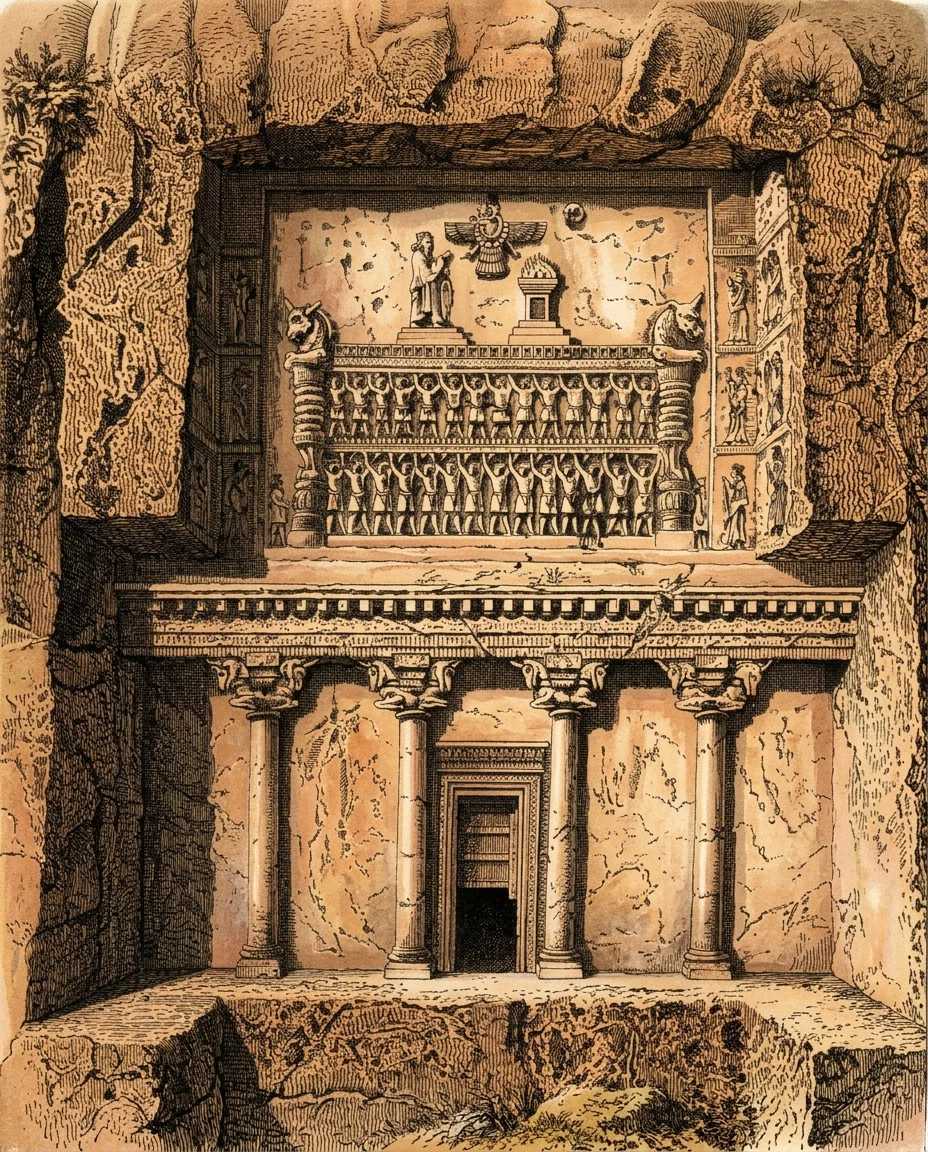
The Rock Grave of Darius.
Daniel was also a faithful servant of God, very scrupulous in regard to the requirements of His law, on which account the Lord had given him great wisdom in both temporal and spiritual affairs. Therefore we may look to Daniel as a reliable exponent of the true relationship of divine and human law. His example, the record of his action when brought face to face with the two authorities in conflict, being given to us in the Word of God “for our learning” (Rom. 15:4), it is well worthwhile to make special note of it.
When Daniel’s fellow-officers failed to find any “error or fault” in his work or character, they concluded to attempt his overthrow on account of his religion. They thought to find occasion against him “concerning the law of his God.” So they came in very subtle and patronizing manner to the king, and asked him to make a law.
When professedly religious men do not like the law of God, they always seek relief in human law. When jealous or overzealous people imbibe a hatred of those who adhere to the law of God, they are prone to trap the objects of their dislike in a “law of the land,” and then make complaint to the authorities. As it is to-day, so it was in Daniel’s time. Those ancient seekers after pre-eminence planned adroitly, making the king believe that they were exceedingly solicitous for his honor.
“Then these presidents and princes assembled together to the king, and said thus unto him, King Darius, live forever. All the presidents of the kingdom, the governors, and the princes, the counselors, and the captains, have consulted together to establish a royal statute, and to make a firm decree, that whosoever shall ask a petition of any God or man for thirty days, save of thee, O king, he shall be cast into the den of lions. Now, O king, establish the decree, and sign the writing, that it be not changed, according to the law of the Medes and Persians, which altereth not. Wherefore King Darius signed the writing and the decree.”
Daniel’s estimate of this statute as compared with the law of God is shown in the fact that he paid no attention to it. Nor did he endeavor to conceal the fact that he disregarded it. With his window open, “he kneeled upon his knees three times a day, and prayed, and gave thanks before his God, as he did aforetime.” Of course the men who had set the trap for him were watching him, and promptly reported his action to the king. Darius now perceived the secret purpose of his officers in desiring the decree, and was “sore displeased with himself” for having allowed them to deceive him. He “set his heart on Daniel to deliver him; and labored till the going down of the sun.” But they were inexorable; they had the law on their side, and even the king could not alter his own decree after it had been signed and sealed. Such was the law of the Medes and Persians. Verses 8, 15.
“Then the king commanded, and they brought Daniel, and cast him into the den of lions. Now the king spake and said unto Daniel, Thy God whom thou servest continually, He will deliver thee. And a stone was brought, and laid upon the mouth of the den; and the king sealed it with his own signet, and with the signet of his lords; that the purpose might not be changed concerning Daniel.”
Such was the consequence of enforcing a human law in conflict with God’s law. And the principle has been the same in all ages, and ever must be when carried to its logical end. But “the Lord bringeth the counsel of the heathen to naught; He maketh the devices of the people of none effect.” Ps. 33:10. King Darius could find no rest that night, either by sleep or by the soothing influences of music. So, early in the morning, “he went in haste unto the den of lions.”
“And when he came to the den, he cried with a lamentable voice unto Daniel; and the king spake and said to Daniel, O Daniel, servant of the living God, is thy God, whom thou servest continually, able to deliver thee from the lions? Then said Daniel unto the king, O king, live forever. My God hath sent His angel, and hath shut the lions’ mouths, that they have not hurt me; forasmuch as before Him innocency was found in me; and also before thee, O king, have I done no hurt.”
Thus we have illustrated in the life and character of Daniel and God’s dealings with him, as also in the faith and practise of our Saviour and His apostles, that “we ought to obey God rather than men.” Acts 5:29.
The subsequent action of the king in casting Daniel’s accusers into the den of lions, and their prompt destruction by the furious beasts, is also an essential part of the foregoing lesson. The king had a right to punish evil-doers (Rom. 13:4) who conspired against the life of an innocent man. Their destruction by the same animals that had been restrained by the angel of God from injuring Daniel, aptly illustrates two points: (1) “The angel of the Lord encampeth round about them that fear Him, and delivereth them.” Ps. 34:7. (2) Of the wicked God says, “He shall bring upon them their own iniquity, and shall cut them off in their own wickedness.” Ps. 94:23. This incident also demonstrated the fact that the Lord is on the side of them that hold His law as the pre-eminent authority, and against them that exalt human law above that of God. The principles of God’s dealings with men are ever the same. The consequences of disobedience are death (Rom. 6:23), but, owing to the long-suffering mercy of the Lord, the sentence is not immediately executed. And “because sentence against an evil work is not executed speedily, therefore the heart of the sons of men is fully set in them to do evil.” Eccl. 8:11.
King Darius acknowledged before his entire empire that the God of Daniel “is the living God, and steadfast forever, and His kingdom that which shall not be destroyed” (Dan. 6:26); but his decree, that all men should “tremble and fear before” Him, was not the utterance of a converted man; it was merely that political policy to secure temporal power in the name of the God of heaven which in our day is known as National Reform. It does not in any sense harmonize with the scriptural call to voluntary service, “Whosoever will, let him take the water of life freely.” Rev. 22:17.