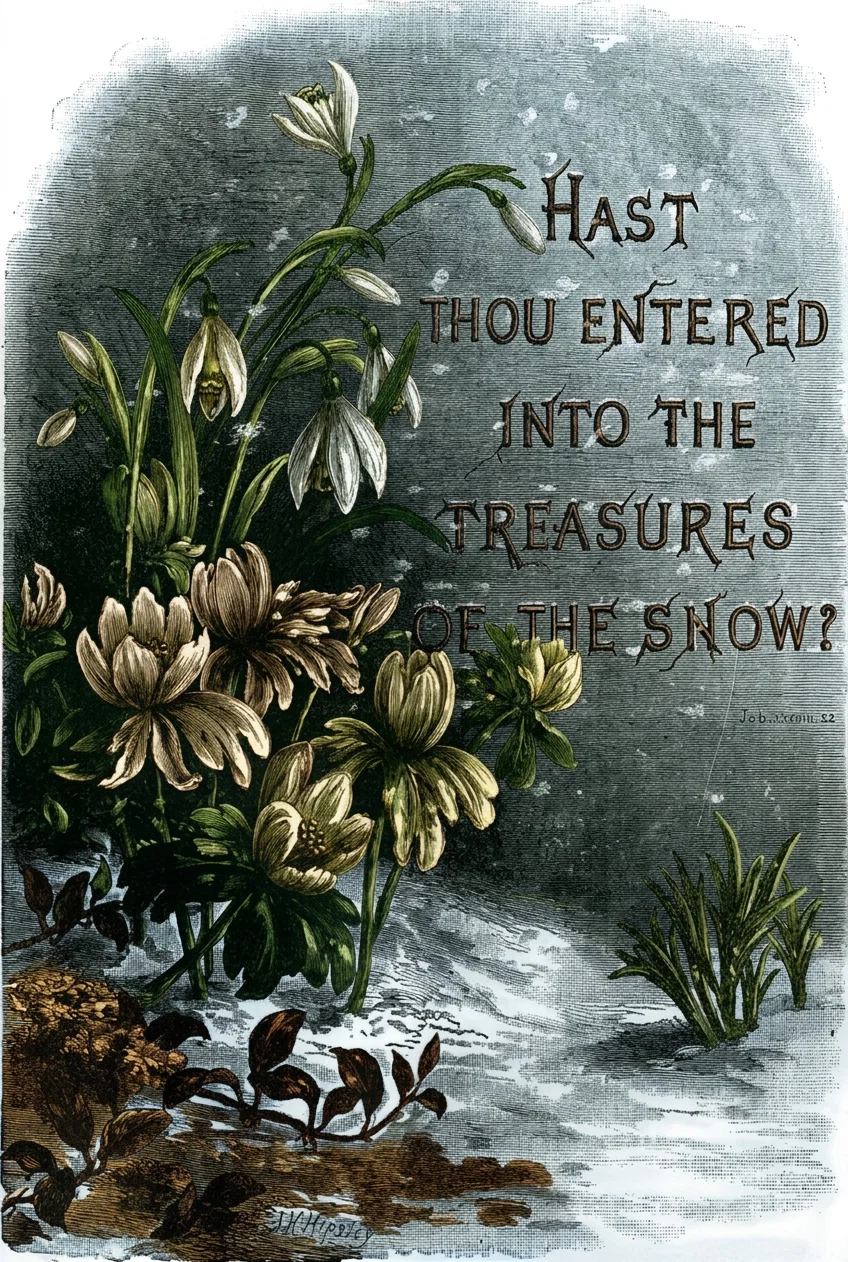
GOD IN HIS WORKS

8%

Pacific Press Publishing Company · Oakland, California · Mar 11, 1897

FromSigns of the Times, Vol. 23, No. 10.

Read the full edition

GOD IN HIS WORKS.

God gave birth to all things, put himself in all things, so as to reveal himself—so as to give an object lesson, that we may know, understand, become acquainted with him. This is what Isaiah heard the seraphim cry when he saw God's glory: “Holy, holy, holy, is the Lord of hosts; the whole earth is full of his glory.” Isa. 6:3. “The Word was made flesh, and dwelt among us (and we beheld his glory, the glory as of the only begotten of the Father), full of grace and truth.” John 1:14.
“For the Word of the Lord is right; and all his works are done in truth. He loveth righteousness and judgment; the earth is full of the goodness of the Lord.” Ps. 33:4, 5.
“The earth, O Lord, is full of thy mercy; teach me thy statutes.” Ps. 119:64.
The earth is full of the glory, goodness, mercy, of the Lord. “In his temple doth every one speak of his glory.” Ps. 29:9, last clause. Every one speaks of his glory. Luther expresses it in a very nice way: “Everything which God has created is a little vocable from his grammar by which he discloses his hidden hand.” “The heavens declare the glory of God.” Everything says, Glory. Were it not for the sinfulness of man, everything would say, Glory, and say it all the time. Of man He said, “I have created him for my glory;” he was crowned with glory. His being, his very existence, says, Glory. We are to glorify God in our bodies and spirits which are his. Creation is an object lesson for our study. When this revelation in the book of nature was first made, it was perfectly clear, not a blot or dim word was upon the page; and man had that eyesight which enabled him to read it. But sin came in and blighted both man and nature, bedimmed our eyes and the pages of that book. Therefore God was constrained to put into language what he had before revealed through his works concerning himself. Everything that God has said to us in human language, he has said to us in his works. The more you think of that, the more it will open up the study.
The vine, the bread, are revelations of Christ; and this is the real object in our study. This is what I mean when I say, All created things are but expressions, symbols, of him. His word caused them to appear there, and keeps them there. His word may take them away; but his word still remains, it abideth forever. These symbols, representations, expressions, are subject to change; “They shall perish, but thou remainest.” “They all shall wax old as a garment, but thou art the same.”
God worked; is still working. In studying nature, we are studying his word. His word, his power, works in us. Anything that thwarts that working, brings in some other element. There is something in man that is not in other plants; for man is but at the top of vegetable creation,—a plant that has power to walk about and think.
We are now prepared for the statement that the only study which should occupy the mind from the earliest down to the latest day of life, whether we are in the home, in the church, in the school, or anywhere else, is the word of God. Is that limiting the field, or is it enlarging it? When we are studying God's word in man and nature, we call that history. All history, then, is the study of God's working with man, and in man, and through man, even tho many oppose him and work out his will and his word unconsciously. He rules in the nations of the earth, but in such a manner as not to be arbitrary. The purpose of our study is to see God at work. The study of material things, which we sometimes call science study, is simply studying God in his works. We can not study God in the abstract; there is no such thing as that. We can not find out God. “Canst thou by searching find out God?” We must see him revealed, see him at work.
What is the difference between the true method of study, of education, and the false method of study and of education?—The true method is to study all things as the study of God; the false method is to leave God out, not to get to him at all, or have his laws control. The laws of nature are the habits of God, simply God’s usual way of working. This field is as broad as the universe, and to begin to illustrate it, we begin an indefinite study. All this is Bible study. This is the study of the Gospel. It is the power that attracts us to Him and keeps us from sin. The result for us of this study is growth. We will desire the sincere milk of the Word that we may grow thereby, and if we are as submissive as nature, we will grow. Every product of creation was pronounced after its kind to be good. God had a certain ideal for trees, grass, plants, man, and that was submission. Perfect submission means perfect being.
Around us we see the word of God in nature. Here in the Bible we see the word of God in language. Would it be proper to say that the Bible is the written book, and these things of nature the illustration of the book? Here is the picture; where does it belong in the book? When Christ was here he was constantly referring to these things.
W. W. Prescott.