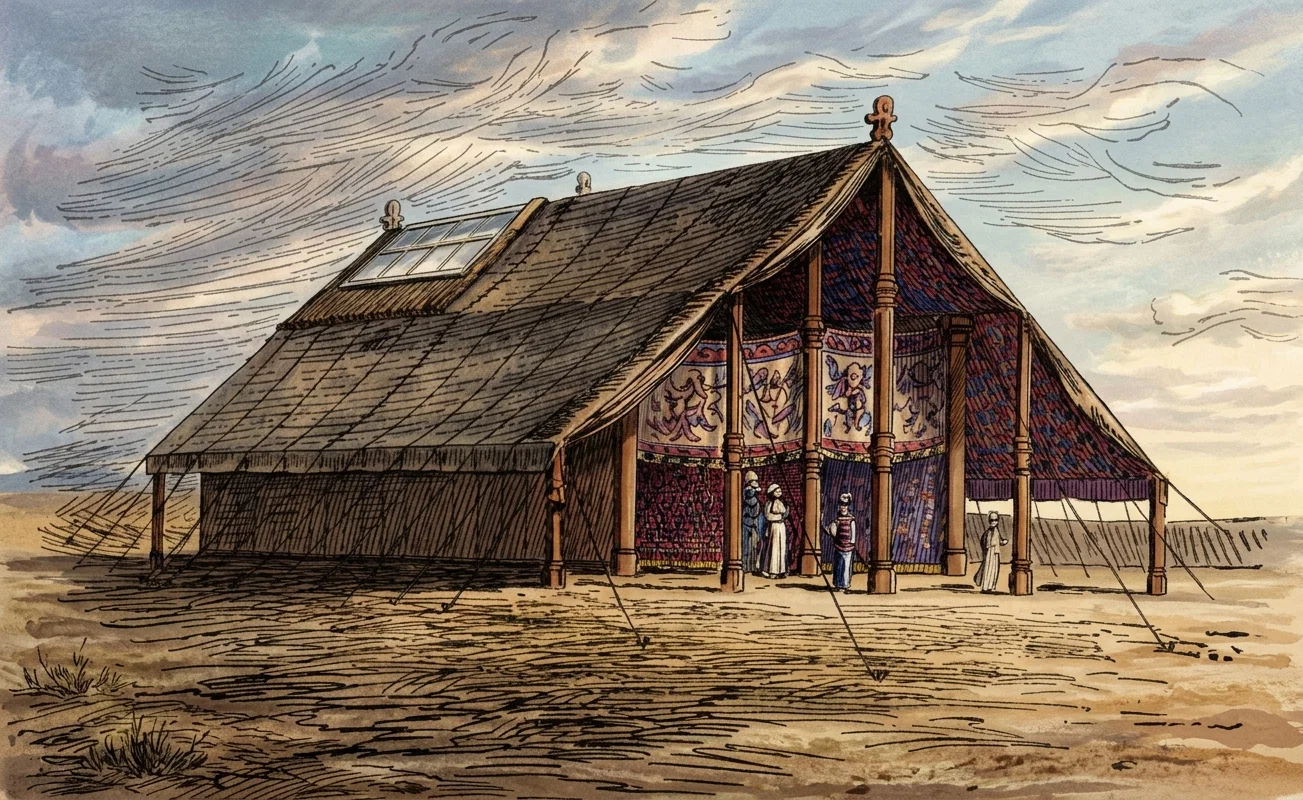
Not one word which Christ ever spoke was devoid of meaning. And how readily we apprehend that such must be the truth. For everything which Christ ever spoke was the word of the living God. We would expect, then, that when Moses received instruction for the erection of the tabernacle, there would be no part connected with it but what would have some great importance attached to it. For the temple, as a whole, was representative of Christ as entire. He tells us himself several times that he is the Temple of God, and we know that in him dwelt all the fulness of God's glory, even as the glory of God filled all the tabernacle. Peter also speaks of Christians being the tabernacle of God, and the bodies of men as God's earthly habitations in which his Holy Spirit dwells. See John 2:19-21; 2 Peter 1:13, 14; 2 Cor. 5:16; 1 Cor. 6:19.
The coverings of the sanctuary were four in number,—the beautiful covering of blue, purple, scarlet, and fine-twined linen, inwrought with cherubim, and worked with gold; then came the goats' hair covering; the third was the rams' skins dyed red; and, lastly, the outer covering was the badger skin. The first thing which attracts our attention is the variety of colors used in the first covering. O, how much they do tell us of that glorious Anointed One—his origin and work! On a clear, beautiful evening as we stand gazing at God's wonderful works in the heavens, and view the dome above us, what does the blue suggest to us but heaven's own canopy? Yes, this spread is to teach us that the Messiah of God was to be of heavenly origin, to come down from heaven. And is not that what the ancient prophets predicted of his birth, and whence he was to come? And did not the Master himself say: “I am from above.” “I came down from God.” “I am the Bread of God which came down from heaven.” “I came forth from my Father!” And this same truth is recognized by many of the writers of the Talmud; and it was this truth that caused the leaders in Christ's day to partly stumble. Yes, his name was “Immanuel, God with us.” Ah, blessed condescension on the part of the Eternal One, to send to us his most dearly beloved to declare to the children of men his great love!
We should remember, too, that what was true of these things in Christ's life is equally true in the lives of his devoted and faithful children. For he is our Example, and we are to follow in his footsteps. All things back there, coverings and all, were made after the pattern; and several times did God emphasize this fact upon Moses' mind: “See, saith he, that thou make all things according to the pattern showed to thee in the mount.” The children of God are not of this world; they are born from above, having their citizenship in heaven. “As he is, so are we in this world.”
As we think of the purple color, how forcibly we are reminded of His purpose in being born into the world. Asked Pilate at the Saviour's trial: “Art thou the King of the Jews?” “Art thou a king then?” Jesus answered and said: “Thou sayest that I am a King: To this end was I born, and for this cause came I into the world.” “Will ye therefore that I release unto you the King of the Jews?” And even in prose and poetry we find that writers have adopted this term to denote the regal state. Our Messiah is a King, as well as of heavenly origin. And one of the greatest Jewish Talmudists, in commenting on Jer. 23:5, says that that Lord referred to there is none other than “King Messiah.” Our Saviour is royal, and what a royal Helper, too!
And, dear reader, have you thought that Jesus, the Messiah, has made you his follower, of royal bearing? “But ye are a chosen generation, a royal priesthood, an holy nation, a peculiar people.” “Beloved, now are we the sons of God, and it doth not yet appear what we shall be; but we know that, when he shall appear, we shall be like him; for we shall see him as he is.” Well can we say, “I am the child of a King.” O most blessed and exalted privilege to be of heavenly regality, with the blessed and bright prospect in view of having a diadem placed on our brow! We shall sit with him upon his throne, and reign as kings and priests. O blessed privilege to be a Christian!
But it was quite essential, while these colors should be part of the tabernacle, that the scarlet, or suffering color, should not be omitted. Yes, the Saviour was to be a suffering Messiah, that he might bring many sons unto God,—yea, the Captain of our salvation was made perfect through suffering. And, Christian, do you expect to wear the golden crown by and by? You surely will, if you have the thorny one platted upon your brow now, that even the scarlet may appear as part of the material in the construction of the earthly tabernacle. And it is this suffering which will enable us to appreciate the glory which is to be revealed. Methinks the sweetness of the beyond could not be appreciated did we not have to endure the suffering here. Or, as the apostle states it, “Our light affliction, which is but for a moment, worketh for us a far more exceeding and eternal weight of glory.”
Doubtless every Bible reader is familiar with the significance of the fine-twined linen. The revelator tells us that the fine linen is the righteousness of saints. But how do the saints obtain righteousness? “And this is his name whereby he shall be called, THE LORD OUR RIGHTEOUSNESS.” And every fiber of the pure garment was woven in the loom of heaven, all the time being made according to the pattern. Yes, Christ worked out that beautiful garment of righteousness, and in it there contained no foreign material. See Isaiah 61, last two verses. Well may we crave with Paul that we might be found not having our own righteousness which is of the law, but being covered with the garment of His righteousness which is granted by His faith. For it is all of Him. And the more we keep our eyes fixed on the Pattern, the more will the work be perfected as He would have it done.
What a beautiful combination the Designer arranged for the innermost covering of the tabernacle! This canopy was visible to none on the outside world, but seen only by the priest who ministered within. How true this was with the Master's life when on earth! Few, ah, how few, saw his beautiful life within, or even understood him! Always misrepresented, maligned, misunderstood, betrayed, and even denied by his best friends! But God, who ministered in that spotless life, saw all the beauty and the glory which it contained; and to Him, who abode in the holy place of Jesus, the life was understood as it really was, beautiful and most glorious. And how often, Christian, is it in your experience that “no one can understand,” not one to enter into what you feel! Often misunderstood, misjudged, wrongly apprehended, misinterpreted in your intentions! Remember that to the world outside these things are not visible in their true light, and are hidden from their natural view. But God, who ministers in that soul, and Jesus, who abides in the sanctuary of your heart, sees all the combination of the colors which are being interwoven within, and he alone understands. Then, child of God, care not for the thought of mortality; fear not the misunderstandings of men; for they can not enter within to see the beautiful inner covering of the life, but rejoice with unspeakable joy, full of glory; for8He abides there and views all as they are, and to Him the curtain is a beautiful one.
The next covering which came upon the beautiful curtain was the goats' hair. How our minds retrospect the service on the day of atonement in the wilderness! How we see the people gathering on that day around the tabernacle, as the high priest takes the goat for the Lord's offering, that reconciliation may be made for the people, and that they might enjoy the oneness with God. Yes, the goats' hair surely speaks to us of the atonement which the blessed Master made for us himself, reconciling us to God by his death, giving his life for us, that his might be given to us. O, the atonement! What meaning is there wrapped up in that term? See him, the Lord of glory, willingly, yea, gladly, giving up his life of incomprehensible happiness and joy, surrounded with untold myriads of loyal subjects in the heavenlies doing him homage such as no earthly potentate ever dreamed,—to reveal to poor, fallen mortality the divine love that dwelt in the bosom of the Father. Yea, suffering shame, agony, and disgrace, that man might enjoy oneness with his Maker. Truly, “God is love!”
But that work did not stop there. He was willing to share it with His children, and give them the privilege of enjoying it with Himself. “And all things are of God, who hath reconciled us to himself by Jesus Christ, and hath given to us the ministry of reconciliation; to wit, that God was in Christ, reconciling the world unto himself. . . . and hath committed unto us the word of reconciliation.” What a thought! Reconcilers for God! Ambassadors for Christ! Intrusting into the hands of frail humanity the work of redeeming the race! Verily God has a right to feel confident in his own power, when he is able to work out the great problem of human salvation through instruments of clay, who have reached such a state of degradation. Exalted privilege to be a coworker with the Almighty God, and co-operator with the Saviour of men!