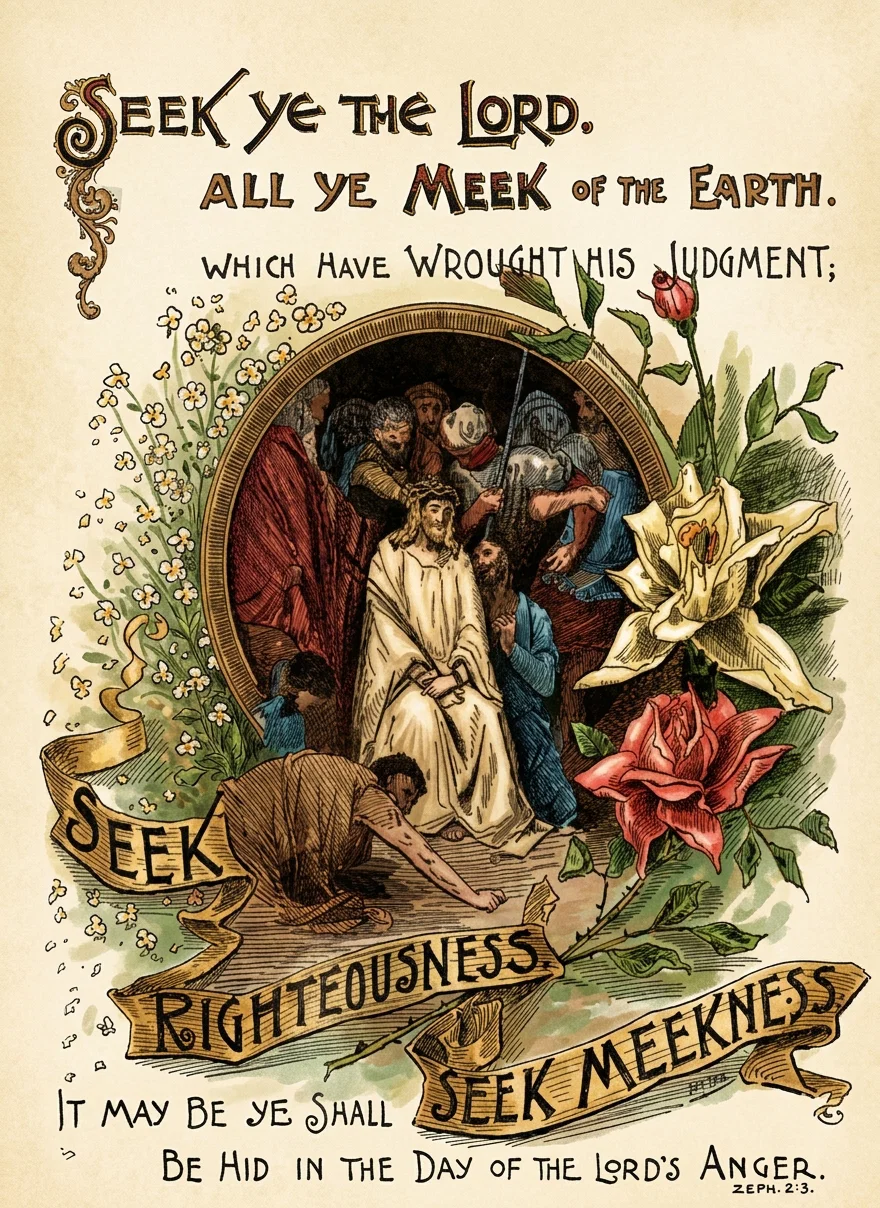
Based on Humility

7%

Pacific Press Publishing Company · Oakland, California · Feb 11, 1897

FromSigns of the Times, Vol. 23, No. 6.

Read the full edition

Based on Humility

Editorial

Meekness

“The fruit of the Spirit is . . . meekness.” The original meaning of the Greek term translated meekness meant, among the heathen, mildness, gentleness, self-control, forbearance, equanimity. It was used almost wholly to express outward conduct of man or beast toward their fellows. In the Christian life it denotes an inward quality not natural to the man, but an outgrowth of the Spirit of God.

Based on Humility

True meekness in the Christian vocabulary is based on humility, and is especially manifest in the Christian’s relation to God. It indicates that the possessor has looked upon God, has seen his greatness, his majesty, and his infinite purity, and, in that ineffable light, has seen his own abject weakness, nothingness, and sinfulness. And yet meekness is not akin to hopelessness. It does not dwell with despair. It is a fruit from the same root which bears love, joy, peace, gentleness, goodness, faith, temperance. But it is humble, submissive.

Not Vacillating

But meekness does not mean a vacillating disposition. It does not mean a weak spirit, one ready to yield to the force of public opinion, or expediency. It does not mean timidity in doing right. It is consistent with the greatest strength of character. It is, therefore, a misuse of the word to refer to a weak, timid, vacillating man as meek. There is a reason why the meek man, the humble, the one who has looked upon God, should not fear. To him who has seen the Majesty of Heaven, what is man that he should be feared? To the humble Elijah of the desert, what were King Ahab and the prophets of Baal? To the meek and humble forerunner of Christ, what was Herod that the prophet should quail before him?

Meekness Is Teachableness

It seems to us there is no better scriptural definition implied than this: “The meek will He guide in judgment; and the meek will He teach His way.” Ps. 25:9. The meek, then, is one who is willing to be taught and guided of God. Knowing God, and knowing himself in the light of God, he also knows his need of divine counsel and direction. Like the prophet of old he will cry, “O Lord, I know that the way of man is not in himself; it is not in man that walketh to direct his steps” (Jer. 10:23); and realizing this he will plead with David: “Show me thy ways, O Lord; teach me thy paths. Lead me in thy truth, and teach me; for thou art the God of my salvation; on thee do I wait all the day.” Ps. 25:4, 5. But meekness will not seek to quench its thirst for knowledge at the broken cisterns of earth, at the stagnant pools of tradition, at the reservoirs of church creeds or councils, at the little buckets of men. It seeks for the knowledge of the Infinite. It would drink from the cool flowing waters of Life’s Lebanon. It would partake of the fruits of the heavenly Paradise. But none of these things are sought by meekness selfishly or exclusively; they are sought unselfishly, humbly, lovingly, sincerely, at the only right Source of seeking. Men may help on the way, but the wisdom given through men is a help to the object sought, but not the object itself.

The Mightiness of Meekness

A wonderful illustration of this lowly yet wondrously divine grace we have in Moses, “the man of God,” and in Him whom Moses typified. Altho the former was “learned in all the wisdom of the Egyptians,” a mighty warrior and statesman (Acts 7:22), he humbly enters the school of Christ for forty years, tending and leading and bearing in his arms under the stars of God the sheep and lambs of the flock. That was his higher university course, preparatory to his great life-work. None but a meek man would have taken it, and none but a meek man would have learned the precious lessons of the deserts of Midian. That finished, God sends him to Egypt to deliver his people. He is to go before earth’s mightiest monarch and proudest court and demand freedom for his enslaved people. But what is man to him who has met God? He bears his message. He is threatened, but quails not. By the power of Jehovah, manifest through his simple shepherd’s crook, he works a succession of the mightiest miracles the earth has ever known. He bears the murmuring, the complaining, the rebellion, the treachery of his kindred, with prayers for their forgiveness. While taught of God, he humbly takes suggestions from the godly shepherd-priest of Midian. When his friends feel that he is slighted because others are prophesying, he is wishing that all God’s people were prophets, and that the Lord would put his Spirit upon every one. When Israel have proved false to God, false to his leadership, he is pleading with an agony of soul among the human second only to that of Gethsemane, “Yet now, if Thou wilt forgive their sin;—and if not, blot me, I pray Thee, out of Thy book which Thou hast written.”It is not discouragement that wrings from his heart the plea, it is the man of God pleading, in sublimest self-effacement. What meekness, what strength of character! In the very meekness was the strength. Among the very mightiest of all God’s human agents and co-workers, and yet the Word tells us that “the man Moses was very meek, above all the men which were upon the face of the earth.” Num. 12:3. It was because of his meekness that God could talk with him face to face even as a man speaketh to his friend.
But the great example of the power of meekness is Jesus Christ the Son of God. Preëminently, altho the Son of the Highest, he was the meek and lowly of heart. Teachable?—Yes. Hear him: “I can of mine own self do nothing; as I hear, I judge; and my judgment is just; because I seek not mine own will, but the will of the Father which hath sent me.” “I do nothing of myself; but as my Father hath taught me, I speak these things.” He was made in all things like unto his brethren. He bore their weaknesses, their sins, their infirmities. In all points as they were tempted, he was tempted. Hence his prayers to God, his strong crying and tears, his complete emptying of self and laying hold of God. This was meekness; and because of this God gave him of his Spirit without measure, filled him with all the fulness of the Godhead, made all fulness to dwell in him, and through him wrought the salvation of the universe. But all the power was the might of meekness, might which only the meek can know.