“The fruit of the Spirit is . . . long-suffering.” “Long-suffering” means “suffering long; bearing injuries or provocations for a long time; patient; not easily provoked.” It is “a patient holding out under trial,” exercised especially toward persons.
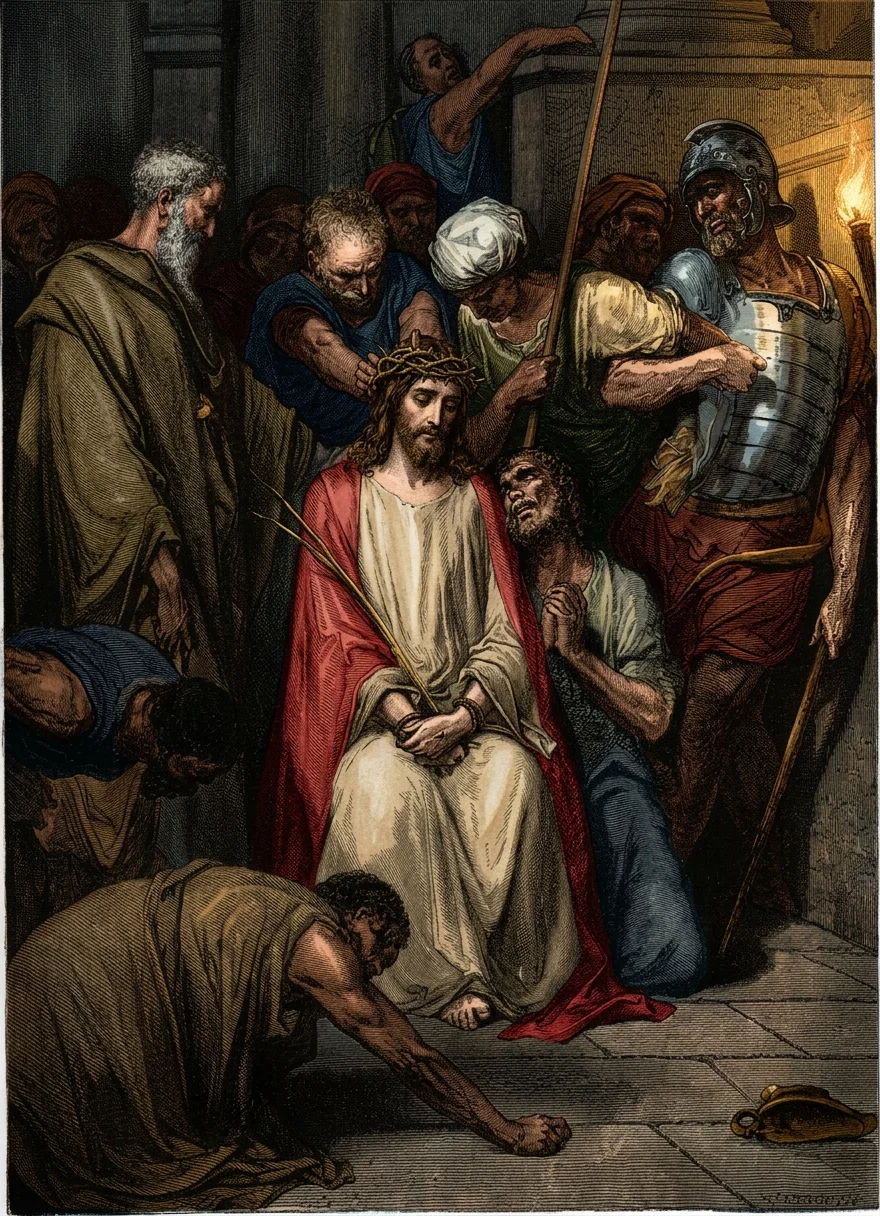
A token of God's long-suffering: “They stripped Him, and put on him a scarlet robe. And when they had platted a crown of thorns, they put it upon His head, and a reed in His right hand; and they bowed the knee before Him, and mocked Him, saying, Hail, King of the Jews! And they spit upon Him, and took the reed, and smote Him on the head.” Jesus said: “Father, forgive them; for they know not what they do.”
Long-suffering, in the light of our text, is not merely to suffer long. The wicked often suffer long. The transgressor of physical law becomes a hopeless wreck, and suffers all his life, complaining all the while he suffers. This is not the long-suffering of the Spirit. There are many who are grievously wronged for long years by others, who suffer greatly from these wrongs, who are oppressed, maligned, defrauded, persecuted; and these wrongs arouse within them bitter feelings of enmity and revenge. This is not the long-suffering of the Spirit.
Long-suffering of God.—
The long-suffering of the Spirit is the long-suffering of love. It dwelt first in God. It is an attribute of his character; for “God is love,” and “love suffereth long, and is kind; love envieth not; . . . seeketh not its own, is not provoked, taketh not account of evil.” 1 Cor. 13:4–6, R. V. This is love. The Lord thus declared his glory, his character, his name to Moses: “The Lord, the Lord God, merciful and gracious, long-suffering, and abundant in goodness and truth.” Ex. 34:6. “The Lord is long-suffering and of great mercy.” Num. 14:18. “But thou, O Lord, art a God full of compassion, and gracious, long-suffering, and plenteous in mercy and truth.” Ps. 86:15. God is long-suffering because he is full of compassion and gracious. Grace is undeserved favor; mercy bestowed upon those undeserving.
God’s Long-suffering
is his kindness and mercy exercised toward men who are all unmindful of his goodness. Day by day he gives them life; they use it regardless of the Giver. He gives light, and men employ the precious agency in selfishly seeking their own without a thought of God. He has filled the earth with life and beauty, with harmony and music, from the majestic voice of the thunder to the trilling of the song-bird, and the murmur of the wind in the shrubbery. He has painted gorgeous and beautiful pictures on fleecy cloud and star-gemmed sky, on land and sea. He has filled the air with the fragrance of a myriad flowers. He has manifested life in forms manifold. He has given man eyes to see, ears to hear, nerves to feel and taste, and tongues to speak of his goodness and praise; the earth is full of his glory. But man brings the harsh and selfish discord of sin into God’s harmony, and foul odors into God’s fragrance. He mars the beauty of God’s pictures. He uses the breath of life to curse God and his name. All the powers of his being, by which and through which God might be glorified, he prostitutes to the service of self and sin and evil; and God suffers it all and is kind. Even the pain that follows sinning is God’s blessed and merciful warning to withdraw from the way of wickedness, and seek him. Would that men could realize that “every good gift and every perfect gift is from above, and cometh down from the Father of lights, with whom is no variableness, neither shadow of turning.” James 1:17. If they did, they would not despise the “riches of his goodness and forbearance and long-suffering,” but would realize that “the goodness of God,” thus manifested, leads “to repentance.” Rom. 2:4.
God’s Object.—
God’s object is to win men to repentance, to save men from sin and sinning. Men—good men—look upon the evil in the world, the oppression of the poor and weak, the crushing out of nations and people, and wonder how it is that God can suffer such things. “How long, O Lord, how long?” is the cry of the centuries from the oppressed and persecuted of every land. Often the crime and the wickedness rouse the professed followers of the Long-suffering One to take up the weapons of carnal warfare, and “crusades” are2 (18)waged against the “ungodly.” But these always result in more harm than good to the cause of Christ. If the life of the sufferer is hid with Christ in God, no power can destroy him, or pluck him out of the hand of Infinite Love. As in the case of Paul, he may know that Christ shall be magnified in him, whether by life or death. Phil. 1:20. We may feel as did impetuous and warm-hearted Peter when we see our Lord in the persons of his followers insulted and betrayed by the ungodly, but the Master bids us put up our sword. If the sword is our trust, we shall perish with it. The cup of persecution must be quaffed by the church as by its Head. As he prayed concerning his enemies, “Father, forgive them; they know not what they do;” so will the church pray concerning her enemies. Meeting bludgeon with blow, sword thrust with stab, may break the persecutor’s head or spill his life blood, but it will not win his heart or save his soul. This is God’s object, to save. “The long-suffering of our Lord is salvation” to every soul who can be reached by him. In justice God could have destroyed Saul, the persecutor; in long-suffering he saved him. His long-suffering is the reason why we are saved.
Our Example.—
“If, when ye do well, and suffer for it, ye take it patiently, this is acceptable with God. For even hereunto were ye called; because Christ also suffered for us, leaving us an example, that ye should follow his steps; . . . who, when he was reviled, reviled not again; when he suffered, he threatened not; but committed his cause to him that judgeth righteously.” 1 Peter 2:21–23, margin. Here is our example. Through all the centuries of sin before he came; from the manger to the desert of temptation; from the desert of temptation to the Garden of Gethsemane, in the arrest, the mock trial before the Sanhedrin, the clamor before the Roman governor, the scourging, the bearing of the cross, the piercing of the nails, and the shameful death; from the Crucifixion until the present, as he has suffered in sympathy with his saints,—in it all is the long-suffering of God manifested toward us and the world for our salvation and the salvation of all. And it will be toward each one till every deed of God’s love is rejected, and man chooses wrath instead of mercy. How long-suffering, then, ought we, recipients of God’s wondrous goodness, to be to our fellows; “with long-suffering, forbearing one another in love” (Eph. 4:2); “strengthened . . . unto all patience and long-suffering with joyfulness” (Col. 1:11); “put on therefore, as the elect of God, holy and beloved, bowels of mercies, kindness, humbleness of mind, meekness, long-suffering; forbearing one another, and forgiving one another, if any man have a quarrel against any; even as Christ forgave you, so also do ye” (Col. 3:12, 13). This is Christlikeness, this is Christianity. This long-suffering is the fruit of the Spirit of God within.