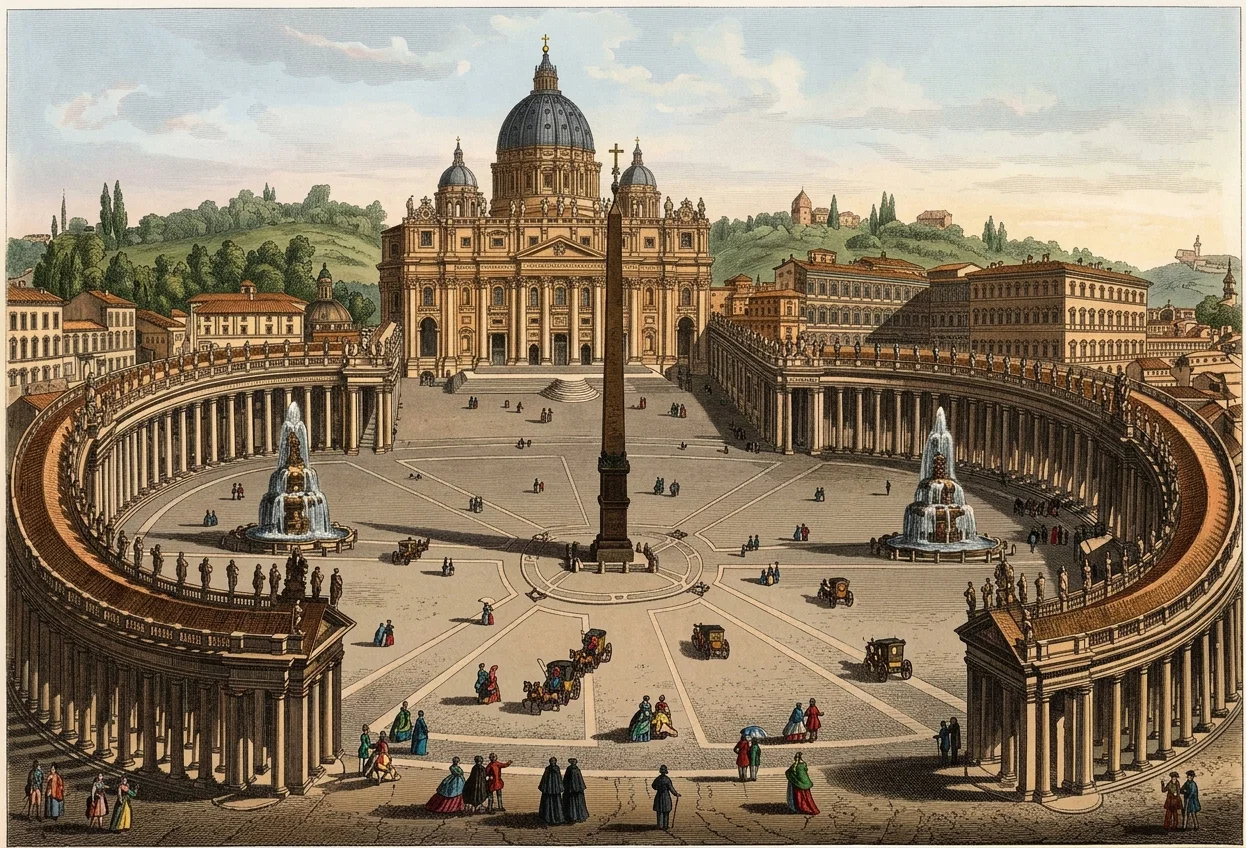
The largest and most famous cathedral in Christendom is that of St. Peter's at Rome. For nearly three hundred years the completed building has been an objective point of thousands of visitors, and has been one of the means of making modern Rome celebrated.
In the year 306 Constantine founded in Rome a basilica over the reputed grave of St. Peter. This building was itself large and magnificent, but had fallen into decay when Pope Nicholas V., in 1450, resolved to erect a new and grand cathedral. He employed the architect Rosselini, who prepared extensive plans, but soon after the pope died, and the project was neglected for about a half century, when Pope Julius II. undertook the work. The services of another celebrated architect, by name Bramante, were secured, and a new design was executed, which is still in existence. The foundation was laid in 1506, and the work was actively pushed until the death of the pope, in 1513. Bramante, too, died the next year, and his work was put into the hands of Baldusarre Peruzzi.
The work of construction went on slowly, with many hindrances and changes in plans; for nearly every architect employed changed the plans to suit his own ideas. The plan of San Gallo, who followed Peruzzi, is still preserved. When San Gallo died, in 1546, the work fell to the great Michael Angelo, then seventy-two years of age. Under his administration rapid progress was made. The great dome was of his designing, and when he died, in his ninetieth year, he saw that part of the building nearing completion. The plans left by him were followed, and the dome finished mainly in accordance with them, in 1590, Sixtus V. being pope.
The plan of the building by Michael Angelo was that of a Greek cross, but this was altered to a Latin cross by the architect Carlo Maderno, under Paul V. The long task which had employed so many minds and hands was finished at last, and the cathedral was dedicated by Urban VIII., in 1626.
The cathedral is 613 feet long and 450 feet across the transepts. The arch of the nave is 90 feet wide and 152 feet high. The diameter of the dome is 195½ feet, and from the pavement to the lantern is 405 feet, and to the top of the cross is 434¾ feet. The façade is 368 feet long and 145 high. Five open arches lead into a great vestibule 439 feet long, 47 feet wide, and 65 feet high. In this are various statues and mosaics, among the latter the celebrated mosaic of St. Peter walking on the sea. This was preserved from the old basilica.
The walls of the interior of the cathedral are adorned with plates of the richest marbles, and copies of celebrated paintings in mosaic. The pavement is of marble of different colors, arranged in beautiful patterns. The dome is the finest part. It is supported by four great arches. Directly beneath the dome stands the high altar over the supposed grave of St. Peter. It is surmounted by a splendid bronze canopy. Beneath the high altar is the shrine, where 112 lamps continually burn.
Many noted monuments and statues adorn the building, some of them by Michael Angelo, Canova, and Thorwaldsen.
It would naturally be supposed that such a vast work would be a model of art, but it does not reach the standard in this respect; for too many plans were in part used, and thus conflicted with each other.—Methodist Times.