LIVE HOG EXAMINED

7%

Pacific Press Publishing Company · Oakland, California · Aug 27, 1896

FromSigns of the Times, Vol. 22, No. 34.

Read the full edition

LIVE HOG EXAMINED

LIVE HOG EXAMINED
LIVE HOG EXAMINED
BY J. H. KELLOGG, M.D.
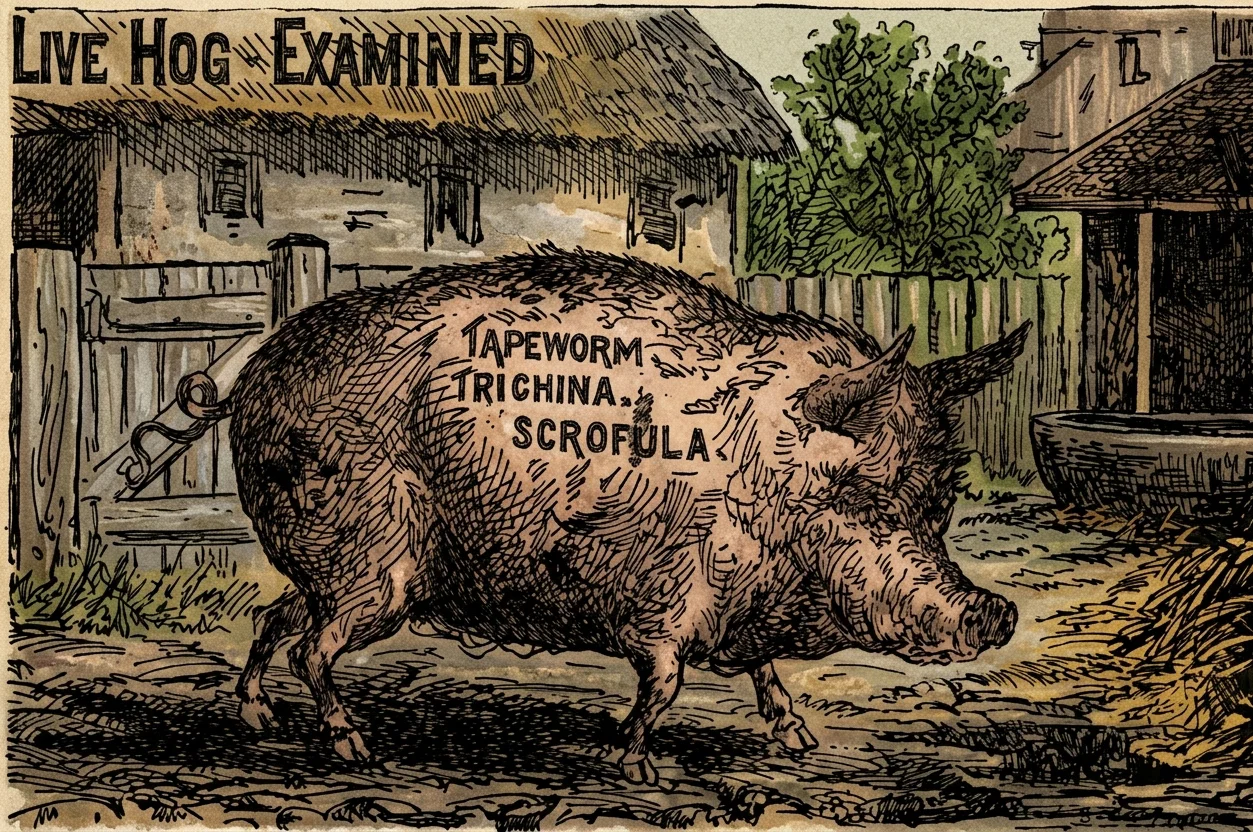
Look at that object in a filthy mud hole by the road-side. At first you distinguish nothing but a pile of black, slimy mud. The dirty mass moves. You think of a reptile, a turtle, some uncouth monster reveling in his Stygian filth. A grunt! The mystery is solved. The sound betrays a hog. You hasten by, avert your face, and sicken with disgust. Stop, friend, admire your savory ham, your souse, your tripe, your toothsome sausage, in its native element. A dainty beast, isn't he?
Gaze over into that sty, our pork-eating friend. Have you done so before? and would you prefer to be excused? Quite likely; but we will show you a dozen things you did not observe before. See that contented brute quietly reposing in the augmented filth of his own ordure. He seems to feel quite at home, doesn't he? Look a little sharper and scrutinize his skin. Is it smooth and healthy?—Not exactly so. So covered is it with tetter, and scurf, and mange, that you almost expect to see the rotten mass drop off, as the grunting creature rubs it against any projecting corner which may furnish him a convenient scratching place. As you glance around the pen, you observe that all such conveniences have been utilized until they are worn so smooth as to be almost inefficient.
Stir up the beast and make him show his gait. See how he rolls along, a mountain of fat. If he were human, he would be advised to chew tobacco for his obesity, and would be expected to drop off any day of heart disease. And so he will do, unless the butcher forestalls nature by a day or two. Indeed, only a few days ago a stout neighbor of his was quietly taking his breakfast from his trough, and grunting his infinite satisfaction, when, without a moment's warning, or a single premonitory symptom, his swinish heart ceased to beat, and he instantly expired, without finishing his meal, much to the disappointment of the butcher, who was anticipating the pleasure of quietly executing him a few hours later, and serving him up to his pork-loving patrons. Suppose his death had been delayed a few hours, as is the case with the majority of hogs? or, rather, suppose the butcher had got the start of nature a little, as he generally contrives to do?
But we have not half examined our hog yet. If you can possibly prevail upon yourself to sacrifice your feelings, in the cause of science, pork-loving friend, just clamber over into the reeking sty, and take a nearer view of the animal that is destined to delight the palates of some of your friends, perhaps your own. Make him straighten out his foreleg. Now observe closely. Do you see an open sore, or issue, a few inches above his foot, on the inner side? and do you say it is a mere accidental abrasion? Find the same on the other leg; it is a wise and wonderful provision of nature. But what are they? Grasp the leg high up, and press downward. Now you see, as a mass of corruption pours out. That opening is the outlet of a sewer. Yes, a scrofulous sewer; and hence the offensive, scrofulous matter which discharges from it. Should you fill a syringe with mercury, or some colored injecting fluid, and drive the contents into the same opening, you will be able to trace, all through the body of the animal, little pipes communicating with it.
What must be the condition of the body of an animal so foul as to require a regular system of drainage to convey away its teeming filth? Sometimes the outlets get closed by the accumulation of external filth. Then the scrofulous, ichorous stream ceases to flow, and the animal quickly sickens and dies, unless the owner speedily cleanses the parts, and so opens anew the feculent fountain, and allows the festering poison to escape.
What dainty morsels those same feet and legs make! What a delicate flavor they have, as every epicure asserts! Do you suppose the corruption with which they are saturated has any influence upon their taste and healthfulness?
The hog is a scavenger by nature, and it is probably for this reason he has been furnished with special means for removing impurities from his gross body.
The process of fattening hogs is one productive of disease. A fat hog is one which is grossly diseased. The process of fattening is one of disease producing. The livers of fat hogs are often masses of disease. Butchers will tell you that they often find the liver in fat hogs crowded with abscesses.
Tapeworm.—This loathsome creature, which often gets into the human stomach and intestines, and sometimes grows there to the enormous length of several rods, is often communicated to man by eating pork. The occurrence of tapeworm is becoming much more frequent in this country than formerly.
Trichinae.—Still more to be dreaded by pork eaters are the terrible trichinae, whichare also communicated by the eating of pork. Each worm is so small that several hundred thousand of them may occupy a single cubic inch of pork. When taken into the body, a single worm produces a thousand young, which at once commence boring into the body in every direction, lodging at last in the muscles. The pain and general disturbance of the system are so great that few constitutions can survive the terrible ordeal. If life is not destroyed at once, the individual lingers along, a sufferer for life, his body filled with disgusting worms, for which there is no remedy. No cure for the disease has been discovered. Probably about one hog in ten is affected by the disease. No more than one in ten of the deaths from this cause are attributed to it, as the disease may appear like many others. It especially resembles cholera, dysentery, typhoid fever, cerebro-spinal meningitis, and rheumatism.
The ancient Jewish law forbade the use of swine's flesh, and the orthodox Jew of to-day would as soon think of eating a cat or dog as a hog. The Jews are noted for their health and longevity, and their abhorrence of the hog may be one reason for this remarkable national peculiarity. It is a question well worth considering, whether, if pork is not good for a Jew, is it good for a Christian?