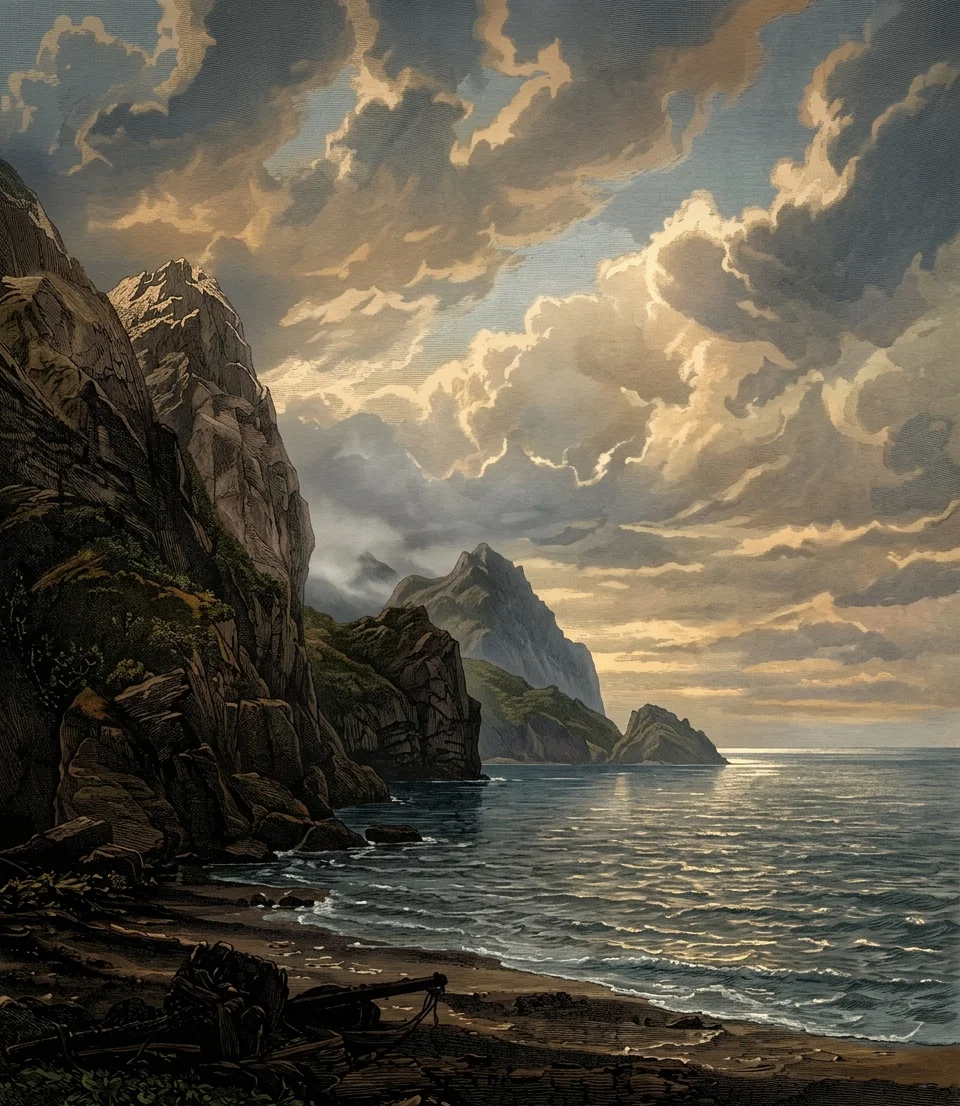
Mountains and Sea

8%

Pacific Press Publishing Company · Oakland, California · Aug 27, 1896

FromSigns of the Times, Vol. 22, No. 34.

Read the full edition

Mountains and Sea

Mountains and Sea.—Striking symbols are both to the Christian. The word of God uses them continually, now associated with the wonderful events in the plan of redemption, and then symbolizing some wonderful truth important to remember.
Mountains.—How majestic they are! What symbols of strength and stability! Rising oftimes from the deepest sea, they tower among the clouds, their tops basking in eternal light of star or moon or sun. How beautiful, rugged, and grand their ever-changing shapes and scenery, lights and shadows! Pyramid, tower, and spire, thunder-riven pinnacle, and weather-beaten dome, sheer cliff and lofty battlement, castle and cathedral, arch and niche, turret, minaret, and cupola, exceeding the grandest of earth, are found in profusion among many of the mountainous districts of earth. What places of refuge they form for the feeble cony or the ferocious lion, or the refugees of human kind! The greatest lands of all lands are the mountainless lands.
God Honors Mountains.—God has seemed to honor mountains above all other conformations of nature. It was on a mountain—Ararat—that the ark of the Deluge found rest. It was on Mount Moriah, “the mount of the Lord,” that God tested Abraham, and then revealed himself to “the father of the faithful” as Jehovah-jireh, “the Lord will provide.” It was at the “Mountain of God” that the Angel of Jehovah met with Moses. It was in that mountain that Moses and Aaron met previous to their meeting with the haughty Pharaoh. It was from the same mountain that God revealed his presence, in majesty, power, and love, in the giving of his law. It was in “the mountain of God” that Moses, “the man of God,” communed with his Creator and Redeemer face to face, as a man talketh with his friend, and for twice forty days did neither eat nor drink, sustained by God’s presence. It was to the same mountain more than six centuries later that Elijah, the prophet of God, fled, and for forty days communed with God, neither eating nor drinking. It was on Mount Carmel that God answered his servant’s prayer for rain. It was from Mounts Ebal and Gerizim that were pronounced God’s curses and blessings upon the disobedient and the faithful—the cursings for the disobedient, the blessings for the faithful. From Nebo’s height Moses beheld the goodly prospect of the Promised Land, and the future of his people, and there he died, and the Lord buried him. On Mount Zion was built “the city of David,” Jerusalem, even as its prototype, the city of the Great King, the New Jerusalem, on Mount Zion above. On a mountain our Lord was tempted. In the mountains he prayed. On the mountain top he was transfigured with the glory of God. On Calvary he was crucified. From Olivet he ascended to heaven; and when he returns, his feet will first rest upon that holy height. We may not mention all the mountains of that wonderful land. More interesting in their associations are they than fiction. From snow-capped Hermon and Lebanon in the north to rugged and glorified Horeb in the south of that land of wonder, God has honored the mountains with the footsteps of his presence.
Safety, Strength, and Endurance.—So God uses them as symbols of strength and power and of himself and his attributes. Man sees in the mountains strength, stability, firmness, endurance. The sea is ever changing; the valleys are flooded; but the everlasting mountains remain unmoved. As symbols of strength, God uses them of earthly kingdoms (Rev. 17:9; Jer. 51:25). In referring to the religion of Christ with other religions, the former is “the mountain of the house of the Lord,” the other systems, “the hills” (Micah 4:1). Difficulties insurmountable to man are as “great mountains” (Zech. 4:7), but to God they are as plains. God uses mountains, the one object of nature above all others speaking of strength, power, and sublimity to man, as symbols of his might, power, and goodness in man’s behalf. So God’s “righteousness is like the great mountains” (Ps. 36:6); and those who believe him receive of that righteousness through grace (Rom. 3:22). Because of this the psalmist sings, “Lord, by thy favor thou hast made my mountain to stand strong.” Ps. 30:7. And this is God’s promise to the believer: “They that trust in the Lord shall be as Mount Zion, which can not be removed, but abideth forever. As the mountains are round about Jerusalem, so the Lord is round about his people from henceforth even forever.” Ps. 125:1, 2. And yet while God promisesall that is good to man by the symbols which seem the most secure and abiding, he also tells us that he is stronger than the strongest of earth. “By his strength [he] setteth fast the mountains” (Ps. 65:6), and yet at his presence the everlasting mountains are scattered, are overturned by the roots, are molten under him. At his word even the floods prevailed above the mountains. The mountains quake at his presence, and are cleft by his power; for God is stronger than the mountains; yea, he himself is the Stone, the Rock, which will become “a great mountain and fill the whole earth.” He tells us that his power and love and care are likened to the strongest things we know, and assures us above this that he is infinitely greater and stronger than the greatest and strongest of earth. And all he is, infinitely stronger than the everlasting mountains and perpetual hills, he is for every soul that will trust him. What a refuge! What a mighty comfort!
The Sea.—“The sea is His, and He made it,” and all God made is good. But the restless, raging, roaring, turbid, angry sea is not a symbol of comfort to man, altho it has its useful lessons. It was a flood of waters that destroyed a world, and that engulfed Pharaoh’s host. It was the Sea of Death that covered the proud cities of the plain, from which Lot escaped to a mountain. It was by the sea enraged that Satan sought to destroy Christ, then his disciples, then Paul. While the Sea of Galilee has many pleasant and blessed associations, the sea of itself, or seas in general, do not convey to the Bible reader the comfort, consolation, and strength of the hills and mountains.
The Sea as a Symbol.—Twice only, we recall as we write, does it bring joy and comfort in a symbolic sense to the child of faith. God tells his people that if they would hearken to him their peace should be as a river, flowing sweetly along, enriching, refreshing, and blessing all the land, and their righteousness like the waves of the sea, following wave on wave, bearing down all opposition, rolling unceasingly its riches over the earth. This is one; the other is that the sea, which buries from sight forever so many of the dear and loved of earth, is the grave of our sins; for has not God said, “I will cast all their sins in the depths of the sea?” But in another aspect—its instability—it is used as an opposite symbol. The unstable man is “like a wave of the sea driven with the wind and tossed,” and, in a wider sense, “the wicked are like the troubled sea, when it can not rest, whose waters cast up mire and dirt. There is no peace, saith my God, to the wicked.” Isa. 57:20, 21. The sea, therefore, becomes a fit symbol of the peoples of earth who know not God, controlled by Satan, the dragon, the leviathan, the crooked serpent (Isa. 27:1), and out of which restless mass came the great but changing kingdoms of earth (Dan. 7:2, 3; Rev. 13:1). Raging, restless sea! weary with constant motion, sobbing out its eternal despair, striving against island and shore, tossing all things on its ever-heaving breast, beating against the eternal rocks, yet perpetually bound and limited by God’s decree in the shifting sand, what a picture thou art of the life of all alienated from the life of God! Its sad moaning seems as the wails of lost souls. Its restless throb like huge birds beating out life against the bars of their cage. Boundless, restless sea! Boundless, restless tide of humanity! Yet the sea has its Master. He spake and it divided; the restless waves and fierce undertow congealed in mighty, solid walls. Roused by the rage of “the prince of the power of the air,” its King walks upon its rolling billows as tho it were a solid rock. Filled with ruined hopes and wrecked lives, he preserves a servant in its depths. A symbol of the lost, he brings from its briny depths the creatures which symbolize the souls rescued by the great Fisher of men.
Hope for All.—And so there is hope. The restless, raging sea hath its Master, even Him who is stronger than the everlasting mountains. He calls to every restless, despairing, hopeless, helpless, imprisoned soul, “Come unto me; . . . I will give you rest.” From out the great sea of human life, he will rescue every soul who longs for him. He is the Rock of refuge on every sin-wrecking shore. He is the Rock cleft for shelter from all storm. He rides in every craft which desires him, and, tho seeming asleep, will say to the raging waves, “Peace, be still.” He is the Rescuer, the Saviour. He throws strong life-lines within reach of every shipwrecked soul struggling in the breakers of life’s sea. His life-boat is ever ready to give them berth. His danger signals may be seen and heard by every one who will heed. There is help, there is hope, and life, and eternal salvation, in him. O sinner, why will you not choose him, the eternal Rock, find refuge in his rifted side, and in the weary land rest in the sweetness of his shadow? He freely offers his righteousness “like the great mountains.” He will make you strong like the rock, on which all the waves of strife and turmoil will beat in vain. You may then look upon the deep, deep sea as the eternal sepulchre of your sins, and the mighty mountains as God’s strong promises to preserve and save. And then if you will trust him to the end, he will bring you to the new earth, to the everlasting mountain of his love, where “there shall be no more sea,” and no more sin.
Old and New Style.—A correspondent sends us an article on the change of the calendar from Old Style to New Style by Pope Gregory in 1532, whereby the period of ten days was dropped from the calendar made by Julius Cæsar, the one then in vogue in European countries, and asks us how this affects the Sabbath. By this change October 5, 1532, was called October 15, 1532. This corrected the mistake in the calendar of Cæsar. England did not make the change until 1752, when September 3 of that year was called September 14; it took eleven days to correct the calendar of Cæsar. Russia still holds to the Old Style. But these changes did not affect the day of the week. For instance, if October 4, 1532, fell on Tuesday, October 15, the next day, fell on Wednesday, and many could have reckoned both ways, dating their letters as follows:—
“Rome, Italy, Wednesday, October 5 (O. S.), or October 15 (N. S.), 1532.”
The day of the week remained the same. This is shown by the facts that there was no difference between the reckoning of the days of the week in Great Britain and the rest of Europe between 1532 and 1752, altho the former reckoned according to the Old Style and the latter by New Style; and the further fact that the week of Russia (where Old Style prevails) is identical with the week of the rest of Europe and America, where New Style is in vogue. None of the changes in years or days of the month of the past have affected the days of the week.