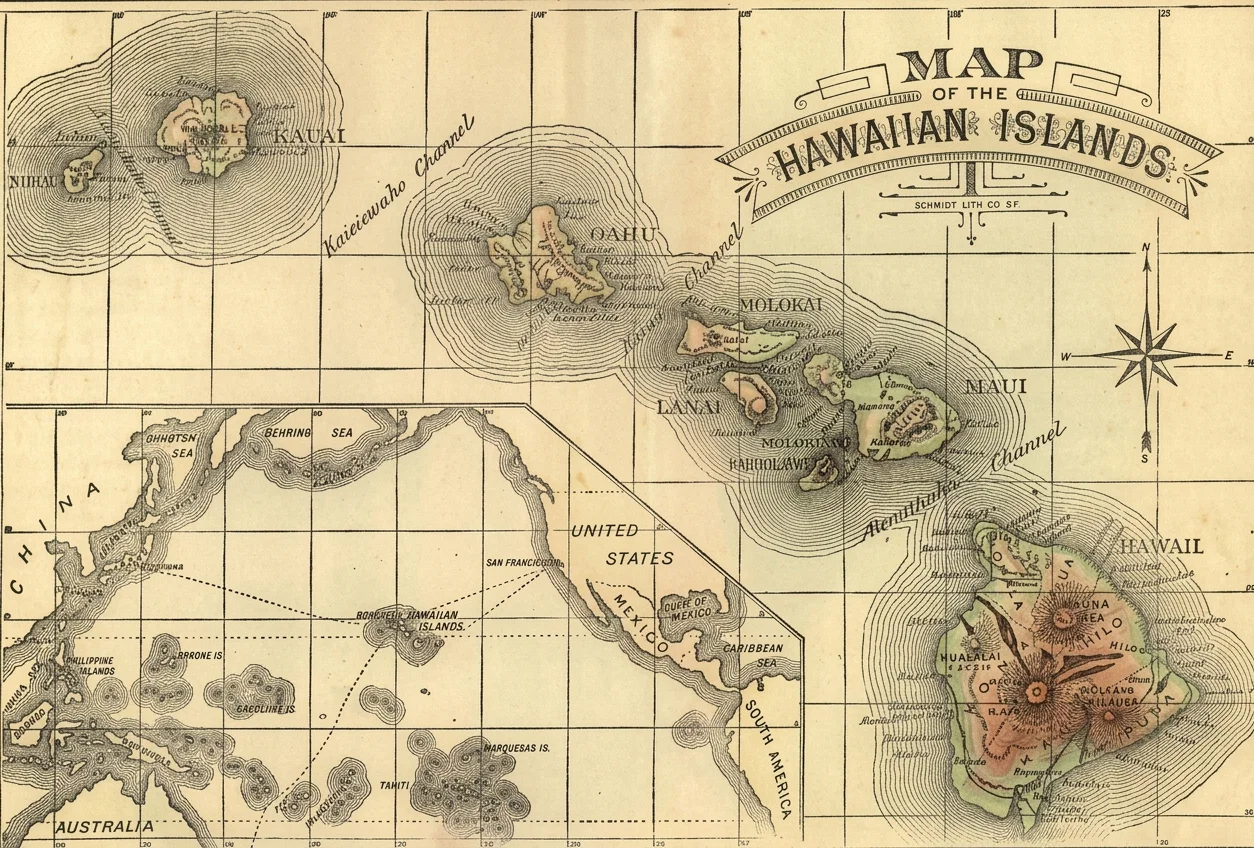
The Sandwich Islands

20%

International Tract and Missionary Society · Oakland, California · Jun 25, 1885

FromSigns of the Times, Vol. 11, No. 25.

Read the full edition

The Sandwich Islands.

“THE SANDWICH ISLANDS” is the popular name of a group of islands in the North Pacific Ocean. We were informed by a native preacher that they dislike the name “Sandwich,” and wish their ocean home to be called by its proper name—Hawaii. The following description is from Lippincott’s “Gazetteer of the World:”
“Hawaii (hä-wi'ee), a kingdom of Polynesia, consisting of a group called also Sandwich Islands, or the Hawaiian Archipelago, in the North Pacific Ocean, mostly between lat. 19° and 22° 20' N., lon. 155° and 160° W. There are 15 islands, only 8 of which are inhabited. The principal are Hawaii or Owyhee, Maui or Mowee, Oahu or Woahoo, Kauai, Molokai, Ranai, Nihau, and Kahoolawe. Area, 7,629 square miles; pop. in 1872, 56,897. The singularly rapid decrease of the native population, estimated by Cook at 400,000, commenced with the visit of that discoverer to these islands. Palmyra Island, lat. 6° N., about 800 miles S. of this group, belongs also to the Hawaiian kingdom; it has an area of 60 square miles, but is scantily peopled.
“In general, the surface has a great elevation, and in Hawaii are several active volcanoes, of which Mauna Loa is one of the highest active volcanoes in the world. The climate is salubrious, with sea-breezes and moderate rains; mean temperature, 75°; range of thermometer, 60° to 88° Fahr. The soil in the uplands is better adapted for grazing than for agriculture; fine wheat is, however, grown there, and the valleys produce coffee, sugar, cotton, tobacco, cacao, arrowroot, the mulberry, yams, sweet potatoes, and taro. Sugar is the staple article of export. Sandal-wood was formerly an important product, but the forests have been too rapidly thinned, and little is now produced. Live-stock of all the ordinary species thrives well. Honolulu, the capital, on the island of Oahu, is an important entrepôt for trade with all commercial nations. On Cook’s discovery of the group each island had a separate ruler; but afterwards the whole of the islands were consolidated under one government, and idolatry was abolished. Missionary stations were established in 1820, and the natives are now converted to Christianity, and have printing-presses and newspapers. The islands are frequented by whaling-vessels, and are in the great line of commerce between California, China, and Australasia.”