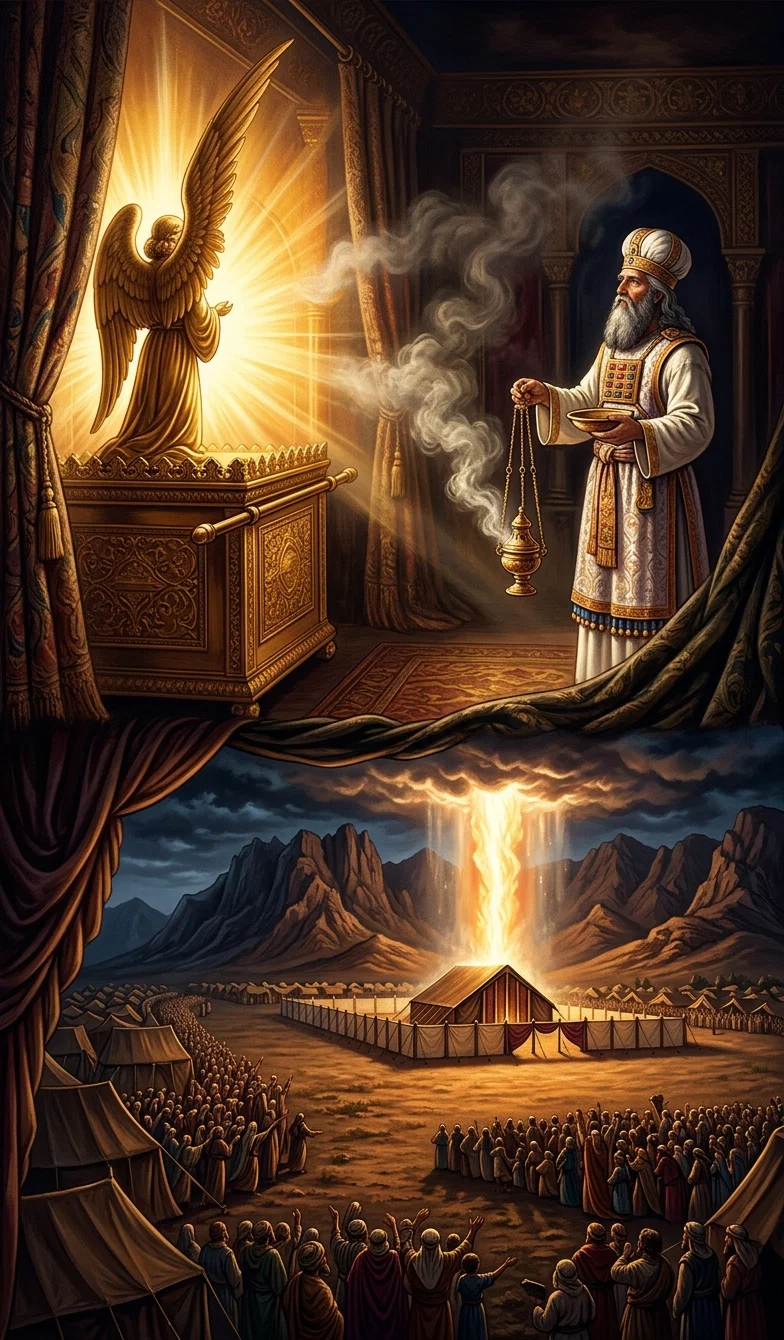
“Unto two thousand three hundred days; then shall the sanctuary be cleansed.” Dan. 8:14.
Whatever this cleansing may be, it must take place at the end of the 2,300 days, or years, of Dan. 8:14. Every conclusion drawn from this prophecy thus far has been based upon the word of God; so we shall still call forth the Bible, to bear testimony upon the cleansing of the sanctuary.
“And almost all things are by the law [ceremonial law] purged [cleansed] with blood; and without shedding of blood there is no remission. It was therefore necessary that the patterns of things in the heavens [the earthly sanctuary] should be purified [cleansed] with these [blood of goats and calves, Heb. 9:12, 19], but the heavenly things themselves [the heavenly sanctuary] with better sacrifices than these.” Heb. 9:22, 23. “Neither by the blood of goats and calves, but by his own blood, he entered in once into the holy place, having obtained eternal redemption for us.” Verse 12.
From these words of Inspiration we draw the following conclusions:—
1. Both the earthly and the heavenly sanctuaries undergo purification, or cleansing.
2. The earthly sanctuary was cleansed with the blood of animals.
3. The heavenly sanctuary is purified or cleansed by the blood of Jesus Christ.
4. The cleansing is of such a nature that it brings in remission of sin.
No one who believes the Bible can doubt that the heavenly things must be purified, or cleansed. This cleansing does not consist in a removal of physical uncleanness, but it is a cleansing from sin, the sins there recorded, for it takes the blood of Christ to do the cleansing.
The work of the high priest of the old dispensation was typical, or was a “shadow” of the work of our great High Priest, Jesus Christ, in the heavenly sanctuary. “For every high priest is ordained to offer gifts and sacrifices; wherefore it is of necessity that this Man have somewhat also to offer. For if he [Christ] were on earth, he should not be a priest, seeing that there are priests that offer gifts according to the law; who [the priests] serve unto the example and shadow of heavenly things.” Heb. 8:3–5. If the priests of the earthly sanctuary did a shadowy work, we can examine their work, and thus look from the shadow to the substance. It will be remembered that there are the same articles of furniture in the sanctuary in which Christ acts as high priest as there were in one in which earthly priests served.
If we can determine the steps taken by the high priest of the old dispensation in the cleansing of the earthly sanctuary, we can soon determine what the cleansing of the heavenly sanctuary is, which was to take place at the end of the 2,300 days of Dan. 8:14, or in A.D. 1844.
The typical, or shadowy, work of the old dispensation may be divided into two divisions, namely, daily work and yearly work. “Now when these things were thus ordained, the priests went always [daily] into the first tabernacle [holy place], accomplishing the service of God. But into the second [most holy place] went the high priest alone once every year, not without blood, which he offered for himself, and for the errors of the people.” Heb. 9:6, 7.
Work in the holy place was going on every day of the year. One day of the year, and only one, the high priest went into the “most holy place” to do a work there. One year’s work of the old dispensation is typical of the entire work of Christ from the time he ascended into heaven until his priesthood work shall close.
The day called the day of atonement (at-one-ment), when the high priest went into the most holy (Lev. 23:27), was the day typical of the great day of atonement, or cleansing of the heavenly sanctuary. In order that the nature of that work may be understood, we give a description of the work done by the priests. All through the year when a person had sinned or broken the law which was within the ark, he brought his sin-offering to the door of the sanctuary, and, placing his hands upon its head, he confessed his sin or transgression, and by this act transferred his sin from the guilty party to an innocent sin-offering. This was not literally accomplished, but only a type of what actually does take place in the work of Christ. This sin-offering was slain, and its blood taken into the holy place and sprinkled before the veil. All through the new dispensation the sinner, or transgressor of God’s holy law,6which is in the ark in the heavenly sanctuary, comes by faith to the great sin-offering (Isa. 52:10, 11), and there confesses his sins (1 John 1:9), the guilt is removed from the guilty party, and placed upon the innocent Lamb of God. “Behold the Lamb of God, which taketh [margin, ‘beareth’] away the sin of the world!” What sacrifice on the part of our loving Saviour! The sinner’s only hope is to accept of Christ as his sin-offering, and when the sin is confessed to him, it is, by the merits of his blood, carried to the holy place of the heavenly sanctuary. The sin has been recorded in the books of heaven.
But altho the sinner has accepted of Christ, and confessed his sin to him, and the sin has been forgiven, it is not yet blotted out. The blotting out of sins does not take place until the day of cleansing the sanctuary, when Christ enters into the most holy place of the heavenly sanctuary. While Christ is there present, the blotting out of sin is accomplished. “Repent ye therefore, and be converted, that your sins may be blotted out, when the times of refreshing shall come from the presence of the Lord.” Acts 3:19.
We have a description of the cleansing of the earthly sanctuary in the sixteenth chapter of Leviticus, from which we gather the following:—
1. The high priest made an atonement for himself and his house. Verse 6. Christ, our High Priest, does not make an atonement for himself, for he was sinless. Heb. 7:26, 27.
2. The high priest took of the congregation two “kids of the goats,” and presented them at the door of the tabernacle, and cast lots upon them, one lot for the Lord, and one lot for the scapegoat, or, as the margin renders it, “Azazel.”
3. One of these goats was a type of Christ, and the other was a type of Satan. Lev. 16:5–10.
4. The goat which was a type of Christ, which was for the people, was slain, and his blood was taken within the veil, or into the most holy place, and sprinkled upon the mercy-seat, which was upon the ark. Lev. 16:15.
5. The high priest then took the scapegoat, and confessed over it all the iniquity of the children of Israel, and the goat was sent away by the hand of a fit man into the wilderness. It was said of this, “And the goat shall bear upon him all their iniquities unto a land not inhabited.” Lev. 16:20–22.
We will sum up the work done in the earthly sanctuary on the day of atonement, in the five following statements: (1) The high priest entered the most holy place of the sanctuary; (2) an atonement was made for the children of Israel; (3) in the atonement work, a goat, typical of Christ, was slain, and its blood carried into the most holy place; (4) the sins of the children of Israel were removed (but only in type) from the sanctuary, and therefore it is called its cleansing; (5) a goat, typical of Satan, bore the sins of the children of Israel into a land not inhabited.
The cleansing of the heavenly sanctuary, or the great antitypical day of atonement, began at the close of the 2,300 days, or in 1844.
We have seen the shadow, now let us look at the substance.
1. Christ, our High Priest, entered, in 1844, into the holy of holies of the sanctuary above, the tabernacle not made by man, to do a work for his people.
2. The work done by him is a work of atonement. It is sometimes said that the atonement was made when Christ died on the cross; but only the provisions for the atonement were then made. If the atonement for individual sins was made by Christ while upon earth, it must have been done irrespective of character, and for all mankind, and the consequence would be universal salvation.
3. Christ enters into the second apartment of the heavenly temple, and there presents the merits of his blood, before the “Ancient of Days” (Dan. 7:9, 10), in behalf of his chosen people. The merits of Christ’s blood reaches the mercy-seat.
4. In the cleansing of the heavenly sanctuary, the sins which have been confessed to Christ, and forgiven, must now be “blotted out.” Acts 3:19.
5. At the close of the day of atonement, the antitypical scapegoat, Satan, is led forth to have the iniquities of God’s people placed upon him, and to be sent into the wilderness, or bottomless pit. Rev. 20:1, 2.
Some have thought that the scapegoat was a type of Christ, because it bore all the sins of the children of Israel. We are all sinners through Adam (Rom. 5:12), but Christ bore the sins of the world, thus freeing us from condemnation through Adam’s sin. Christ “tasted death for every man,” and so “as in Adam all die, even so, in Christ shall all be made alive.” As individuals, we must bear the penalty of our own sins, unless we accept of Christ; but if we do break partnership with the devil and accept of Christ, our sins will finally be placed upon the devil, the senior partner in the firm, who is the originator of sin, and has used his satanic power to lead us into it. This is the reason Satan is so persistent in leading men into sin and away from Christ. If we accept of Christ, Satan must bear the penalty; if we do not, we bear it ourselves.
If at-one-ment is to be made, sins blotted out from the books of heaven and placed upon Satan, it must be determined who are worthy.
The cleansing of the heavenly sanctuary is a work in which Christ appears before the “Ancient of Days” as our advocate, and “the books” of heaven “are opened,” and the judgment day begins. This will be considered next week.