What Is the Sanctuary?

6%

Pacific Press Publishing Company · Oakland, California · Jul 2, 1896

FromSigns of the Times, Vol. 22, No. 26.

Read the full edition

What Is the Sanctuary?

PROPHECY OF DANIEL 8. NO. 3.

BY W. L. ILES.
Number 2 of this series closed with a quotation from Dan. 8:14: “Unto two thousand and three hundred days; then shall the sanctuary be cleansed.” We now wish to inquire,

What Is the Sanctuary?

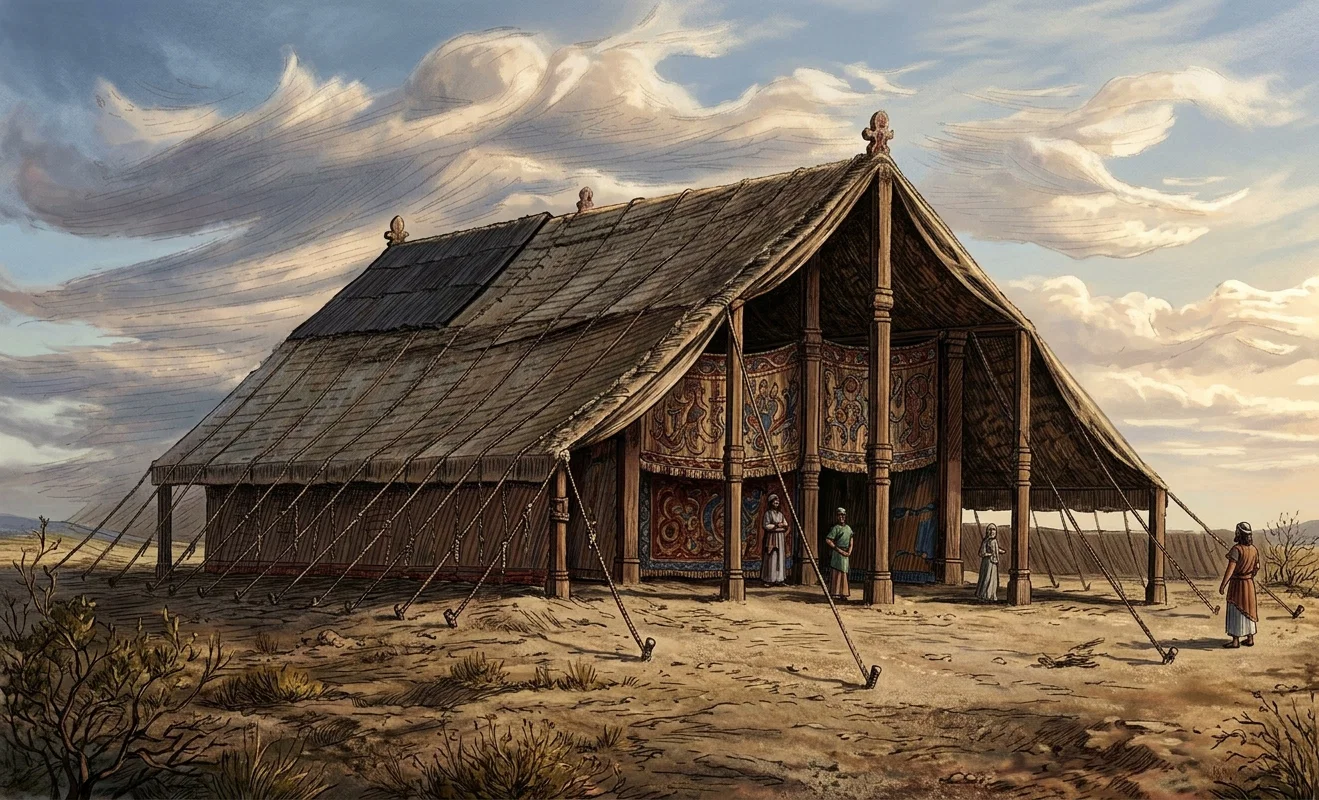
“Now of the things which we have spoken this is the sum: We have such an High Priest, who is set on the right hand of the throne of the Majesty in the heavens; a minister of the sanctuary, and of the true tabernacle, which the Lord pitched, and not man.” Heb. 8:1, 2. We have here two sanctuaries spoken of. One was pitched by the Lord, and one by man. The sanctuary built by man is the one built by the children of Israel after coming to Mount Sinai,—the earthly sanctuary. “And the Lord spake unto Moses, saying, Speak unto the children of Israel, that they bring me an offering; of every man that giveth it willingly with his heart ye shall take my offering.” “And let them make me a sanctuary; that I may dwell among them.” Ex. 25:1, 2, 8. The sanctuary built by Israel was patterned after the one in which Christ is High Priest, namely, the heavenly. See Ex. 25:9; Acts 7:24, and Heb. 8:1–5.
1844.
1844.
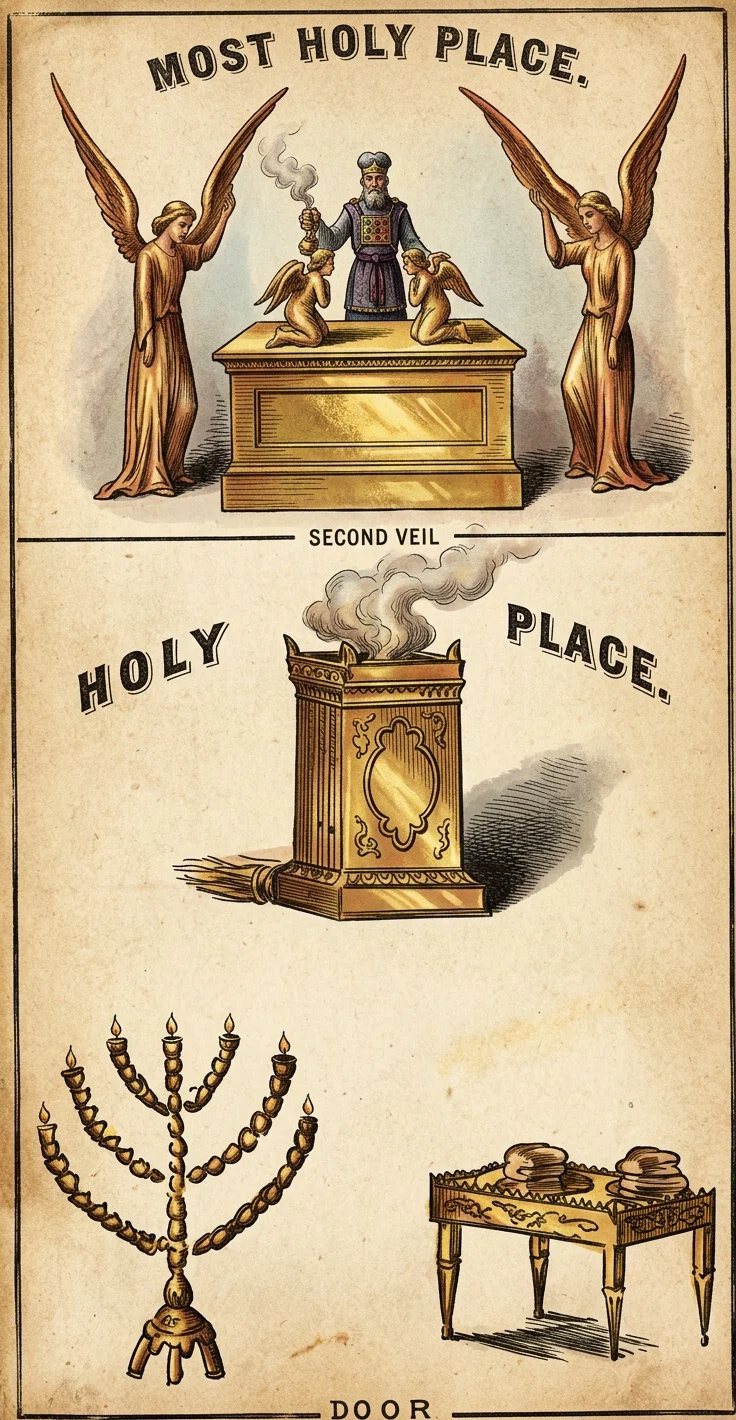
The earthly sanctuary had in it two apartments, called the “holy” and the “most holy” places. Ex. 26:33. These apartments were “figures of the true.” Heb. 9:23, 24. From these statements of God’s word we would conclude that there are in the heavenly temple, two apartments, and this will become moreevident as we consider the work of Christ as high priest. The “heavenly sanctuary,” or temple, has in it articles of furniture corresponding to the furniture in the “earthly,” built by Israel. “For there was a tabernacle made; the first [apartment], wherein was the candlestick, and the table, and the showbread; which is called the holy place [see margin]. And after the second veil, the tabernacle which is called the holiest of all [most holy place]; which had the golden censer, and the ark of the covenant overlaid round about with gold, wherein was the golden pot that had manna, and Aaron’s rod that budded, and the tables of the covenant; and over it the cherubim of glory shadowing the mercy-seat.” Heb. 9:2–5. A description of the golden candlestick is given in Ex. 25:31–40. The corresponding article of furniture in the heavenly sanctuary is shown in Rev. 4:1–5: “After this I looked, and, behold, a door was opened in heaven; . . . and, behold, a throne was set in heaven, and One sat on the throne. . . . And out of the throne proceeded lightnings and thunderings and voices; and there were seven lamps of fire burning before the throne, which are the seven Spirits of God.”
There was in the earthly sanctuary an altar of incense, and the priests burned incense thereon. Ex. 30:1–9. There is also in the heavenly sanctuary, in which Christ ministers, an altar of incense. “And when he had opened the seventh seal, there was silence in heaven about the space of half an hour. And I saw the seven angels which stood before God. . . . And another angel came and stood at the altar, having a golden censer; and there was given unto him much incense, that he should offer it with the prayers of all saints upon the golden altar which was before the throne. And the smoke of the incense, which came with the prayers of the saints, ascended up before God out of the angel’s hand.” Rev. 8:1–4. As the “ark of the testament” was the place where God “communed with the children of Israel,” and “gave commands to them,” so the “ark of his testament,” throne of God, is in the heavenly sanctuary, and is the place where he sits as ruler of the universe.
First let us notice the description of the ark, as found in Ex. 25:10–22. It was in form like a box, and was overlaid within and without with pure gold. It had two rings in each side of it, and “staves” passing through the rings, thus forming handles, by which it was borne by the children of Israel. Upon the ark, as a cover, was the “mercy-seat of pure gold.” Upon each end of the mercy-seat there was a “cherub” of pure gold, and the cherubim stretched “forth their wings on high, covering the mercy-seat,” and “their faces did look one to the other.” In the ark was the testament, or ten commandments. “And I turned myself and came down from the mount, and put the tables [of stone] in the ark which I had made; and there they be, as the Lord commanded me.” Deut. 10:5.
After giving the description of ark, mercy-seat, and cherubim, the Lord says: “And there I will meet with thee, and I will commune with thee from above the mercy-seat, from between the two cherubim which are upon the ark of the testimony, of all things which I will give thee in commandment unto the children of Israel.” Ex. 25:22.
Let us now turn our attention again to the heavenly sanctuary, and see if we can find anything that will correspond to the ark which was in the sanctuary built by man. “And the temple of God was opened in heaven, and there was seen in his temple the ark of his testament.” Rev. 11:19. How could the ark be seen in the temple of God, unless there was one there? and how could it be called the “ark of his testament,” unless the testament, the Ten Commandments, God’s will, was in the ark? This throws light upon the subject of the law of God. No wonder Christ should say, “It is easier for heaven and earth to pass, than one tittle of the law to fail.” Luke 16:17. The law of Ten Commandments is the foundation of God’s government; for they are in the ark, in the sanctuary of heaven, in which Christ ministers.
We have found the “ark” and the “testament” in the heavenly sanctuary; let us find the cherubim upon the mercy-seat, and God dwelling between them, ruling the universe. “The Lord reigneth; let the people tremble; he sitteth between the cherubim; let the earth be moved.” Ps. 99:1. “O Lord of hosts, God of Israel, that dwellest between the cherubim, thou art the God, even thou alone, of all the kingdoms of the earth; thou hast made heaven and earth.” Isa. 37:16.
We have produced abundant evidence to show that there is a similarity between the earthly sanctuary, built by man, and the heavenly, pitched by the Lord.
We now come to a very important question, namely, To which of these two sanctuaries did the “saint” refer, when he said, in Daniel’s vision, “Unto two thousand and three hundred days; then shall the sanctuary be cleansed”? Did he refer to the one built by Moses, or to the one in which Christ ministers as our high priest?
We have found that the 2,300 days, or years, ended in 1884, and the sanctuary built by Moses, or the temple built by Solomon, which took its place, was destroyed by the Romans in A.D. 70; so there was not left “one stone upon another.” Then the sanctuary to be cleansed at the end of the 2,300 days of Dan. 8:14, is the one in which Christ is acting as our high priest.
  • (To be continued.)