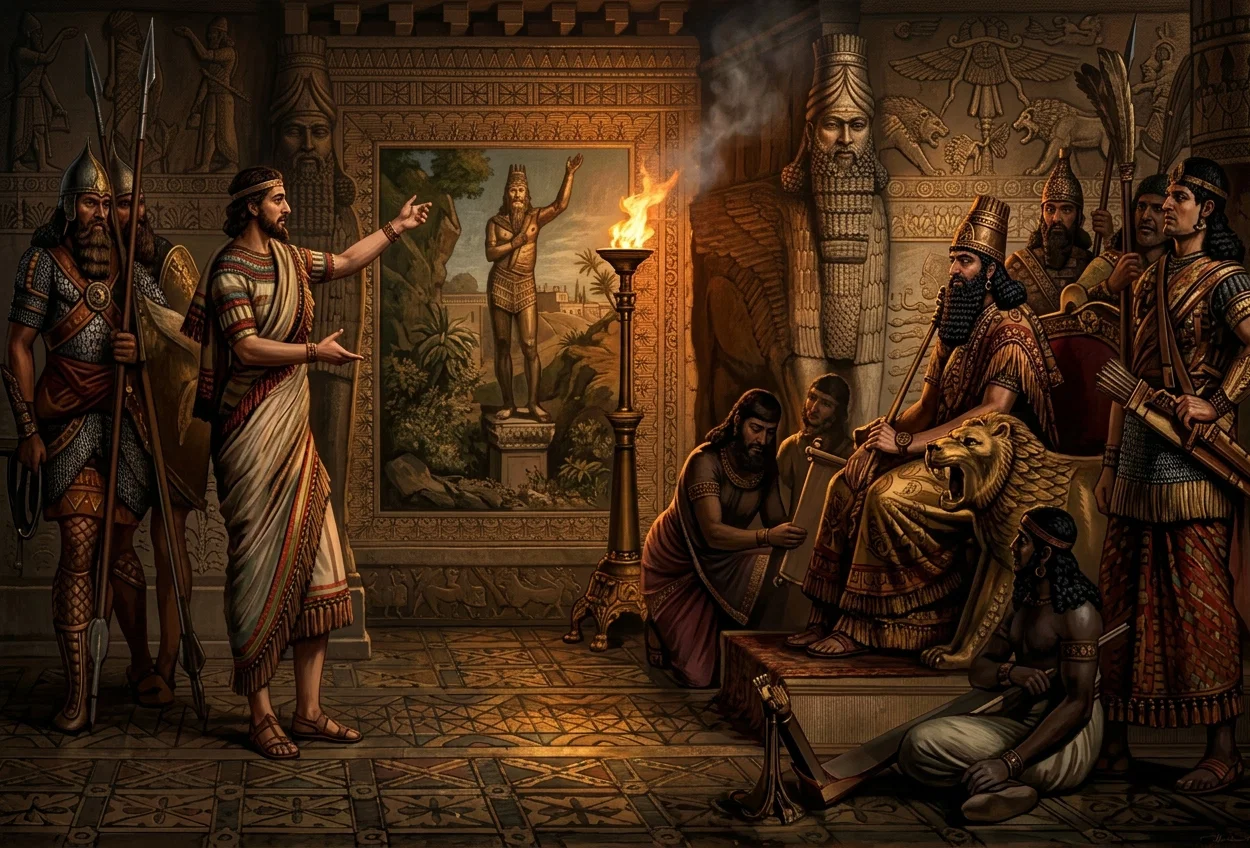
The first great symbolic prophecy we have in the word of God is found in the second chapter of Daniel. It spans all history, from the great Babylonian Empire to the everlasting kingdom of God, yet so wonderfully comprehensive is its divine expression that it is contained in the limited space of less than one hundred and fifty words, and its interpretation is composed of about three hundred words. Yet in its simple and clear outlines the history of the world is given in a most remarkable manner. Both prophecy and interpretation are found in verses 31–45.
To Whom Given, and Why.
The prophecy is a dream given to Nebuchadnezzar, the king of Babylon, the greatest ruler that ever sat upon the proud throne of “the glory of kingdoms, the beauty of the Chaldees’ excellency.” Both empire and city reached the height of their glory under Nebuchadnezzar’s skill, genius, and power. It was the golden kingdom of a golden age, of most ancient renown, the metropolis of the earth. This proud monarch seemed to wish to know who would follow him, and what the course of empire would be after him. To answer this desire and the desire of every other one who might live after him, as well as to light a torch for his people in the world of darkness, God gave to Nebuchadnezzar a dream. In the morning the dream could not be remembered, but its importance was deeply impressed upon the mind of the king. This also was of God, that the king’s mind might be led from the folly of idolatry to the true worship of Jehovah. The king demanded of his magi, soothsayers, wise men, etc., under penalty of death, not only the interpretation of the dream, but the dream itself, which he had for the time forgotten. Of course the magi could give neither the dream nor its interpretation, and on account of this the matter, in God’s providence, was brought before Daniel.
Acquainting his godly companions with the king’s requirement, together they sought the God of heaven for human wisdom, and he made them know the dream and its interpretation. To him they returned thanks, and gave to him all the glory. A record of all this will be found in verses 1–30. Thus it is that Daniel reveals God’s hand in the affairs of men:—
“Blessed be the name of God forever and ever; for wisdom and might are his; and he changeth the times and the seasons; he removeth kings, and setteth up kings; he giveth wisdom unto the wise, and knowledge to them that know understanding; he revealeth the deep and secret things; he knoweth what is in the darkness, and the light dwelleth with him.”
And thus also declares the prophet Amos (3: 7): “Surely the Lord God will do nothing but he revealeth his secret unto his servants the prophets.” The object of revealing these things is thus stated by Daniel:—
“But there is a God in heaven that revealeth secrets, and maketh known to the king Nebuchadnezzar what shall be in the latter days. As for thee, O king, thy thoughts came into thy mind upon thy bed, what should come to pass hereafter; and He that revealeth secrets maketh known to thee what shall come to pass. But as for me, this secret is not revealed to me for any wisdom that I have more than any living, but for their sakes that shall make known the interpretation to the king, and that thou mightest know the thoughts of thy heart.”
And for this purpose it was given to the king then, but it was written and the record has been preserved “for our learning, that we through patience and comfort of the Scriptures might have hope.” Rom. 15: 4. It is a part of the “more sure word of prophecy,” to which we “do well that we take heed, as unto a light that shineth in a dark place, until the day dawn,” and Jesus Christ appears. (See 2 Peter 1: 19.)
The Dream.
After thus giving the purpose of the dream, that all who desired might know what should come to pass, the prophet thus states the dream:—
“Thou, O king, sawest, and behold a great image. This great image, whose brightness was excellent, stood before thee; and the form thereof was terrible. This image’s head was of fine gold, his breast and his arms of silver, his belly and his thighs of brass, his legs of iron, his feet part of iron and part of clay.”
“Thou sawest till that a stone was cut out without hands, which smote the image upon his feet that were of iron and clay, and brake them to pieces. Then was the iron, the clay, the brass, the silver, and the gold, broken to pieces together, and became like the chaff of the summer threshing-floors; and the wind carried them away, that no place was found for them; and the stone that smote the image became a great mountain, and filled the whole earth. This is the dream.” Verses 31–36.
In these words are briefly stated the course of empire—the molding, shaping, dominant empires of earth—till Christ’s kingdom should supersede them all.
The Interpretation.
“This,” said the prophet, “is the dream; and we will tell the interpretation thereof before the king.” Verse 36.
The Head of Gold.—Thus is given the meaning of this part of the image:—
“Thou, O king, art a king of kings; for the God of heaven hath given thee a kingdom, power, and strength, and glory. And wheresoever the children of men dwell, the beasts of the field and the fowls of the heaven hath he given into thine hand,3and hath made thee ruler over them all. Thou art this head of gold.”
Nations and empires in prophecy are measured from the view-point of their influence upon the world, of their effect upon the Gospel, of their connection with the people of God. From this elevation Babylon stands at the head of the kingdoms. Its career began in the days of Nimrod. (See Gen. 10: 10, margin.) It reached the height of its power under Nebuchadnezzar, a little more than six hundred years before Christ. Here also it took captive the people of God, led them to Babylon, and burned Jerusalem and the temple. It was the glory of kingdoms, the height of worldly power, prosperity, and pride, the golden kingdom of a golden age of more than barbaric splendor. Nebuchadnezzar, as the head of the empire, the great beautifier of the capital city, stood as its representative; and when the prophet said to the king, “Thou art this head of gold,” he referred not simply to the king himself, but to his kingdom as well. This is evident from the fact that the words “king” and “kingdom” are used interchangeably in Daniel (chap. 7: 17, 18); but after the head of gold should arise not only a king, successor to Nebuchadnezzar, but a kingdom of a different character. The Babylonian Empire closed its career in B.C. 538. The same power is represented in Daniel 7 as a lion with eagle’s wings.
The Breast and Arms of Silver.—The interpretation thus continues: “And after thee shall arise another kingdom inferior to thee.” The successor in empire to Babylon was Medo-Persia, which overthrew, under Cyrus, the former power in B.C. 538. Babylon was weighed in the balances of God’s righteous purposes, and was found wanting. See Dan. 5: 18–31. When Babylon’s rulers took to themselves all glory, as did Nebuchadnezzar (chap. 4: 30, 31) and Belshazzar, as above noted, the day of her humiliation was at hand. Men must be taught to know that “the Most High ruleth in the kingdom of men, and giveth it to whomsoever he will.” chap. 4: 32. If they serve God’s purpose even in wrath and rebellion, well; but if otherwise, their days are numbered. Medo-Persia is represented in chap. 7: 5 by a bear, and in chap. 8: 3, 4, 20 by a ram with unequal horns, indicating the two nationalities composing the empire. It closed its career at the battle of Arbela, B.C. 331, by the victory of Alexander the Great. It was inferior to Babylon in the general character of its rulers and the length of time it existed, as well as in imperial splendor.
The Trunk and Thighs of Brass.—The metal depreciates in value, but increases in strength. Each metal was characteristic of the people it represented. The Greeks were known as “brazen coated.” Under Alexander the Great, Grecia succeeded Medo-Persia, in B.C. 331, as above stated. In chap. 7: 6 Grecia is represented by a four-headed leopard, and in chap. 8: 5–8, 21, by a rough goat, having at first one notable horn, representing Alexander, and afterward by four horns, symbolizing the four divisions in which Grecia was afterward divided. See also chap. 11: 3, 4, where the same prediction is given in literal language.
The Iron and Clay.—The iron is of less value but stronger than the preceding metals. It represents the unbending imperialism of Rome, the strong nation of the kingdoms. The same power is symbolized in chapter 7 as a great and terrible ten-horned beast, “strong exceedingly,” with “great iron teeth.” In chapter 8 its symbol is a little horn, waxing greater and greater, until it rules the world.
Rome came in connection with the people of God in B.C. 161 by a league with the Jews. Seven years previous to this it had conquered the Macedonian division of the Grecian Empire. In B.C. 65 it subjugated the Syrian division; in B.C. 30 Egypt fell before it, and Rome ruled the world. Rome’s cruelty and rigor of rule are proverbial. See also Deut. 28: 49–57. This is the interpretation of the prophet:—
“And the fourth kingdom shall be strong as iron; forasmuch as iron breaketh in pieces and subdueth all things; and as iron that breaketh all these, shall it break in pieces and bruise. And whereas thou sawest the feet and toes, part of potters’ clay, and part of iron, the kingdom shall be divided; but there shall be in it of the strength of the iron, forasmuch as thou sawest the iron mixed with miry clay. And as the toes of the feet were part of iron, and part of clay, so the kingdom shall be partly strong, and partly broken. And whereas thou sawest iron mixed with miry clay, they shall mingle themselves with the seed of men; but they shall not cleave one to another, even as iron is not mixed with clay.” Dan. 2: 40–43.
Rome was strong as iron in her imperial power and rule. She bruised and broke and subdued all nations, grinding them beneath her iron heel. But the iron of imperialism did not continue. The democracy of clay intermingled, and the one kingdom of iron became divided. This is symbolized by these two materials, which will not mix and become one compound. “Whereas thou sawest the feet and toes, part of potters’ clay, and part of iron, the kingdom shall be divided.” This division began soon after Constantine. Incursions of northern barbarians, religious feuds kindled by partisans of various isms of a paganized and state religion, the excessive burdens of profligate emperors, and ambition of generals and nobles, all conspired to bring in discord and weaken the empire, so that between the years A.D. 351 and 476 Rome was divided into ten kingdoms, as indicated by the ten horns of the fourth beast of Daniel 7. Yet, tho it was divided, it should still be strong, dominating, molding the world’s civilization, even in its divided state which was to continue to the end. It would also possess the weakness of the clay, making it impossible to unite. The legs—from the knees to the feet—were iron. The clay of democracy came into the feet, and continues to the end, evidently growing more and more apparent. Whether the toes denote division or not is conjectural, as is the case with the arms and legs; but if they do, it is evident that they refer to the very last manifestation of Rome—the ten uncrowned divisions which go into destruction. See Rev. 17: 12–14.
Verse 48 indicates that efforts would be put forth to unite these nations. They should mingle with the seed of men. Royal houses would intermarry, princes would exalt democratic leaders, but it would be of no avail. There could be no union. Charlemagne, Charles V., and Napoleon I., all tried to unite Europe into one grand empire and failed. One writer has truly said that one line of God’s prophecy is stronger than all the power and plotting of men. The last state of world empire is a divided state, each division controlled by the same spirit and aims. What next?
The Everlasting Kingdom.—The prophet continues:—
“And in the days of these kings shall the God of heaven set up a kingdom, which shall never be destroyed; and the kingdom shall not be left to other people, but it shall break in pieces and consume all these kingdoms, and it shall stand forever. Forasmuch4as thou sawest that the stone was cut out of the mountain without hands, and that it brake in pieces the iron, the brass, the clay, the silver, and the gold; the great God hath made known to the king what shall come to pass hereafter; and the dream is certain, and the interpretation thereof sure.” Verses 44, 45.
It is well to note some of the more prominent features of this interpretation regarding this everlasting kingdom:—
1. Whose Kingdom?—The kingdom of Christ, the Stone (Isa. 28: 16, 17; Eph. 2: 20; 1 Peter 2: 6–8), not shaped by man, nor carved out by earthly hands. It is Christ’s everlasting kingdom.
2. How Set Up?—The Stone kingdom is not established by the conversion of the other kingdoms, nor by their gradual overthrow, but it follows their utter destruction. “It shall break in pieces and consume all these kingdoms.” They become “like the chaff of the summer threshing-floors,” carried away by the wind, so “that no place is found for them.” Thus is the kingdom of Christ elsewhere said to be set up: “Thou shalt break them with a rod of iron; thou shalt dash them in pieces like a potter’s vessel.” Ps. 2: 9.
3. When Set Up.—Not at the first advent or ascension of Christ. It was not to be in the days of united, or iron Rome, but in the days of divided Rome—“in the days of these kings”—the last divisions of the Roman Empire—that the kingdom of Christ is to be set up. It could not be at the first advent of Christ; for Rome was not divided until more than three hundred years after that event. It is to be set up “at his appearing and his kingdom” (2 Tim. 4: 1); “when the Son of man shall come in his glory, and all the holy angels with him, then shall he sit upon the throne of his glory” (Matt. 25: 31); when, under the sounding of the seventh trumpet, “the kingdoms of this world” “become the kingdoms of our Lord, and his Christ” (Rev. 11: 15); then, and not till then, will Christ take to himself his great power, and reign (verse 17); and this he will do, not through politicians or politics, but “the zeal of the Lord of hosts will perform this” (Isa. 9: 7).
4. Its Nature.—This kingdom is not the church, or a kingdom now established. It is true that Christ now reigns a king-priest, after the order of Melchizedek, on the Father’s throne. See Heb. 8: 1; 5: 10; 7: 1, 2; Rev. 3: 21; Zech. 6: 12, 13. On this throne he “builds the temple of the Lord,” gathers out his body, the church, or takes out of all nations and generations those who will be subjects of his future kingdom; but this priest reign does not last forever; it is only preliminary to his eternal reign. When it is ended, when his work as priest is done, then will he yield up that throne, and receive from the Father the throne of eternal glory (see Dan. 7: 13, 14; Ps. 110: 1; 1 Cor. 15: 23–28), and will return again to reign (Luke 19: 12; Matt. 25: 31). The kingdom of Christ is, therefore, a literal kingdom on this earth, a successor to all earthly kingdoms; but it is not the less spiritual because literal.
5. Its Subjects are the people of God, not as in this life, but made immortal; for that “kingdom shall not be left to other people.” One will not die and give place to another. “Thy people shall be all righteous,” and righteousness is life. Then “the kingdom and dominion, and the greatness of the kingdom under the whole heaven, shall be given to the people of the saints of the Most High, whose kingdom is an everlasting kingdom, and all dominions shall serve and obey Him.” Dan. 7: 27. “And there shall be no more curse; but the throne of God and of the Lamb shall be in it; and his servants shall serve him.” Rev. 22: 3. It will be Christ, a righteous, immortal King, reigning over righteous, immortal subjects. And, reader, that Being who is “no respecter of persons,” who gave his Son to save each and all, declares, “He that overcometh shall inherit all these things; and I will be his God, and he shall be my son.” Rev. 21: 7, margin. “And the dream is certain, and the interpretation thereof sure.” And so may its precious promises be to all our readers.