Two Ways

14%

Pacific Press Publishing Company · Oakland, California · Mar 26, 1896

FromSigns of the Times, Vol. 22, No. 13.

Read the full edition

Two Ways

Two Ways.—There are a number of things which all men want, and which God wishes them to have. Among these are long life, liberty, health, wealth, honor, and pleasure. Then why do not all have these blessings?—Because in the very beginning of the history of the race man chose to seek them in the wrong way. God placed before him the true way, the way of obedience to his counsel; but Satan came in and suggested another way, the way of disobedience to God. The man was at liberty to make either of these ways his own way, so he chose the way that Satan suggested, and with that choice he lost all. Altho an experience of about six thousand years has adduced evidence upon evidence that the way of transgressors is hard, mankind still persists in seeking in that way the blessings which he desires, and which God would fain give him in very deed. Is it not time our race had learned that “as for God, his way is perfect,” and that “the way of the wicked is as darkness; they know not at what they stumble”?
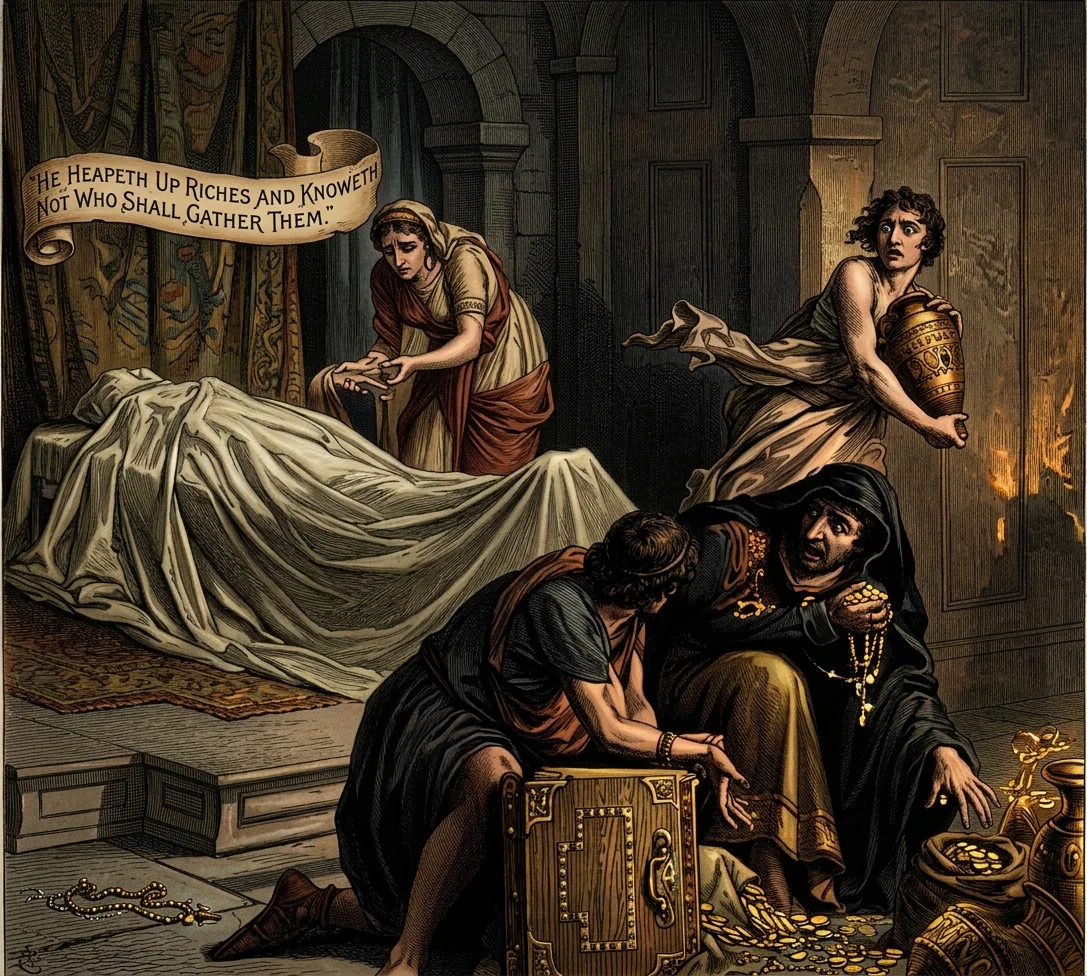
Wealth.—The natural man especially desires wealth, because he imagines that wealth can purchase for him everything else that he desires. But, having chosen a selfish, worldly way in which to secure all his benefits, he naturally takes that way to secure wealth. Now the natural man, having rejected the counsel and wisdom of God, is consequently short-sighted; he is impatient to accumulate wealth in a hurry, and therefore aims to grasp that which is in sight. As everything in this world is under the curse of sin, and doomed to be “burned up” (2 Peter 3:10), the wealth to be acquired by those who walk by sight only is necessarily of a very uncertain and transient nature. It is subject to the ravages of the flames, of the winds, and of the floods; it is subject to spoliation by moth and rust, by corrosion and decay, by wear and tear, as well as by the depredations of thieves and robbers of every caste and trade and profession.
A Testimony from Experience.—Solomon had an abundance of riches, above any one who had preceded him, and he used every possible means that a love of carnal revelry could suggest for the purpose of enjoying his immense wealth. But, with the lessons of experience before him, and an extraordinary endowment of wisdom from the Lord, he gives this testimony: “Labor not to be rich; cease from thine own wisdom. Wilt thou set thine eyes upon that which is not? for riches certainly make themselves wings; they fly away as an eagle toward heaven.” Prov. 23:4, 5. “For riches are not forever; and doth the crown endure to every generation?” Chap. 27:24. “Better is the poor that walketh in his uprightness, than he that is perverse in his ways, tho he be rich.” Chap. 28:6. “By humility and the fear of the Lord are riches, and honor, and life.” Chap. 22:4.
Apostolic Testimony.—The apostle Paul is very pointed on the subject of the riches of this world; he tells us that “they that will be rich fall into temptation and a snare, and into many foolish and hurtful lusts, which drown men in destruction and perdition. For the love of money is the root of all evil; which while some coveted after, they have erred from the faith, and pierced themselves through with many sorrows.” 1 Tim. 6:9, 10. Notice, it is not merely those who succeed in accumulating wealth, but those who seek to be rich, who want to be rich in this world. The poorest individual who wants to be rich is subject to these temptations and snares just as well as the one who succeeds and still wants more. To the rich men in the last days, when this world’s history is about to close, the apostle James gives prophetic warning: “Go to now, ye rich men, weep and howl for your miseries that shall come upon you. Your riches are corrupted, and your garments are moth-eaten. Your gold and silver is cankered; and the rust of them shall be a witness against you, and shall eat your flesh as it were fire. Ye have heaped treasure together for the last days. Behold, the hire of the laborers who have reaped down your fields, which is of you kept back by fraud, crieth; and the cries of them which have reaped are entered into the ears of the Lord of Sabaoth. Ye have lived in pleasure on the earth, and been wanton; ye have nourished your hearts, as in a day of slaughter. Ye have condemned and killed the just; and he doth not resist you.” James 5:1–6.
The Example of Christ.—The foregoing very brief testimonies of the Spirit of God show very clearly that man’s way of securing the blessings which God designed that he should have must prove an utter failure. Jesus Christ came into the world to show men, by precept and example, the truth in regard to these things. He came to show them the true way (by faith in him) for even sinners to secure the manifold blessings in store for all who will seek them in the light of his word and life. The initiative of his earthly career, his life as a visible teacher and example, is thus described by Paul: “For ye know the grace of our Lord Jesus Christ, that, tho he was rich, yet for your sakes he became poor, that ye through his poverty might be rich.” 2 Cor. 8:9. And this example was followed by those who united with the church at Jerusalem after the outpouring of the Holy Spirit on the day of Pentecost. “The multitude of them that believed were of one heart and of one soul; neither said any of them that aught of the things which he possessed was his own.” Acts 4:32. And of the forerunner of Christ, John the Baptist, whose honor it was to proclaim him to the world, it is said that he “had his raiment ofcamel’s hair, and a leathern girdle about his loins; and his meat was locusts and wild honey.” Matt. 3:4. When a certain scribe declared his intention to follow Christ, the Lord’s reply to him was, “The foxes have holes, and the birds of the air have nests; but the Son of man hath not where to lay his head.” Chap. 8:20. Christ left his exalted position in heaven, “made himself of no reputation, and took upon him the form of a servant, and was made in the likeness of men; and being found in fashion as a man, he humbled himself, and became obedient unto death, even the death of the cross. Wherefore God also hath highly exalted him, and given him a name which is above every name.” Phil. 2:7–9.