The Great Example.— The only model for man, the only perfect copy set before him by his Creator, is our Lord Jesus Christ. Other men had virtues and excellences in marked degree. Job was noted for his patience, Moses for his meekness, Abraham for his faith, Elijah for his loyalty; but in all these were manifest also imperfections. In Jesus Christ alone is perfection. He blended all virtues in himself. He only could say to man, “Which of you convinceth me of sin?” Of him only it could be said, “Who did no sin, neither was guile found in his mouth.” To him could the God of all perfection say, “Thou art my beloved Son, in whom I am well pleased.”
He Was Tempted.— And yet he was tempted. He was made “in the likeness of sinful flesh.” He was “made of a woman, made under the law.” “In all things” he “was made like unto his brethren.” He came in this way, he was made thus, that he might “redeem” man, might “be a merciful and faithful high priest,” might “save his people from their sins.” He was the Son of God yet the Son of man. The two natures became joined never to be severed. Deity sacrificed itself that humanity might be glorified. Christ became man that he might help man, that he might set a perfect example of God’s wonderful righteousness and love for the race.
Every Act of His Life— Every act of Christ’s life, therefore, becomes a worthy object of study. He did not live in vain. His whole recorded life is an object lesson, or series of object lessons, illustrating God’s love, power, and wisdom. Men speak vain words and do vain acts; but not so Christ. Not one act of his life nor word of his tongue was “void of power.” While his early life, to the age of thirty, was secluded, the humble life of a carpenter at Nazareth, it was still a preparation for his future work. He met the trials of life in a humble home, growing constantly in the fear of God, obedient, gentle, patient. The simple record is that he “was subject” unto his parents, and “increased in wisdom and stature, and in favor with God and man.” A brief record, but wonderfully comprehensive.
His First Public Appearance.— The first public appearance of Jesus was at his baptism. His forerunner, John, foretold by Isaiah and Malachi, had been for six months heralding his coming, the coming of the royal Majesty of Heaven. He did not know, in all probability, that Jesus was the Christ, but he knew that when the Messiah should appear, God would make it known unto him.
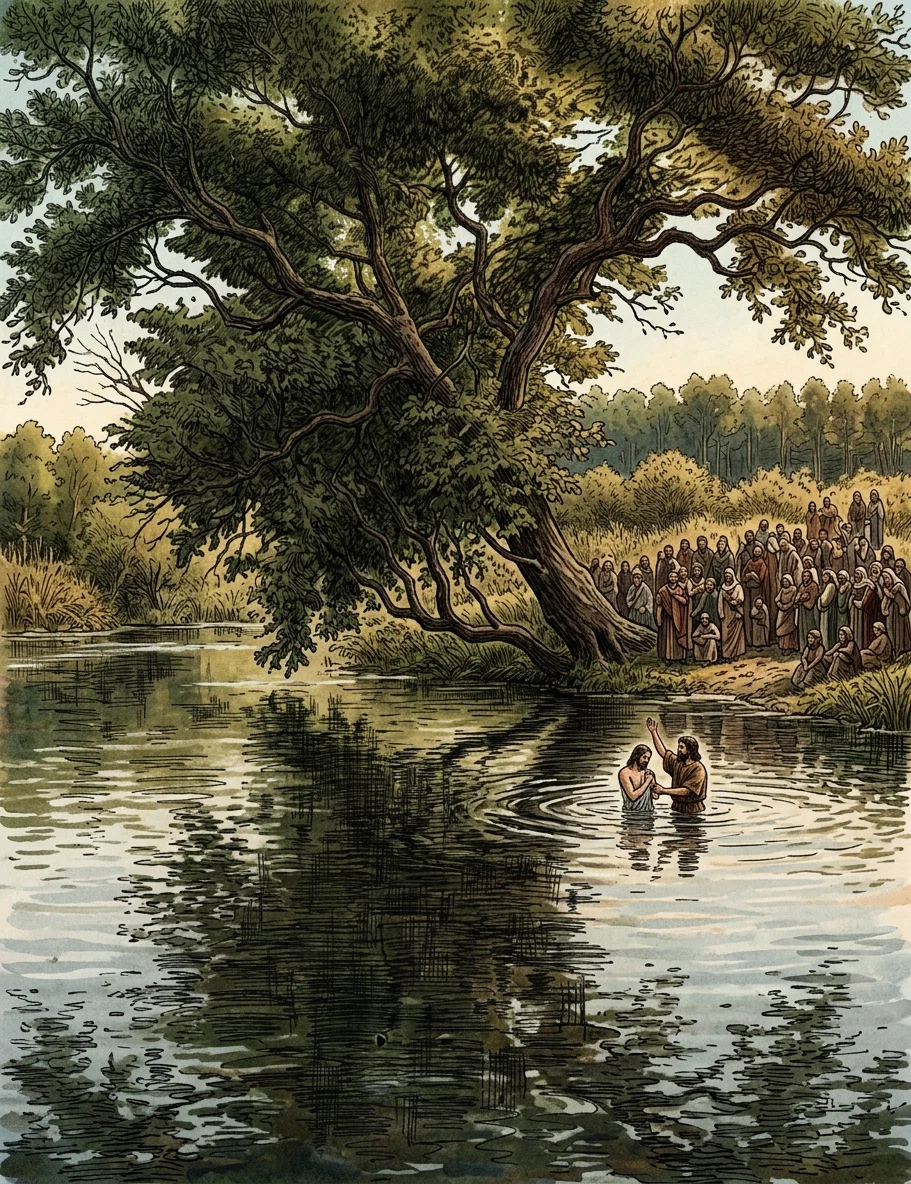
The Baptism of Jesus.— That time came at the river Jordan, where John was baptizing. From his home in Galilee, he came to the river Jordan to be baptized of John. John knew the sinless One, and wondered that he should come to him to be baptized. The record says that “John forbade him, saying, I have need to be baptized of thee, and comest thou to me?” John did not exalt himself, nor glory in his own estimation. He knew that his own burning and shining light was to be dimmed in the greater glory of Christ, and yet in that was his joy fulfilled. John 3:29, 30. Most Jews would have boasted, as does Josephus, of their lineage. John could have boasted of his honored ancestors in the priesthood, but he was content to be “the voice of one crying in the wilderness, Make straight the way of the Lord, as said the prophet Isaiah.” John 1:23. He knew that baptism indicated a change in life and purpose on the part of the receiver, and he knew, doubtless, that the life of Jesus of Nazareth required no change. Hence, his almost refusal.
To Fulfill All Righteousness.— But Jesus answered, “Suffer it now; for thus it becometh us to fulfill all righteousness.” (R. V.) While he had no sins of his own, he bore the sinner’s sins. He stood in the sinner’s stead, repenting for the sinner, doing for the sinner, living the life of God in sinful flesh that the sinner might live it after him in sinful flesh. Righteousness is the character of God as expressed in his law. Those who know righteousness are those who have God’s law in their hearts. Isa. 51:7. Says the psalmist, “My tongue shall speak of thy word; for all thy commandments are righteousness.” Ps. 119:172. So spake Christ through the psalmist, prophetically of his first advent: “Lo, I come; in the volume of the book it is written2of me, I delight to do thy will, O my God; yea, thy law is within my heart.” Ps. 40:7, 8. He came to do his Father’s will. It was his daily food so to do. John 4:34. “I have kept my Father’s commandments, and abide in his love” (John 15:10), he declared in the close of his earthly ministry. He did it all for man. It became him; it was fitting, proper, comely, for him to do it, that man might do it after him.