There is comparatively little or no controversy about the Sabbath in the old dispensation; nor is there scarce a shadow of effort to show that a change of the Sabbath from the seventh to the first day of the week took place during the time of Christ; hence the change must have taken place in the time of the apostles, or after their day. What took place in this line after the time of the apostles may be of importance to the Roman Catholic, who is guided by tradition as well as Scripture; but it has no weight with the Protestant who is guided by the word of God alone. Hence, as the Sabbath was not changed before the days of the apostles, and as a change after their time could not be accepted by Protestants, it becomes of special importance to study what took place with reference to this subject during the time of the apostles, since in this brief period of time we must find the settlement of the question.
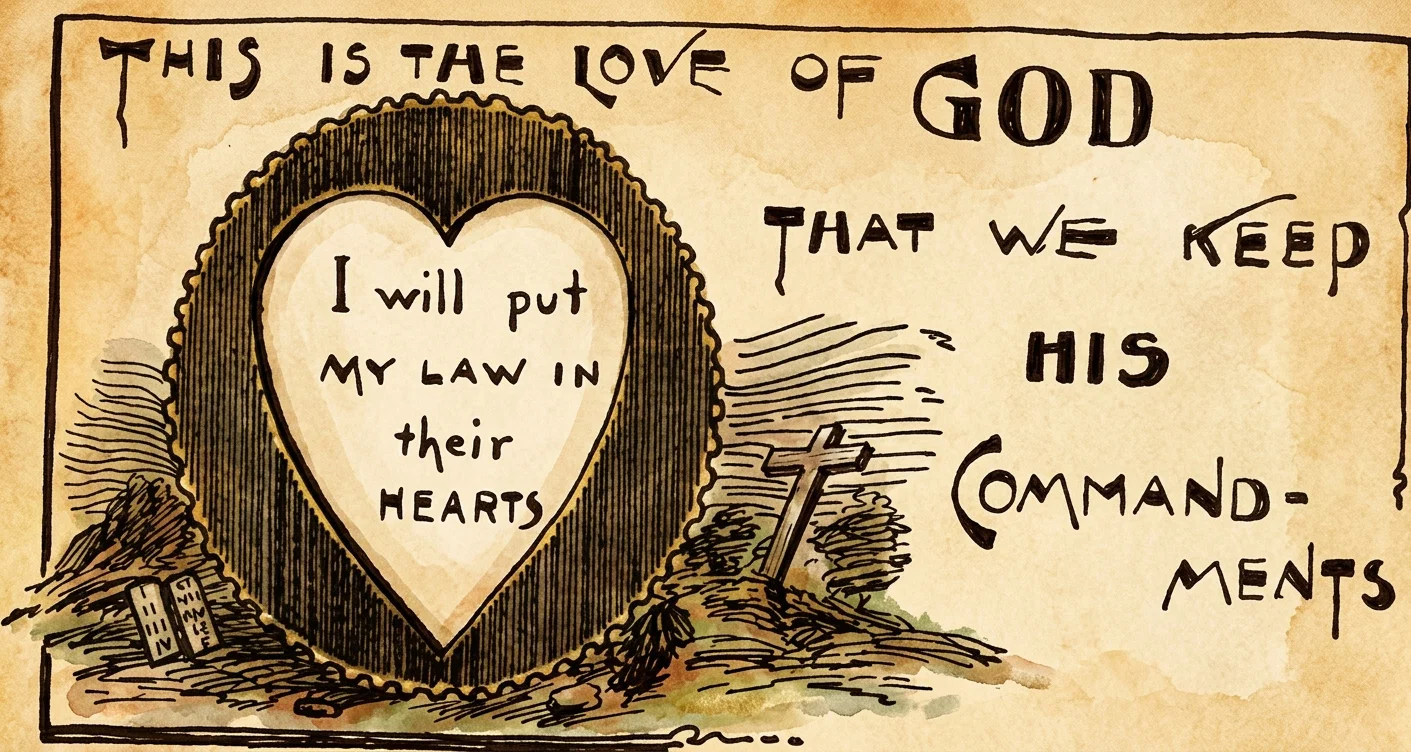
The New Testament makes plain the attitude of the apostles to the Sabbath. Christ sent his disciples into the world as he was sent. John 17:18. He came not to destroy the law of Ten Commandments, but to magnify and make it honorable. His disciples were to do the same. They were sent forth as ministers of the new covenant; under this covenant, the law was not to be abolished, but to be written in the heart. Heb. 8:10. Before, it was written in tables of stone; but now it was to be more intimately connected with the life of the believer. Out of the heart are the issues of life, and, the law being written there, all the outward life would be in harmony with that law.
As to what law is to be written in the heart and form the basis of the Christian life, there can be no question; for the promise of the new covenant was written over six hundred years before Christ, when the term, as all admit, included the Ten Commandments as proclaimed on Sinai. The term “the law” is frequently used in the New Testament without qualification, and hence can apply only to what the same term signified in the Old Testament.
The apostles not only recognized the law as binding for Christians but showed that the object of Christ’s coming in the flesh was for the express purpose of enabling man to keep this law perfectly. In his own strength man can not keep the Ten Commandments, and for this reason many argue that they were abolished. The apostle Paul also recognized the fact that man of himself could not keep this law; but instead of concluding that it was therefore abolished, immediately adds, “For what the law could not do, in that it was weak through the flesh, God sending his own Son in the likeness of sinful flesh, and for sin, condemned sin in the flesh; that the righteousness of the law might be fulfilled in us.” Rom. 8:3, 4. Hence the righteousness which comes alone by faith in the Son of God does not destroy the law, but establishes a law is to keep it. The apostles further teach that the keeping of the law includes every part of it, for says James, “For whosoever shall keep the whole law, and yet offend in one point, he is guilty of all.” James 2:10.
It being clear that the apostles taught the keeping of every part of the law, without the slightest reference to a change, we must conclude that they taught the keeping of the seventh-day Sabbath; for the law provides for no other day as the Sabbath. That in teaching the binding force of the law the apostles taught the observance of the seventh-day Sabbath, is further evident from their own custom and experience on this point.
The apostle Paul was chosen of God to preach the Gospel to the gentiles, and received his knowledge of the Gospel by revelation. When, in accordance with the instruction of the Holy Ghost, he was sent forth to this work from Antioch, he went regularly into the synagogues to teach on the Sabbath. This was not for the Jews only, for gentiles also were present. Acts 13. When the gentiles requested a meeting expressly for themselves, the apostle said nothing about a special day for them, but met with them the next Sabbath. (See Acts 13:42, 44.) This was Paul’s first journey among the gentiles; many were brought to the faith, and thus the foundation was laid for the great work among the gentiles that followed. Yet here the seventh-day Sabbath is regularly introduced as a meeting day, and no mention made of any other.
As the apostle Paul continued to extend his work, and build up new churches among the gentiles, we find him steadily following the custom of giving the Sabbath the same place as the Jews gave it. When the Gospel was first introduced into Europe, at Philippi, Paul met on the Sabbath with gentiles who feared God, and taught them the Gospel. When he came to Thessalonica, “as his manner was,” he met with the people on the Sabbath. During the year and a half spent developing the church at Corinth, Paul supported himself by working at his trade, and in order to do so more effectually, he entered into partnership with a Jew. Had he observed another day as the Sabbath than the Jews, he would have gone into partnership with a gentile. That he here observed the seventh day is further evident from the fact that while working “he reasoned in the synagogue every Sabbath, and persuaded the Jews and the Greeks.” Acts 18:4.
The greatest enemies of the Gospel were the Jews. Wherever the apostles preached, the Jews were on hand to oppose them. In many of the churches sharp disputes resulted. But in no case was there contention about the seventh-day Sabbath, or suggestion of another Sabbath. As may be seen from the epistles to the Romans, Galatians, Colossians, etc., which were written in part to correct the errors introduced by Jews that had accepted the Gospel, the main points at issue were circumcision, and righteousness by works instead of by faith alone.
When the apostles were publicly accused as destroyers of the faith of the fathers, they were never once accused of Sabbath breaking, or of teaching the gentiles another day. To the Jew nothing was more sacred and prominent than the Sabbath and circumcision. The apostles plainly taught that circumcision as practiced by the Jews was done away; and at every step the Jews controverted them on7this point. As the Jews held the Sabbath as sacred as circumcision, had the apostles set it aside as they did circumcision, the Jews would have made no little stir about it. But their entire silence on this point, and the fact that the apostles regularly met with the people on the Sabbath for preaching the Gospel, leaves not the least room for doubt that they kept and taught to the gentiles the observance of the seventh-day Sabbath. This conclusion is further strengthened by the fact that, when near the close of his life, Paul could say to the chief of the Jews at Rome, “I have committed nothing against the people, or customs of our fathers.” Acts 28:17.
While there is such uniform testimony in the acts and teaching of the apostles in favor of the seventh-day Sabbath, there is nothing to establish the first day of the week, or Sunday, as the Sabbath. The first day of the week is always mentioned as a secular day, and not once given a sacred title. Some think to find evidence in favor of the Sunday sabbath in the fact that the apostles once met on that day. They met on other days also; but that does not make them Sabbaths. But even in this instance the context shows that the meeting was held on the Sabbath, and continued over part of Sunday, and that the remainder of this Sunday was employed in a secular way.
It is also argued by a few that Paul’s order to make collections on the first day of the week indicates that this was the common day of meeting. But Paul’s order expressly stated that they were to do this at home, showing that they were not in meeting; and this collecting of goods to send to the poor at Jerusalem was a work more suitable to a secular day like Sunday than to the Sabbath.
That the seventh-day Sabbath was recognized as such in the Christian church as late as the close of the first century, when the last of the apostles passed away, is evident from Rev. 1:10, where the apostle says, “I was in the Spirit on the Lord’s day.” In all the Bible, none other than the seventh day is called the Lord’s day. The Sabbath means God’s rest day; it is the day on which the Creator rested. Jesus Christ is the Creator, and hence the Sabbath is his rest day; therefore he declares himself to be Lord of the Sabbath day. Mark 2:27.
Thus all through the work and teaching of the apostles, to the very close, we find the Sabbath of the Lord uniformly recognized, observed, and taught, and never once set aside, while the first day of the week is always mentioned as a secular day, and not once given a sacred title. Therefore, as those that follow the word of God and that alone, we can accept no other rest day than the Sabbath of the Lord.