God chose to speak his law from Sinai’s peak, amid the solitudes of earth. He did not trust prophet or priest to proclaim it; he uttered it with his own voice. Deut. 4:12, 13; Ex. 20:1–17. He did not proclaim it in stillness to the heart, but in trumpet tones, which shook the earth, amid such glory as the world had never seen nor will see till He who was on Sinai shall come again in his glory. Ex. 19:18; Heb. 12:26. This law was not written on parchment or papyrus, but graven by God’s finger on tables of enduring rock. Ex. 31:18; 32:16. A costly receptacle—the ark of the testimony—was made for it, the cover of which was symbolic of God’s throne. Ex. 25:21. Everything attending the giving of the law showed its exceeding and extraordinary importance, majesty, holiness, comprehensiveness, singularity, and obligation, high over all other laws. It was the reflect of God’s character, the expression of his righteousness (Ps. 119:172; Isa. 51:6, 7), and is a complete compendium of all morality. After referring to the Decalogue, and in greater part repeating it, forty years after God gave it, Moses thus declares:—
“These words the Lord spake unto all your assembly in the mount out of the midst of the fire, of the cloud, and of the thick darkness; with a great voice, and he added no more. And he wrote them in two tables of stone, and delivered them unto me.” Deut. 5:22.
As God “added no more,” it must have been complete and perfect, and it is so declared to be. “The law of the Lord is perfect, converting the soul.” Ps. 19:7. It contains “the whole duty of man.” Eccl. 12:13. To add or to take from a perfect and complete law would make it incomplete and therefore imperfect.
The Fourth Commandment.
In the very heart of this law, containing about one-third of its words, is the law of the Sabbath, the fourth commandment of the Decalogue:—
“Remember the Sabbath day, to keep it holy. Six days shalt thou labor, and do all thy work; but the seventh day is the Sabbath of the Lord thy God; in it thou shalt not do any work, thou, nor thy son, nor thy daughter, thy manservant, nor thy maidservant, nor thy cattle, nor thy stranger that is within thy gates; for in six days the Lord made heaven and earth, the sea, and all that in them is,4and rested the seventh day; wherefore the Lord blessed the Sabbath day, and hallowed it.” Ex. 20:8–11.
Notice the following facts:—
1. The very word “remember,” with which the commandment begins, shows that the Sabbath is not a new institution, and indicates how carefully God would have the Sabbath regarded.
2. Remember the Sabbath to keep it holy. God had already made it holy; man’s duty was to keep holy what God had made holy. God made it holy at its institution. Gen. 2:2, 3. He alone can make anything holy. This he does by placing in it his own presence. He only can keep the Sabbath holy who is himself holy, made so by the indwelling of the Lord Jesus Christ. A recognition of these facts will show the utter futility and assumption of all man-made or civil Sabbath laws.
3. It is the same day of the weekly cycle as we have in Gen. 2:2, 3, based on the same facts,—the Creator’s rest, blessing, and sanctification,—thus identifying it with the original Edenic Sabbath.
4. It is a memorial of God’s creative power, wisdom, and love.
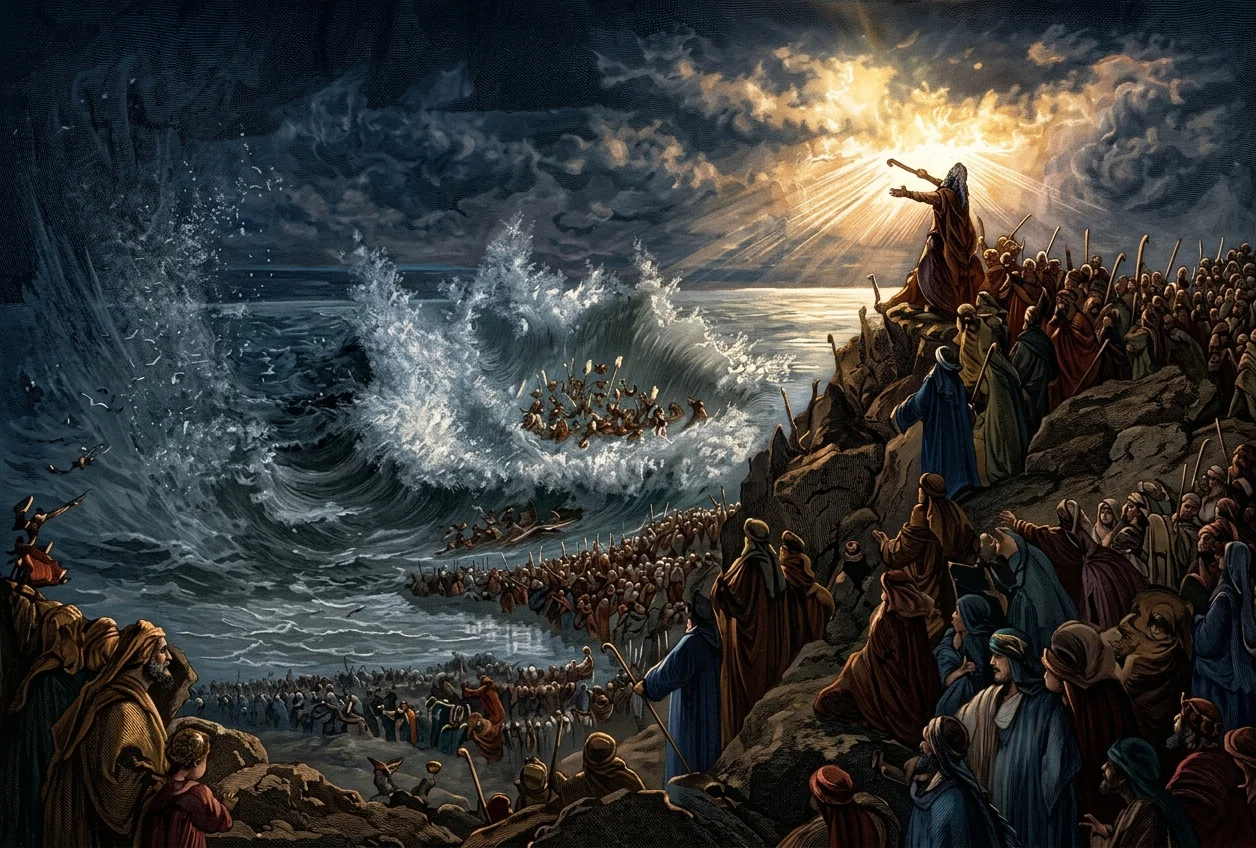
Copyrighted 1890. From “Patriarchs and Prophets,” by permission. REDEMPTION OF ISRAEL AT THE RED SEA.
5. It points out the seventh day of the cycle as the Sabbath—the seventh day of the seven—the day on which God rested, which he blessed, which he set apart for man.
6. There is not one hint of a seventh-part-of-time Sabbath, or that the Sabbath was for the Jews. The commandment is addressed to the individual, not to a race or nation.
Note again the position of the Sabbath commandment in the law. It is not at the beginning or at the close. Were it at the beginning, it might be declared to be no part of the law. Were it at the close, it might be declared to have been added. But divine wisdom placed it in the very heart of the moral law, so that three immutable precepts guarding man’s duty to God must be passed over, on the one hand, and six immutable precepts guarding man’s duty to his fellow, crushed out, on the other hand, before the impregnable fortress of the Sabbath can be reached in order to attack it. But not one of these massive walls which surround it can be successfully assaulted. The Sabbath law is a part of the Decalogue, and no sophistry can evade it.
Made Known the Sabbath.
Says Nehemiah, in alluding to this fact:—
“Thou camest down also upon Mount Sinai, and spakest with them from heaven, and gavest them right judgments, and true laws, good statutes and commandments; and madest known unto them thy holy Sabbath; and commandedst them precepts, statutes, and laws by the hand of Moses thy servant.” Neh. 9:13, 14.
“And madest known unto them thy holy Sabbath,” does not mean that it was at Sinai that the Israelites first had a knowledge of the Sabbath, for they knew it at the least calculation more than two weeks previous to this in the wilderness, as has been before shown from Exodus 16. “Madest known” means to have made acquainted with, to have revealed its true character. And how did God do this?—He did it in two ways:—
1. He spoke it in connection with nine other moral precepts, and placed it right in the very heart of that law about which the generations to come would have no question. They could not say that the Sabbath was ceremonial or typical; God made it known to them, and to all who should come after them, that the Sabbath was just as moral and unchangeable as any other precept of his law. It was founded on facts which concern the race, and was made a memorial of God’s creative power. Fasten this fact, dear reader, in your memory forever, that you may remember that the holy Sabbath of the Lord is as moral, permanent, and obligatory as the other nine precepts with which it is associated.
A Sign of Redemption.
2. The Lord made known his Sabbath in a still fuller sense in the beginning of the Levitical dispensation. He revealed it not only as a memorial of his creative power, but as a sign of his mighty power to redeem. All through the word of God the deliverance of Israel from Egypt is presented as an evidence of God’s redeeming love and power, typical of the greater redemption and deliverance of the whole Israel of God when Christ comes. How many times in history, in prophecy, and inspired song do we read of how God brought Israel out of Egypt “by a mighty hand, and by a stretched-out arm” (Deut. 4:34; Ex. 15:11–13; Deut. 9:26, 29); “in his love and in his pity he redeemed them” (Isa. 63:9); and he manifested his mighty power that his people might “know that the Lord [Jehovah] he is God; there is none else beside him” (Deut. 4:35). The very power of creation is manifest in the redemption, or salvation, of his people. “Israel shall be saved in the Lord with an everlasting salvation; . . . for thus saith the Lord that created the heavens; God himself that formed the earth and made it; he hath established it, he created it not in vain, he formed it to be inhabited; I am the Lord; and there is none else.” Isa. 45:17, 18. See Isa. 43:3, 14, 15; 44:24; 45:15, 22; 49:26, where creative, redeeming, and saving power are joined together in the names by which God reveals himself to his people. Who can not see from the scriptures cited above, and many others, that the same power which created is the same power which redeems, sanctifies, and saves? In fact, redemption, or regeneration, is creation.
“For we are His workmanship, created in Christ Jesus unto good works.” Eph. 2:10.
“Therefore if any man be in Christ, he is a new creature.” R. V., margin, “a new creation.” 2 Cor. 5:17.
Therefore as the Sabbath is the memorial of God’s creative power in the beginning, how fitting it is that it shall ever be a sign of the same power in the redemption and sanctification of man! And this is what in the wisdom of God the Sabbath is. Thus saith the Lord: “I gave them my Sabbaths, to be a sign between me and them; that they might know that I am the Lord that sanctify them” (Eze. 20:12), that his people might ever remember that God’s creative power is pledged to make them holy and to save them. It is for this reason that the Lord not only gave the Sabbath as a memorial of his creative power, as spoken by his own voice, but he made it known as a sign of Israel’s redemption from Egypt, typical of the redemption of all the Israel of God from the bondage of sin and Satan. Thus we read:—
“Keep the Sabbath day to sanctify it, as the Lord thy God hath commanded thee. . . . And remember that thou wast a servant in the land of Egypt, and that the Lord thy God brought thee out thence through a mighty hand and by a stretched-out arm; therefore the Lord thy God commanded thee to keep the Sabbath day.” Deut. 5:12–15.
God redeemed his people from Egypt that they might be a holy people, like himself. “Ye shall be holy; for I the Lord your God am holy.” Lev. 19:2. Therefore the Sabbath, which was given of God primarily and forever to be a memorial of the mighty power of God in the creation of the heaven and the earth, a memorial of that same power which redeemed Israel from Egypt, typical of the greater deliverance from sin, was at the same time to be to them a continual sign that the same mighty power was pledged to their continual sanctification, as shown by Eze. 20:12, before quoted. Thus God made known his Sabbath, as he did himself—a memorial and sign of both Creator and Redeemer.—The Lord’s Day the Test of the Ages, chapter 1, part 2.