THE PLACE OF THE SECOND ADVENT IN THE SCHEME OF REDEMPTION.
By W. N. Glenn
BY W. N. GLENN.
“The grace of God that bringeth salvation hath appeared to all men, teaching us that, denying ungodliness and worldly lusts, we should live soberly, righteously, and godly, in this present world; looking for that blessed hope, and the glorious appearing of the great God and our Saviour Jesus Christ.” Titus 2:11–13.
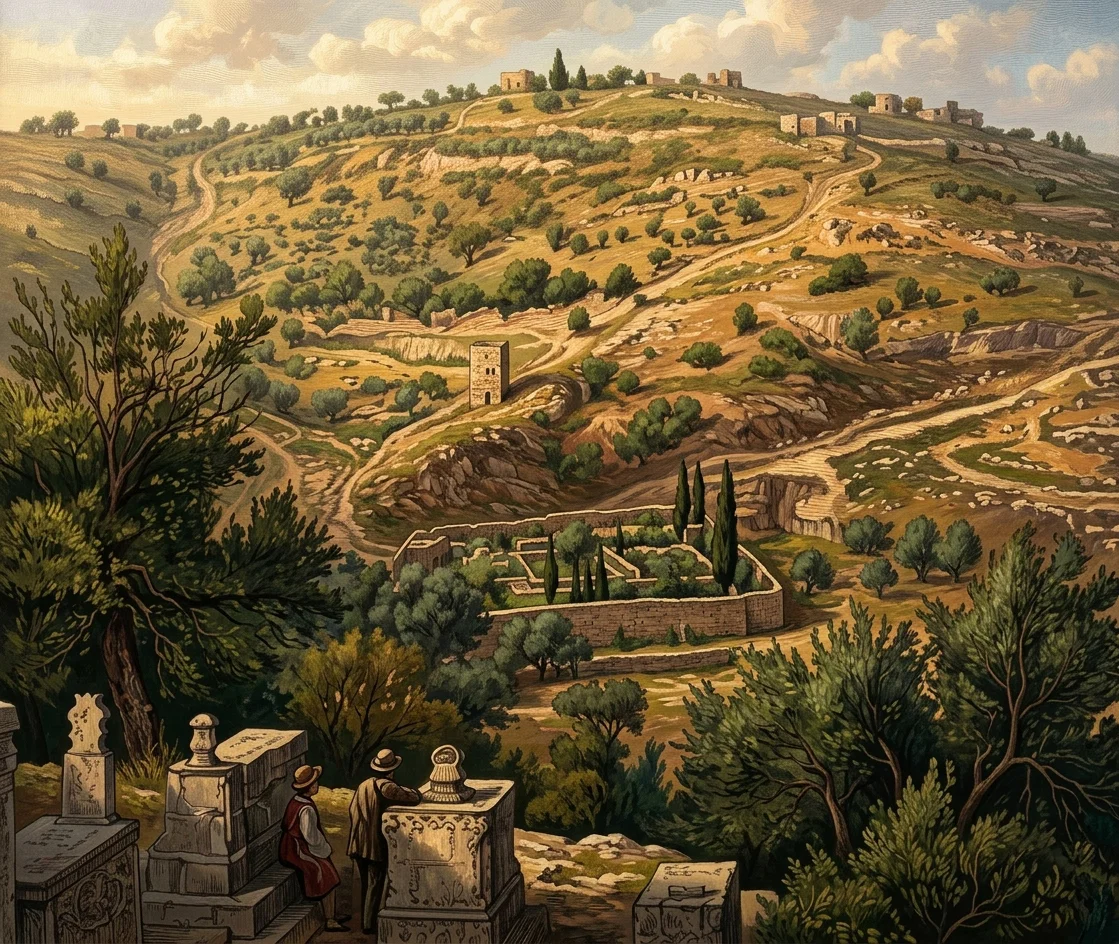
THE MOUNT OF OLIVES
Every feature, every event, every principle involved in the great plan of salvation, has its indispensable place, and, as God does not deal in superfluities, not one could have been left out. Therefore it would seem presumptuous in man to draw comparison as to which is the most important. Yet in all matters having an ultimate object in view, the consummation of that object is always the point to which the expectant mind is especially directed. So to the “little flock,” tempted, tried, persecuted in this life (as “all that will live godly in Christ Jesus” must be (2 Tim. 3:12), the day of final victory and entrance into immortal glory must ever be the point in which the “blessed hope” is centered. Of Christ himself it is said that “for the joy that was set before him” he “endured the cross, despising the shame, and is set down at the right hand of the throne of God.” Heb. 12:2.
As to chronological order, the place of Christ’s second coming in the scheme of redemption must be yet in the future, for he tells us concerning that event that “as the lightning cometh out of the east, and shineth even unto the west; so shall also the coming of the Son of man be.” Matt. 24:27. Also that “all the holy angels” will be with him (chap. 25:31), that the righteous dead will be raised, and the living saints will be changed, and all “caught up together to meet the Lord in the air” (1 Thess. 4:16, 17). As none of these things have yet taken place, it is evident that the Lord has not yet come, notwithstanding the many delusive claims to the contrary.
But that to which we would here call special attention is the exalted place the second advent occupies in the Scriptures, in the design of the Author and Finisher of our faith, and consequently in the mind of “all them that love his appearing.” What does the Lord’s coming mean to his disciples? We have this question profusely answered in the word of God. The foundation principle of redemption is stated in John 3:16: “For God so loved the world, that he gave his only begotten Son, that whosoever believeth in him should not perish, but have everlasting life.” The love of God is the starting point of the great plan, and everlasting life for all who will believe is the ultimate object. While the true believer in Christ now has eternal life, by means of the Holy Spirit dwelling in him (1 John 5:11, 12; 4:13), yet the “crown of righteousness,” immortality, is given at the second advent of the Lord (2 Tim. 4:8). Then will be fulfilled the prayer of Jesus,
“Father, I will that they also, whom thou hast given me, be with me where I am; that they may behold my glory, which thou hast given me.” John 17:24. Then also will be fulfilled the promise, “To him that overcometh will I grant to sit with me in my throne, even as I also overcame, and am set down with my Father in his throne.” Rev. 3:21.
Well may that glad day be called the “glorious appearing,” for not only will he “come in his glory, and all the holy angels with him,” but there is involved in it the precious promise to believers, that “when the chief Shepherd shall appear, ye shall receive a crown of glory that fadeth not away.” 1 Peter 5:4. To this we may very appropriately add the testimony of John: “Beloved, now are we the sons of God, and it doth not yet appear what we shall be; but we know that, when he shall appear, we shall be like him; for we shall see him as he is.” 1 John 3:2. With this glorious prospect in view, it is not difficult to appreciate the joy of those who, coming up to that long-looked-for time “through much tribulation” (Acts 14:22), will shout in triumphant acclaim, “Lo, this is our God; we have waited for him, and he will save us; this is the Lord; we have waited for him; we will be glad and rejoice in his salvation” (Isa. 25:9).
Even the natural man, whose only hope is in the things of this life, labors earnestly for reward; and ofttimes many will contend for a prize which only one can possibly obtain. 1 Cor. 9:24. And to this common characteristic the Lord makes appeal in beseeching men to seek eternal reward: “Lay up for yourselves treasures in heaven, where neither moth nor rust doth corrupt, and where thieves do not break through nor steal.” Matt. 6:20. “Labor not for the meat which perisheth, but for that meat which endureth unto everlasting
life, which the Son of man shall give unto you.” John 6:27. “This is the Father’s will which hath sent me, that of all which he hath given me I should lose nothing, but should raise it up again at the last day.” Verse 39.
Of Moses it is said that “he had respect unto the recompense of the reward,” therefore he chose “rather to suffer affliction with the people of God, than to enjoy the pleasures of sin for a season.” Heb. 11:24–26. All who have lived or will yet live by faith in Christ, have done so or will do so in hope of reward, of which the measure of the Spirit imparted here is but the “earnest,” or partial payment, for the sustenance of faith. “We through the Spirit wait for the hope of
righteousness by faith.” Gal. 5:5. The faithful in all past ages have waited for the consummation of their hope: “And these all, having obtained a good report through faith, received not the promise; God having provided some better thing for us, that they without us should not be made perfect.” Heb. 11:39, 40.
And when shall the reward be fully meted out?—At the coming of the Lord. “For the Son of man shall come in the glory of his Father with his angels; and then he shall reward every man according to his works.” Matt. 16:27. Then the second advent of the Lord will be a “glorious appearing,” the fruition of the “blessed hope,” because it will be the great pay day for those servants who “endure to the end,” “whom the Lord when he cometh shall find watching,” as well as for those who were “faithful unto death.” Heaven4will be emptied and silent, in order that “all the holy angels” may be spared to swell the bright cloud of glory upon which the Lord will descend “when he shall come to be glorified in his saints, and to be admired in all them that believe.” 2 Thess. 1:10.
Happy pay day! inestimable reward! wonderful exchange of condition! “when this corruptible shall have put on incorruption, and this mortal shall have put on immortality,” for “then shall be brought to pass the saying that is written, Death is swallowed up in victory.” 1 Cor. 15:54. Then will the glorious King give unto the redeemed host, “beauty for ashes, the oil of joy for mourning, the garment of praise for the spirit of heaviness; that they might be called Trees of righteousness, The planting of the Lord, that he might be glorified.” Isa. 61:3.
In that great and glorious day of rewards, all the trials and afflictions which the faithful will have endured during their probationary sojourn here will seem as nothing. Then will be fully appreciated the words of Paul, “I reckon that the sufferings of this present time are not worthy to be compared with the glory which shall be revealed in us.” Rom. 8:18. But even the Scriptures fail to convey to our finite minds the glory of which the redeemed will be made full partakers, and the unspeakable reward of faith in the crucified Nazarene. Our inquiry in this direction is cut short by the inspired word: “Eye hath not seen, nor ear heard, neither have entered into the heart of man, the things which God hath prepared for them that love him.” 1 Cor. 2:9. Suffice it for the present purpose to add this injunction of the apostle Peter: “Wherefore gird up the loins of your mind, be sober, and hope to the end for the grace that is to be brought unto you at the revelation of Jesus Christ.” 1 Peter 1:13.