ON TRIAL

1%

Pacific Press Publishing Company · Oakland, California · Sep 12, 1895

FromSigns of the Times, Vol. 21, No. 36.

Read the full edition
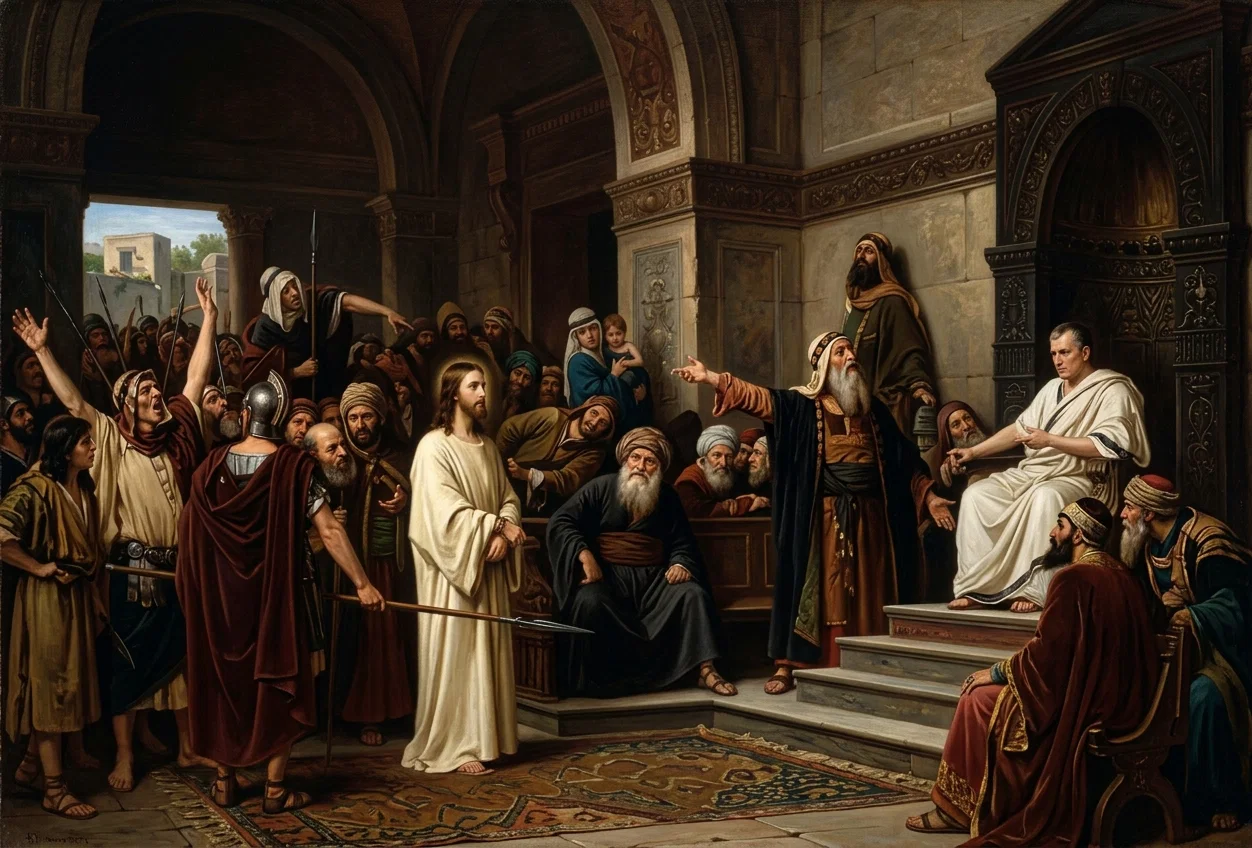
From Munkacsy's Celebrated Painting. CHRIST BEFORE PILATE. From “Bible Readings.”

ON TRIAL.

In last week’s issue we made brief mention of the appearance of the managing director of the International Tract Society—the missionary agency of the Seventh-day Adventists—before the Clerkenwell Police Court, London, Eng., to answer for Sunday work. In this we desire to show what is really involved in the case.
In the first place, let it be clearly understood that these facts and statements are not published for the sake of eliciting sympathy for the society. Much less is it for the purpose of arousing any feeling against the authorities, who are so courteous in the performance of what they conceive to be their duty. We would ask our readers to leave us and the amount of the fine entirely out of the question, and to think only of the truth involved, and of their own relation to it. It is not the International Tract Society, but the truth of God, that is called in question. But when truth is put upon trial, if it be indeed the truth, it becomes the judge, before whom even judges and kings, in common with the people, are called to render account.
When Jesus Christ, who is the Truth, was before Pontius Pilate, the question which that governor asked was, “What shall I do then with Jesus, which is called Christ?” Matt. 27:22. The people cried out, “Let him be crucified.” Thus the people, as well as Pilate, acted as judges in the case. Against Jesus, “both Herod, and Pontius Pilate, with the gentiles, and the people of Israel, were gathered together.” Acts 4:27.
Truth is the final judge of all. It is a trite saying that nothing is ever settled until it is settled right; but nothing is ever settled right until it is settled according to truth.
Every judgment, therefore, which is contrary to the truth will at last be reversed. In this life truth is on trial, not simply before civil courts, but before all the people. Each one for himself is called upon to decide what shall be done with the truth. But while the truth is thus on trial, it is in reality the people themselves who are on trial; for as they judge the truth, so will the truth judge them. The day of judgment will simply be the announcement of the judgment which people have in this life pronounced upon themselves in their dealing with the truth.
This case, therefore, instead of being the International Tract Society before the Clerkenwell Police Court, is the truth before the people, and it is before this court that the truth appears to plead. What then is the truth in the case?

Clearing the Way.

In order to get at the exact truth, it is necessary to clear away any mistaken ideas that may exist. Therefore let it be emphasized that there is no question of “sweating” employees, or in any way whatever infringing upon their rights. In making the charge before the court, the factory inspector said that the persons who were mentioned in the charges were “protected persons,” and that it was forbidden to employ them on Sunday. But the fact is that in this case, at least, it is Sunday alone that is sought to be protected.
The young women in question do work that is ordinarily done by women in a printing house. They work at their own desire. Like the women who followed Jesus to the cross and the tomb, they rest the Sabbath day according to the commandment (Luke 23:55, 56), and in harmony with the same commandment they labor on the first day of the week. If the society should refuse to employ them on that day, they would work upon it just the same, wherever they could find proper work to do. It is evident, therefore, that it is ridiculous to speak of such persons as being “protected” by the Factory Act.

What Is the True Rest Day?

The real question at issue is incidentally stated in the Chronicle’s comments upon the case. We quote from its issue of August 3:—
The managing director of the eccentric body known as the Seventh-day Adventists was again before Mr. Haden Corser yesterday for putting the peculiar principles of the body into practice by employing women on Sunday. It is the cherished faith of this particular sect that it is sinful to work on Saturday, and accordingly its employees make holiday on that day. This, of course, is purely a matter for the Adventists themselves; but when they seek to restore a balance which they conceive to be wrong by making Sunday an ordinary working day, Her Majesty’s inspectors would be neglecting their duty if they did not take note of the circumstance.
We have emphasized the words in the Chronicle’s statement which indicate the real question at issue. It is not primarily a question of whether or not certain individuals shall be employed at a given work, but it is whether or not Sunday shall be made “an ordinary working day.” This is the real case, and we will now proceed with the evidence, which is all upon one side.

The Commandment.

God came down from Mount Sinai “with ten thousands of saints,” and “Mount Sinai was altogether on a smoke because the Lord descended upon it in fire; and the smoke thereof ascended as the smoke of a furnace, and the whole mount quaked greatly.” “Out of the midst of the fire, of the cloud, and of the thick darkness,” God spoke the ten commandments “with a great voice.” Here is the fourth:—
“Remember the Sabbath day, to keep it holy. Six days shalt thou labor, and do all thy work; but the seventh day is the Sabbath of the Lord thy God; in it thou shalt not do any work, thou, nor thy son, nor thy daughter, thy manservant, nor thy maidservant, nor thy cattle, nor thy stranger that is within thy gates; for in six days the Lord made heaven and earth, the sea, and all that in them is, and rested the seventh day; wherefore the Lord blessed the Sabbath day, and hallowed it.” Ex. 20:8–11.

Sanctifying the Sabbath.

God blessed the Sabbath day, the seventh day, and sanctified it. He made it holy, and he calls upon men to keep it holy. Not that men can by any act of theirs diminish its holiness, but by profaning it they bring sin upon themselves.
To sanctify is to set apart for a sacred use, and to distinguish the thing sanctified from everything else. By his own word God has distinguished the seventh day of the week from every other day of the week, and has said that cessation from secular labor on that day is to be the mark by which its sanctity is recognized.
It is evident, therefore, that the seventh day cannot be kept holy according to God’s command unless it is regularly observed as a rest day, and every other day of the week is habitually used as a working day. Work on Sunday is not for the purpose of restoring a balance conceived to be wrong, but in simple recognition of the explicit command of the God of the universe.

To Whom Given.

“The Sabbath was made for man.” Mark 2:27. The Sabbath commandment, therefore, is for every man, no matter what his position in this world.
Moreover, it was made at the creation, and given to the head of the human family. It is the memorial of the creation of the heavens and the earth, and consequently a mark of the power of the Creator, calling to mind his power to create man anew in Christ Jesus. The fourth commandment therefore demands the obedience of every soul on earth.

A Matter of Fact.

It should be noted that the question of the Sabbath is not one of somebody’s belief or interpretation, but of fact. Those who have the matter of the day of rest before them, whether they be lawmakers, judges, or workingmen, have not to take account of men’s opinions or beliefs, but of hard and plain facts. They have not to deal with what people may think, but with what God says. The commandment is so explicit that there is no chance for misunderstanding it. That this is so may be shown by some made by people of widely differing profession. None of them, however, observe the seventh day, which makes their statements all the more forcible.

THE “STANDARD.”

To begin with the latest that has come to our notice, we quote from the Evening Standard of August 3. In speaking of the case in question it said:—
The magistrate who has to deal with cases of this sort is not to be envied. It is indisputable that the seventh day, not the first, was set apart for rest and worship. There is nothing more than tradition to explain how or when or why the early Christians exchanged the seventh day for the first. Mr. Haden Corser did wisely to refuse all argument, insisting upon the law—so did Pilate, his victim might explain.

MR. GLADSTONE.

In his article on “The Lord’s Day,” in the March number of the Church Monthly, Mr. Gladstone said:—
The seventh day of the week has been deposed from its title to obligatory religious observance, and its prerogative has been carried over to the first, under no direct precept of Scripture.

THOMAS SCOTT.

In commenting on Acts 20:7, concerning the rest day, Mr. Scott wrote:—
The change from the seventh day to the first appears to have been gradually and silently introduced, by example rather than by express precept.

CANON EYTON.

In a series of sermons on “The Ten Commandments,” preached at Holy Trinity, Chelsea, and published in 1894 by Kegan Paul, Trench, Trübner & Co., Mr. Eyton, after having stated that “the Sabbath was the solemn recalling of God to the mind of the people,” said:—
The observance of Sunday in the Christian church comes to us with quite a different sanction, based on different grounds, from that of the Jewish Sabbath. It rests upon no direct divine command; no word is said about it in the New Testament. . . . There is no word, no hint, in the New Testament about abstaining from work on Sunday. —Pages 61, 62.

Again:—

Into the rest of Sunday no divine law enters.—Page 65.

Still further:—

The observance of Ash Wednesday or Lent stands on exactly the same footing as the observance of Sunday.—Page 65.

REV. ISAAC WILLIAMS, B.D.

In a book entitled “Plain Sermons on the Catechism,” published by Longman’s, Green & Co., 1894, the above-named churchman makes the following statements:—
Where are we told in Scripture that we are to keep the first day at all? We are commanded to keep the seventh; but we are nowhere commanded to keep the first day.—Page 334.
The reason why we keep the first day of the week holy instead of the seventh is for the same reason that we observe many other things, not because the Bible, but because the church, has enjoined it.—Page 336.

CANON KNOX-LITTLE.

This eminent churchman, in his book on “Sacerdotalism,” in which he pleads for certain customs not warranted by the example of Christ, says:—
It is certain that our Lord when on earth did observe Saturday, and did not observe Sunday; but no one, as far as I know, has ever been called a “sacerdotalist”for departing from his undoubted habit of “resting on the seventh day.”—Page 75.
And again, referring to those who urged the example of Christ against the rites which the Canon upholds, he says:—
Their effort strictly to adhere to our Lord’s example to the letter, in spite of the usage of the church, implies that they know better what our Lord desired than his church. If they are consistent, as I have said, they must keep Saturday, not Sunday, as the day of rest.—Page 92.

THE LATE DR. R. W. DALE.

In 1871 a book entitled “The Ten Commandments,” written by this eminent Congregationalist, was published by Hodder & Stoughton, of whom it has been said that their imprint is a certificate of orthodoxy. In that we read:—
It is quite clear that, however rigidly or devotedly we may spend Sunday, we are not keeping Sabbath. The Sabbath was founded on a specific divine command. We can plead no such command for the obligation to observe Sunday.—Page 106.
There is no reason to believe that the apostles required their converts to keep the first day of the week as a day of rest.—Page 112.
As it was difficult to determine the exact time when Jewish Christians ceased to rest on the Sabbath, it is also difficult to determine the exact time when Christians generally began to rest on Sunday.—Page 110.

“Eccentricity.”

Time and space do not permit us to quote all the admissions of a similar nature which we have in hand. What is the evidence?—Simply this, that the Scriptures of God enjoin the observance of the seventh day of the week as a sacred day of rest, and the use of Sunday as an “ordinary working day.” And yet a body of Christians who follow the word of God and the example of Jesus Christ, are styled “eccentric” for so doing. Well, it is better to be eccentric than disobedient. Why these men from whom we have quoted do not observe the Sabbath of the Bible instead of a day for which there is no divine authority whatever, is for them to settle with the Lord. But the fact that they excuse themselves from obeying his plain command is no warrant for others to do likewise.

The Human against the Divine.

From what has preceded, it is very evident that the question to be settled is one of authority; it is a question of whether God or man is the source of authority.
It is as true as God’s word, that the seventh day of the week is the only rest day God ever appointed, and that by his command all other days of the week are ordinary working days.
It is also a fact that men, solely on their own motion, have presumed to substitute another day for the Sabbath of the Lord. It is not necessary just now to inquire into the origin of this change; it is enough to know that it was done by men, without any divine authority, and in the face of God’s commandment. The magistrate said that Parliament had made the Factory Act, which requires the recognition of Sunday as a rest day, and that he would not be doing his duty if he did not impose a penalty for the violation of it. The inspectors also say that they would not be doing their duty if they did not prosecute for the neglect to regard it. Now those men would be perfectly right if Parliament were supreme; but there is another side to the question.
God has sanctified the seventh day as the Sabbath, distinguishing it from all other days by making them ordinary working days. Now we say that we, including magistrate, officers, and people with ourselves, are not doing our duty if we do not obey the Lord. Parliament itself is composed only of men. They are not God but are subject to him. It is as much the duty of members of Parliament to obey the Lord as it is that of the humblest man. And no man is absolved from his duty to God because members of Parliament have been so unmindful of their duty to God as to enact laws in direct opposition to his law. With all respect to Parliament, we are bound to consider it as infinitely inferior to God, and its authority as nothing as compared with his. We say, therefore, “We ought to obey God rather than men.” And this duty rests upon magistrates and other officers of the law as much as it does upon us.

Defiance of the Law.

It has been said that the International Tract Society, in continuing Sunday work, notwithstanding the prohibition of the Factory Act, is defying the law. This comes from taking a very superficial and narrow view of the case. Let us look farther and deeper.
God is supreme. He is the Creator. His law existed before there was a man or a nation. It is the law for all mankind and the universe. Now, if it seems to the magistrate and to others that a simple failure to comply with a human law that prohibits labor on Sunday is defiance of that law, what will they say of the making of that law in open opposition to the law of God? Is not that where the defiance of the law comes in? The very existence of Sunday laws on the statute books is an open insult to God, and a defiance of his authority.
Let us make this matter clear by an illustration. Here is a family of a dozen children. Their father sets them all at work, giving express directions as to how the work shall be done. In order that no mistake may be made, he writes out the directions very plainly.
Very soon they become careless, and almost before they are aware of it they find themselves doing exactly contrary to the directions. Only one has been faithful. The rest say, “Well, our way is just as good, and we will continue it.” But this is not all. Not content with disobeying orders, they pass a formal vote that their way shall be followed by all, and then, because the one still clings to the original instructions, they accuse him of defying them. Any one can see that the fact is that he is not defying them, because they have no authority in the matter, but that they are guilty of the most daring act of defiance.
The application is easy, and the parallel perfect. God has made of one blood all nations of men. He is the Father of all, both high and low. All men, no matter what their birth or station, are alike subject to his authority. His law says that the seventh day is the Sabbath, and that the other days are laboring days. But certain men have taken it upon themselves (that is Mr. Gladstone’s language) to alter his ordinance, and to say to their fellows, “You must recognize another day as the Sabbath.” Some, however, continue quietly to obey the law of the Lord, and they are charged with defying the law.
But what are the facts?—Simply this, that the law which thrusts itself into the face of God’s law has no jurisdiction whatever. To disregard it is not to defy law, but is the only way in which one can be truly law-abiding.
When our fellow-mortals forget or despise the claims which God has upon them in common with us, and enact laws contrary to his, they are simply presuming to act where they have no jurisdiction. It is no one’s duty to obey such a law, and much less to enforce it upon others. On the contrary, it is the duty of all to obey God rather than man. When human law opposes the law of God, it is the solemn duty of every man to break that human law, since only by so doing can they obey God. Not England, but the God of the universe, expects every man to do his duty.

Guilty or Not Guilty.

It is stated in the papers that the managing director in behalf of the society pleaded guilty. Perhaps the court took it so, but it was not the case. He was not asked to state whether he was guilty or not. He was simply asked if he admitted the charge that certain persons had been allowed to work on Sunday, and as an honest man he could do no other than say that he did. But that was not an admission of guilt. He could not by any possibility have pleaded guilty, since no manner of guilt attached to Sunday work, or to the employment of willing laborers on Sunday.
But the great court day is fast approaching when the Judge of all shall sit, and all men, “small and great,” shall stand before him, to hear the decision of their cases. In that day no allowance will be made for the fact that a man held an office in civil government; for God “without respect of persons judgeth according to every man’s work.”
The law of God will be the sole standard in that judgment. As the result of what it says, every mouth is stopped, and all the world stand guilty before God. All have broken that holy law. Legislators, in passing laws, have simply been doing in a formal way what every man has done in his heart, for all have rebelled against God’s authority. “All have sinned and come short of the glory of God.” “Who then can be saved?”
With men it would be impossible, but God’s infinite love and wisdom make it possible for “whosoever will.” The case is thus: We are all guilty. If we, whether kings, judges, officers, or common people, continue until the judgment day to put human will and human authority above God’s will and authority, we shall have no power to plead,for our mouths will be stopped. “Guilty” will be stamped upon our faces.
But if now we plead guilty, acknowledging our wicked rebellion against God, and our usurpation of his authority, we shall be guiltless in that day, for “if we confess our sins, he is faithful and just to forgive us our sins, and to cleanse us from all unrighteousness,” “If any man sin, we have an advocate with the Father, Jesus Christ the righteous; and he is the propitiation for our sins; and not for ours only, but also for the sins of the whole world,” for the sins of rulers and judges as well as for those of the most obscure in this world.
The invitation, therefore, which we extend to all in this time, when men are being tried to see on whose side they will elect to stand at last, is to come to Jesus, the Lord of the Sabbath day, and find in him true Sabbath rest, the sanctification from sin. E. J. W.