Rev. Curtin G. Roop, in The Missionary Review of the World
(Concluded)
WITH four hundred soldiers, Legaspi conquered the Philippines for Spain, 1565-71. The conquest, however, was actually accomplished more by the Augustine missionaries accompanying the expedition than by the military force. The natives being without deep-rooted religion, and the Tagalogs especially being of a tractable disposition, they were easily won by the placid persuasion of the friars and the ceremonial trappings of Spanish Catholicism. A traveler of the time writes that no town resisted conversion, and there were not priests enough available to baptize and shepherd the converts. The Inquisition, having headquarters in Mexico, kept its commissioners in the Philippines, but never found it necessary to exercise severities against the natives. The first preachers were Augustine friars; following them came the Franciscans, Dominicans , Jesuits, and bare-footed Augustines. For thirty or forty years the religious affairs of the islands were under these orders, after which they were placed under the organized administration of secular clergy subject to an archbishop at Manila.
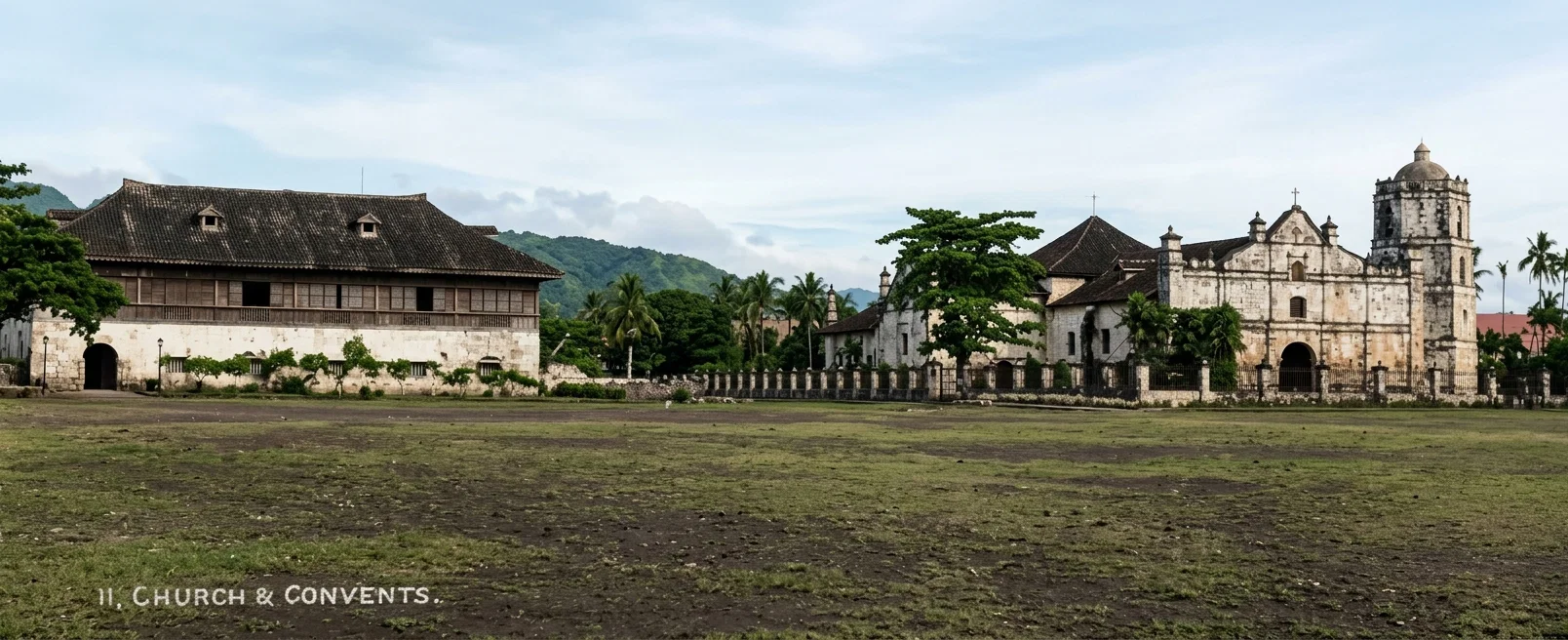
CHURCH AND CONVENTS, CEBU, P. I.
The converts from the first till now have grasped only the form of Christianity, not its substance. They attend church on Sunday; they celebrate religious festivals with music, illuminations, and fairs, exploiting relics and trinkets for sale. Outward observance they exaggerate. For instance, on some of the days of the week preceding Easter not a vehicle is allowed to appear on the streets of Manila. They confess; they take sacrament once a year at least; and some, especially women, spend one half of their time between Mariolatry and the confessional. But, withal, in matters relating to the spiritual and ethical substance of Christianity they are but children. For instance, a milkman was accused by one of his customers with having watered the milk brought; when hard pressed, he confessed, but pleaded that he had diluted it with holy water. Thus he felt guilty in the act, but strangely confused Christianity and ethics. So do the people in general fail to absorb the spiritual and ethical essence of Christianity.
Moreover, a deep substratum of primeval superstition underlies their conventional Christianity. Illustrations of this fact abound. For instance, the Tagalogs, the most advanced tribe, believe to this day in an evil divinity, Tic-Balass, dangerous to the man who does not respect him nor carry herbs about himself. Every time an Indian passes beneath one of the large fig trees, believed to be the favorite dwelling place of this divinity, he makes a sign with his hand, and says, “Tavit Po” (By your leave, my Lord). Among them Assuan is another evil divinity still thoroughly and almost if not quite universally believed in. This divinity is believed to affect women unfavorably who are in child labor. At such times the Indian may be seen sitting astride his house, cutting and thrusting in the air, sometimes for hours, to drive away the Assuan. Among the Bicols, Christianized neighbors of the Tagalogs, Calapuitan (Lord of the Bats) is a much-regarded divinity. Bats being found in caves, the natives fear to enter there, and when they do so, are careful to respect Calapuitan by conforming all their movements and talk to this Lord of the Bats. For instance, they would not mention the torch they happened to be carrying except by the formula, “Lord Calapuitan’s torch.” The farther back into the interior, the more rife, of course, is primeval superstition. But even in the metropolis, Manila, it is only the small minority of Spanish and half-castes that are even relatively free from superstition.
As one goes far back into the interior, Christianity shades off into paganism, and some sections will be found where the two are blended. Thus there is not only variety but confusion of religions in the islands. For instance, there is a15small sect of pagan natives living on the slopes of the volcano Yriga, some of whom are criminal exiles from the villages, but more of whom have voluntarily withdrawn thither on account of aversion to the labor and conventionality of village life. These people, though pagans, yet decorate their walls with crucifixes as talismans. They say that if these crucifixes were not of some value, the Spaniards would not use so many of them. Similar confusion of paganism and Christianity is found among the Cimaronese, a tribe found in the central islands, who live not in villages, but independently in the forests. These pagan people have adopted a few Catholic forms. When, for example, according to their primeval custom, they make an offering of rice at each corner of the field after sowing, they use some Catholic prayers, which suit them just as well as their old heathen forms. They also occasionally have children baptized. Otherwise they are pagan. Among the Tinguanes an oath is administered to the head men, in some instances by the Spanish, as follows: “May a pernicious wind touch me, may a flash of lightning kill me, may the alligator catch me asleep, if I fail to fulfill my duty.” Thus paganism is retained, though Christianity is partially accepted. Shall we not say that many of the people, then, are Christian-pagan, and that not in transition, but in a fixed state, about as old as Spanish Christian occupation?
Confining ourselves to the purest general type of Christianity existing in the islands, we find the grossest admixture of superstition. The saints have been largely substituted for the old pagan anitos, or idols. Miraculous images, patron saints, marvelous shrines, etc., abound. The oldest miraculous image is the Holy Child of Cebu, reputed to have been found on the shore of the island of Cebu in 1565. It is said to be an image of the holy child Jesus. It is a wooden image fifteen inches long, with ebon features, and is kept in a strong-room in the Church of the Holy Child, on the island of Cebu. When exposed to view before the populace, it has the honors of field marshal accorded to it. During the annual feast held in its honor, January 20th, pilgrims from the remotest islands and from across the sea come to purify their souls at the shrine of the Holy Child. By far the most popular shrine, however, is that of the Virgin of Antipolo, now in the parish church of Antipolo, not far from Manila. This image was brought from Mexico by a governor-general of the islands. In the month of May thousands repair to this shrine. It is estimated that there is brought hither by devotees about thirty thousand dollars during the season of the pilgrimage. The history of the public celebrations of this image furnishes an extreme picture of superstition, not to say idolatry. The shrine business in general is quite attractive to enterprising priests, for it is about the most lucrative undertaking in the islands.
Patron saints also figure largely. The patron saint of Manila is St. Francis of Tears. Thereby hangs a tale. An image of St. Francis Assisi, kept in the house of a native near Manila, was seen to weep copiously, so that many cloths were moistened with its tears, while with hands outstretched for three hours it asked God’s blessing on Manila. Then, on closing its hands, it grasped a cross and a skull so firmly that these appeared to be one. Vows were straightway made to the saint, who was styled protector of the capitol. Thus the crassest superstition in the name of Christianity itself universally prevails.
The Christian church in the islands is administered by the Archbishop of Manila. He is a metropolitan, having authority over the Ladrones, Carolines, and Pelew Islands, besides the Philippines. The parish priest, however, is the chief factor in administration, both civil and religious. For two hundred years he was about the only tie in sympathetic touch with the people, and begets in them perfect submission to his authority, not to say superstitious reverence for him personally. There are, it has been estimated, about twelve hundred Spanish priests in the islands. Most of them have been educated in Spain, where they generally originate from the lower classes. Besides these there are native priests, who hold subordinate positions, and are very jealous of their Spanish superiors. This jealousy and division of feeling among the priesthood prevents consolidation of power in the islands, a thing which Spain has always guarded against.
Abuses in the religious administration are by no means lacking. Here might be mentioned the sale of indulgences for revenue; the dishonest and corrupting exploitation of shrines; the widespread licentious immorality of the priests; the suppression of intelligence; exorbitant burial and marriage fees, because of which natives must often beg to secure the burial of their dead—indeed, the dead are sometimes disinterred and thrown upon a bone heap because of failure of relatives to continue burial annuities. And large numbers of the people live in marriage relations without having their union solemnized by any rite, because of inability to pay the exorbitant fee of the priest. Much might be said, much has been written, concerning these abuses, and their sum total is perhaps the cause, together with oppressive taxation, of the late Philippine rebellion against Spanish rule.
In the southern islands, as has already been said, we find the Mussulmans in possession. When the Spanish arrived, some of the strongest chiefs here were already Mussulmans. It is supposed that this religion was originally brought to the islands by Arab missionaries. Simultaneous with the arrival of the Spanish in the north there came from Borneo a chief who afterward combined the Mohammedan powers in the south. About thirty or forty years later the Spaniards from Luzon in the north attempted the conquest of these Moslems in the south. The effort failed, and thus was begun a mutual warfare, largely piratical on the Moslem side, which lasted for two hundred and fifty years, or until the middle of the present century. Only within twenty-five years has the sovereignty of Spain been acknowledged in these southern islands, and then with the explicit proviso that the Moslems are not to be disturbed in their religion. The attempts of the Jesuits (who flourish mostly toward the south) to convert them to Christianity have all been futile, for the panditas (Moslem priests) and the Romish priests are equally fanatical. The Spanish from the first have found in these Moros, as they call them, peoples who, unlike the pagan tribes of the north before encountered and easily converted, had a deep-rooted religion of their own, and would not yield to be converted to Christianity. Only on the northern edge of the island, in Mindanao, has the Christian religion any hold at all. Here are found some Jesuit missionaries.
On the other hand, to say that this part of the archipelago is Mohammedan would be true in only a qualified sense. It is Mohammedan in the same sense that the northern part is Christian—namely, the coast and the towns are Mohammedan, but in the interior a variety and confusion of religion prevails, similar to that in the interior of the northern islands.
The customs and administration of the modified Mohammedanism of the Philippines are less clearly outlined by writers than are the practices of the Christianized portions of the islands. We learn, however, that each Friday is dedicated to worship. On this day the faithful are called to the temple by the beating of a box or hollow piece of wood. They here engage in modified forms of Moslem worship. At the beginning of each year and at important events they hold a very solemn ceremonial. The city of Sulu, on the island of the same name, is their Mecca, so to speak. The original Mecca of the Mohammedan world, however, claims their pilgrimages. Strangers are not allowed in the sultan’s mosque at Sulu, and, indeed, strangers are rarely found in the city. The higher clergy are represented by the sheriff, who has temporal as well as religious power. Pandita is the name for priest. He seems to be chief in his district, somewhat as the Spanish parish priests are in the north. He performs all the functions of the priest, receives the vows of the juramentados, and expounds to them the mysteries and glories of that better world whither they will go without delay if they die spilling Christian blood. These juramentados are persons who vow to die killing Christians, and believe that, meeting death thus, they will go to especial bliss. Having thus devoted themselves, they fall upon the first Christian they meet, and slay until slain. Besides the priestly offices already named, the pundita usually exercises the functions of physician in the community. The head of authority, however, in church and state, is the sultan of the Sulu Archipelago, who exercises absolute power. He, in turn, is said to acknowledge the sultan of Turkey as his superior.
A complete treatment of the religion of the Philippines requires the separate mention of the Chinese. They have always been in the islands, but with very few exceptions have not embraced the religion of their adopted soil. They have generally come as traders, bringing along with them their idol images as well as their wares. Indeed, it is thought by some writers that some of the images found on the seashore, and now exploited at Christian shrines, were lost at sea by wrecked Chinamen, and washed ashore.
Summing up the present religious state of the Philippines, we find in the northern three fifths of the archipelago, on the coast and extending inland, superstitious Roman Catholic Christians; in the deep interior, primeval native pagans, and intermediate conglomerates of religion; in the southern two fifths of the archipelago we find Mohammedanism, modified by Malay superstition; and, in the interior of Mindanao especially, aboriginal Malay paganism holds full sway.