Foods in Brazil

13%

Seventh-day Adventist Publishing Association · Battle Creek, Mich. · Sep 30, 1902

FromReview and Herald, Vol. 79, No. 39.

Read the full edition

Foods in Brazil

W. H. THURSTON
In almost every country one finds a national dish. In Brazil it is rice, beans, and farina. Rice grows there with but little cultivation, as do beans also, but large quantities of rice are also imported. The rice is cooked with fat—generally lard—in such a way that every kernel is whole, dry, and mealy, and the beans are thoroughly boiled, and served with plenty of broth. These two are mixed together on the plate, and then sprinkled with farina, and eaten with gusto. Every variety and color of beans can be found in the cities, as well as different varieties of lentils and peas. Black beans, however, are the general favorites, though in some states a small brown bean supersedes them.
Farina is made from the mandioca root, which is extensively grown. This root grows to quite a length, being sometimes as long as one's arm and eight or ten inches in circumference. The flesh is pure white, and when boiled, much resembles the Irish potato. The natives grate the uncooked root, or grind it, and then subject it to heat, until it is thoroughly dried, and this is their much-loved farina, which one finds on the tables of rich and poor, high and low, alike. Of course it is only a raw starch, and plays much mischief with the digestive organs. However, it is not as dreadful as the dry salted beef which they use to a great extent, even eating it raw or steeped in vinegar. Its appearance is very repulsive to a foreigner as it hangs in great slices in all the grocery shops; but the native feels that he is an object of charity when he cannot get money to buy his carne secca, as he calls it. From its use and the constant drinking of their fiery paraty, a whisky made from sugar cane, one sees very many most pitiable cases of the terrible elephantiasis.
But one can live in Brazil and fare sumptuously. A great many vegetables are grown the year round, almost all, in fact, except cabbage, which is abundant in the cool season. Sweet potatoes are plentiful, large, and well flavored.
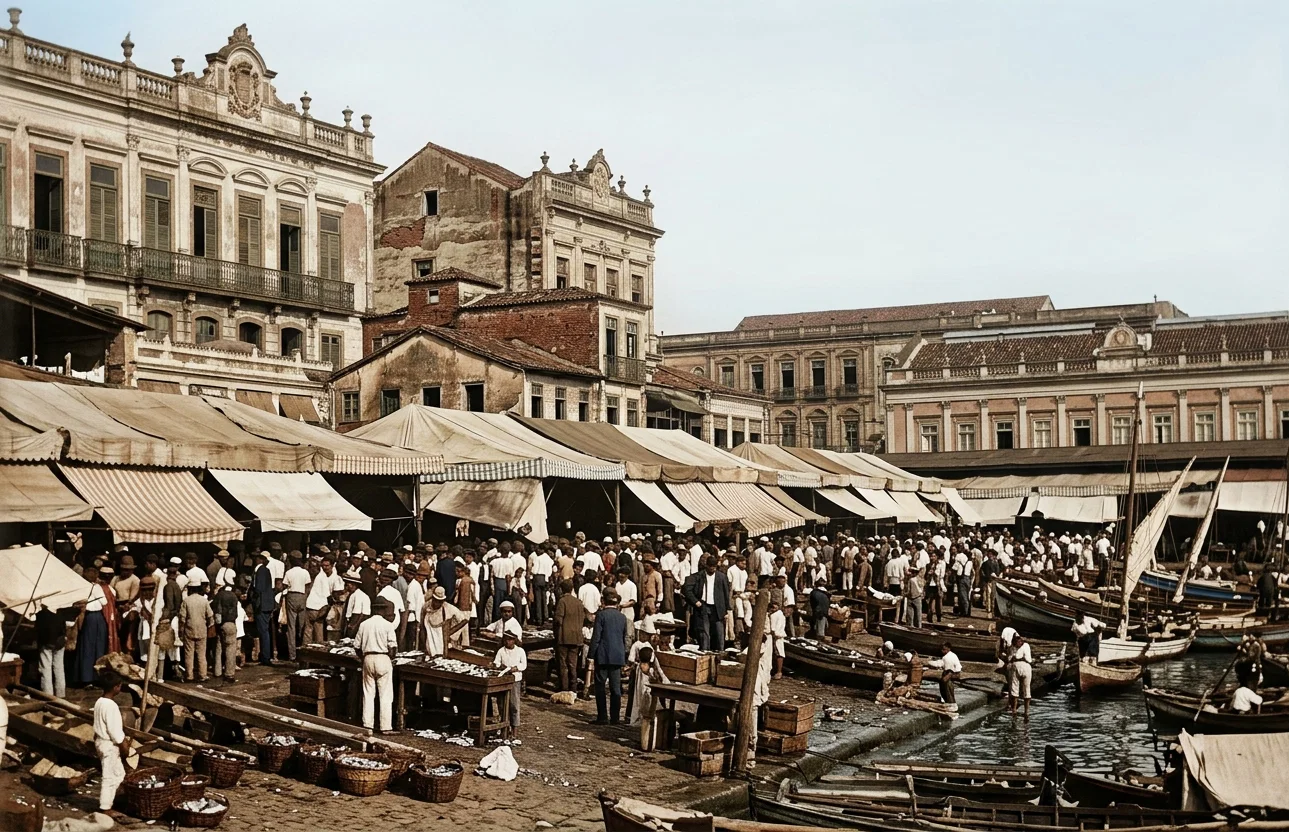
FISH MARKET IN RIO DE JANEIRO
A great deal of macaroni is made, and it is cheap. Fruits are abundant, and their name is legion. Some varieties are on the market the year round, while others come in their season; but as soon as one or more varieties are gone, others take their places. Pineapples are large, juicy, and abundant from November until February. Watermelons and muskmelons grow to enormous size, and in some parts are very plentiful. Bananas can be had all the year very cheap, while the greater part of the year one can buy one hundred large, juicy oranges for even less than the price of a dozen in this country. Nuts are no dearer than in the United States, while walnuts and peanuts are even cheaper.
Corn is the only grain which can be successfully raised in that warm country; but one does not need such a variety of grains when fruits, legumes, and nuts, as well as vegetables, are so plentiful all the year. But, as is the case in all this sad old world, the natives have perverted the bounties of nature, until the diet is far from being pure, simple, and natural, as our loving Father designed it should be; and the great need of that great land is for patient, loving hearts to go among the people, live with them, and show them how to live. As they leave the stimulants and coarse, fiery diets, their warm, impulsive natures can be directed to the Desire of nations, for whom they also long, though they know it not. O that we for whom the truth has done so much would so love and so appreciate it that our whole desire and effort would go out to the suffering ones of earth who know it not!