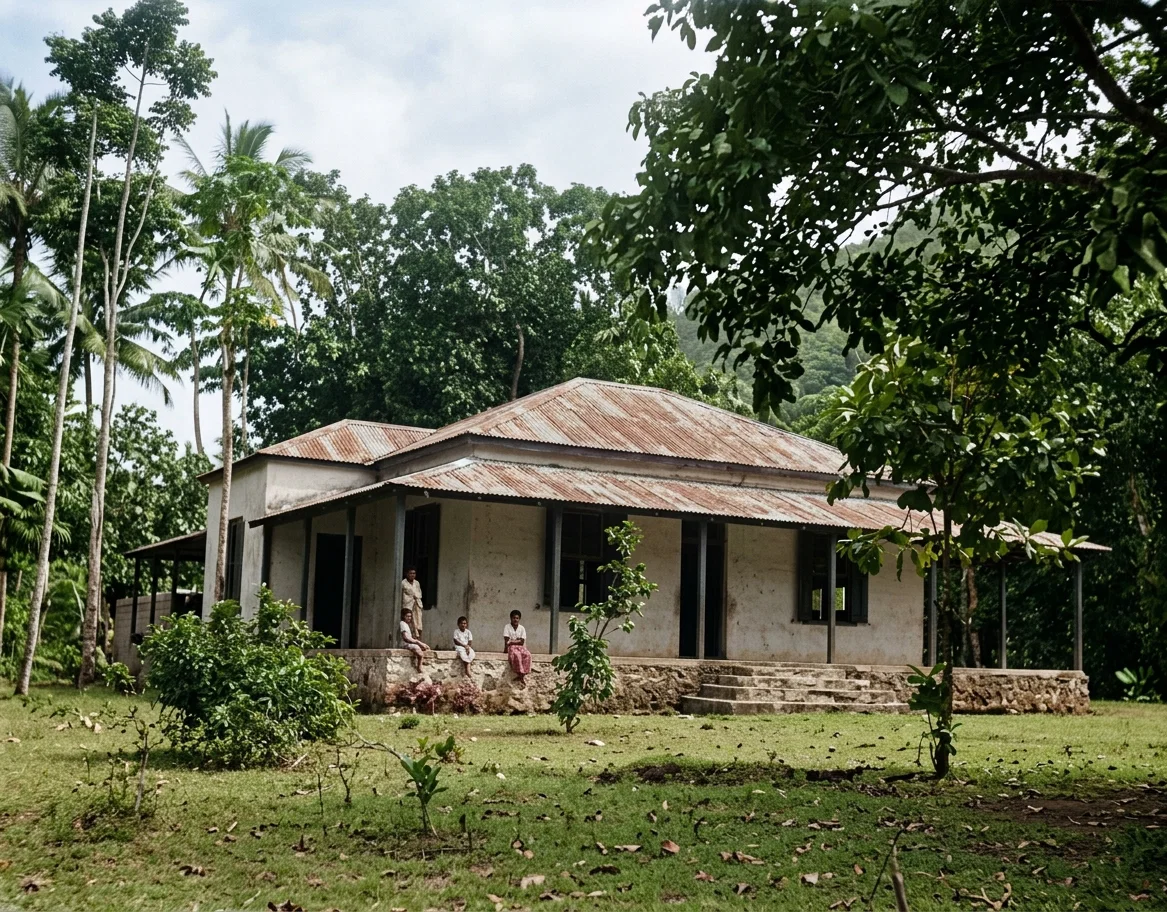
On the first trip of the brig “Pitcairn,” three of the Cook Islands—Mangaia, Raratonga, and Aitutaki—were visited. This was in April, 1891. A variety of our publications were sold and given away at each place. Three years later, in 1894, on the third trip of the “Pitcairn,” Dr. J. E. Caldwell and family and Brother D. A. Owen and family were located on the island of Raratonga.
WHERE THE SCHOOL OPENED
Dr. Caldwell opened up a medical mission, which, until it was closed in 1900, was a means of blessing to many of the natives. Through its agency several were led to accept the truth. One of these, a woman who was afflicted with one of the foulest diseases known to mankind, and who for years had hardly moved from her hut, was greatly benefited by treatment. The queen of the island wished the doctor to let this woman alone, that she might die, but he did not listen to such advice, and to-day, although not altogether free from disease, she is one of the most intelligent Sabbath keepers in the group. She and her husband were the first of the Cook Islanders to be baptized.
In 1895 Sister Owen was laid to rest, and Brother Owen left the island, and located in Samoa. About this time the “Pitcairn” brought other workers to the field, all of whom have since been compelled to leave. The work progressed slowly, and a small company was gradually gathered who were obedient to the faith. Among them was the government translator, who has since translated several of our books, such as “Steps to Christ” and “Christ Our Saviour,” as well as a number of tracts, into Maori.
In the beginning of 1900 there was quite an awakening on the Sabbath question throughout the whole group. Previously to this year the inhabitants of these islands had kept the seventh day of the week as the Sabbath, having been taught to do so by the early missionaries. However, in the latter part of 1899 the local government had passed an act ordering that the Sabbath be observed on the first day of the week, in conformity with the rest of the world. Our brethren, by all that lay in their power, warned the natives that the proposed change was not according to the Word of God. When the time for the change came, the local churches were almost deserted by their adherents. Large companies in the several villages of Raratonga continued to worship on the seventh day. At the villages in which our brethren lived, many came to the meetings held by them. Then began a severe persecution on the part of the authorities. The natives were fined if they worked on Sunday, and did not attend church. Policemen were placed at the gates of the places where meetings were held on the seventh day, and would not permit the natives to enter. Many had their lands and offices taken away from them, and gradually by this means and through fear of the chiefs the majority were led nominally to worship on Sunday.
Still there was one company that held out, and they invited our brethren to minister to them at their village, Titikaveka. This they did, and about the middle of the year, Brother E. H. Gates, who was visiting the mission, baptized twenty of them. They were still tested by the threat to deprive them of their homes and land, and then they were fined and ordered to work on the road for twenty-eight days. Still they were firm.
About this time, Dr. Caldwell and his family were beginning to suffer because of a protracted stay in the tropics. My wife and I came from Australia to relieve them. We tried to get land on which to build a meeting house, but were baffled by the chiefs who own the land. Our next move was to clear a piece of land for the purpose of building a church on a section that was placed at our disposal for twelve months by a white man. As soon as we started, all our native brethren and sisters were again called upon to work on the roads. We did not go on with the building because of the shortness of the time that we were to have the land. We made up our minds to wait and pray, and in the meantime met in the deacon’s house for worship each Sabbath and two mornings in the week. After thirteen months of waiting we secured the piece of land that we wanted in the beginning. This was brought about one week ago. We thank the Lord for it, and take courage.
During the year 1901 all the old workers retired from the field, leaving us alone. But since then Sister E. Gooding has come from Australia, and we have been able to open an industrial school on a small scale. Beyond a visit now and then on the part of our workers, nothing has been done in the other islands. For a long time the natives of Aitutaki have been asking for help, and we believe that the Lord would have us help them. We are about to begin to train one of our native brethren as a worker, and trust that he will become a useful man. As soon as I can leave this island for a time, I intend to visit the other islands. Owing to the irregular shipping, one never knows on leaving Raratonga when he will be able to return. This makes it rather perplexing with the field undermanned.
Respecting the call from Aitutaki, we believe that a married couple should be sent there. One of them should have a thorough knowledge of nursing, as the natives of this island have no medical help whatever, and are in a bad condition, physically as well as spiritually.
We are anxious that when the work of the third angel’s message shall be finished, and that time is not far off, some of the Cook Islanders may, by the grace of God, have proved themselves worthy to be eternally saved.