E. H. GATES

6%

Seventh-day Adventist Publishing Association · Battle Creek, Mich. · Sep 23, 1902

FromReview and Herald, Vol. 79, No. 38.

Read the full edition

E. H. GATES

From Padang to Deli

E. H. GATES
ON January 14, after a four days' voyage from Batavia, Java, I reached Padang, Sumatra. With little difficulty I succeeded in finding Elder Munson. After traveling over seven thousand miles without meeting a person of like precious faith, it seemed very pleasant to sit down with this family in their own home in that far-off land. Brother Munson was in the midst of his school duties, surrounded by a little company of Chinese students. It seemed good to know that in this distant heathen land the principles of God's truth are being taught. Though Brother Munson was, a few years ago, a confirmed dyspeptic, he is now enjoying better health than for many years. I am sorry to say that his wife is not in such good health. Before I left Sumatra, she was obliged to go to the mountains in order to get a cooler climate. These tropical lands are very hard on those who are physically weak; but the climate in the mountains is agreeable. The difficulty is that our laborers cannot live in the mountains while carrying on their work; for most of the people live in the towns on the coast.
FORT DE KOCK
FORT DE KOCK
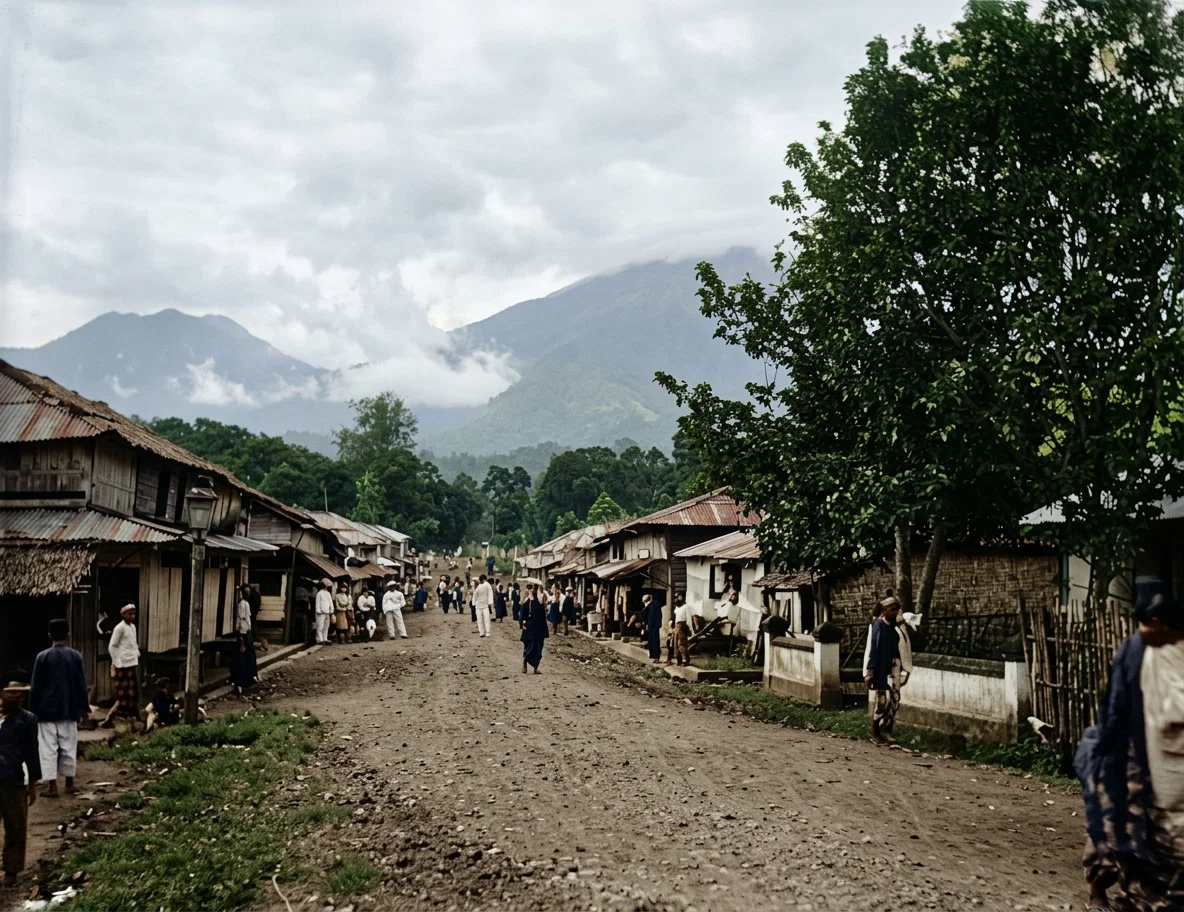
A few days after my arrival in Padang, I had the privilege of visiting Fort de Kock, a beautiful town away up in the mountains, almost under the equator. The climate was delightful. All the way up the side of the mountain were seen fields where the most excellent rice in the world is grown. The people here are nearly all Mohammedans.
Brother Munson has been able with God's help to bring out a small company of Sabbath keepers among the Chinese. During my stay at Padang, I had the privilege several times of preaching to this company, Brother Munson interpreting in the Malay language. Most of the Chinese can speak that language, having been born in this island. I also had the privilege of speaking a few times to the few English-speaking people at Padang. On Sunday morning I spoke to a small company on the subject of Christ's coming. This was interpreted by Brother Munson into the Malay language for the Chinese brethren who were present. In the evening of the same day, I spoke in a public hall, the use of which had been given to us free of charge by the city authorities . As the night was a stormy one, and as there were but few English-speaking people in the place, our attendance was small; but I never saw a more intense interest to hear. The subject was the signs of the second advent, especially those relating to the Eastern question. The people present listened with the deepest interest, and as I had told them that I had some publications treating upon that subject, at the close of the service they made a rush to the stand, and took every book I had, and wanted more. I am hopeful that good will come from these meetings.
Our health foods are also being used by some. The United States consul makes constant use of them. Others who are suffering from stomach troubles come often to Brother Munson to purchase health foods. I am satisfied that these foods will meet with a ready sale in all these Eastern countries. The hot climate and the unhygienic habits of the people produce a great deal of sickness. Health principles will solve to a great extent the question of how white people can live in these latitudes.
My stay in Padang covered about three weeks. Receiving a cablegram from Brother Teasdale, who had reached Java, it was arranged that Brother Munson and I should proceed to Medan in Deli, on the east side of the island, to assist Brother Teasdale in starting a school at that place. A cablegram was sent to Brother Teasdale, to go directly to Deli, instead of coming to Padang.
February 5 we took the steamer “Reael,” of the Dutch line, by way of the north end of the island, for Penang, in the Malay Peninsula. In the northern part of Sumatra is the district of Acheen, where for about thirty years war has existed between the Dutch and the natives. The Dutch government is slowly gaining ground, but it will probably be many years before the whole district is conquered.
On the 7th we reached Ulali, which is the port of Kota Raja, the most northern point of the island. This is the place where, in the beginning of the thirteenth century, the Mohammedan missionaries first preached the faith of Islam in the East Indies. Here the natives are all fierce Mohammedans. We were at this place on Friday, which is the Mohammedan sabbath. We visited the large mosque in the town, and were permitted, after removing our shoes, to go inside and see the building. It was a splendid structure, with polished marble floor, but entirely empty of seats or statuary, or anything that could be considered an idol, there being nothing within except a sort of seat, or throne, on which the officiating priest sat.
When we left Kota Raja, we proceeded to a small island north of this place, which is a coaling station. Here we remained for a few hours. Lying in the beautiful harbor were three splendid Russian war ships on their way through the Suez Canal to China, via Singapore. They had put in here to get coal. The Russian government has tried to purchase these islands of the Dutch for a coaling station. The war spirit seems to be in the very air in all these countries. As we left this port, and proceeded along the northern part of Sumatra, we stopped at several places, at each of which was a military post. Here Dutch soldiers were taken on board, and discharged from our ship.
On the 11th of this month we reached Penang, which is a little island just off the coast of the Malay Peninsula. The town is a very beautiful one. Here we were entertained during our stay by a Methodist pastor, an old friend of Brother Munson's. This gentleman and his family did all they could to make our stay a pleasant one. At night we attended the Tamil conference, which was in session, and saw a number of converted Indians who were engaged in the gospel work. The pastor reported having found about seventy-five Christian converts from Burma who had come to the Malay Peninsula to work in the tin mines. They were Baptists, and probably were the descendants of those who accepted the Baptist faith during the work of Judson, in the early part of last century. We also visited the Methodist Chinese school at that place. The pastor referred to was considerablyinterested in the matter of health foods, and it was arranged by Brother Munson for him to receive health foods from our manufactory in Calcutta. Everywhere we go, we find people who are interested in our health foods and health publications. I know of no place where these principles are more needed than in this Eastern country.
Leaving there, we proceeded to Medan, which we reached after traveling one day and a night. Being strangers in the place, we did not know where we could find board and lodging for which we could afford to pay. Such accommodations are very high-priced in those countries. But we made it a subject of prayer, and the Lord answered. A Eurasian gentleman received us, and during our stay of about two weeks entertained us free of charge, giving us the best that the house afforded. As soon as possible we arranged for the holding of a Chinese school. It was necessary to get the consent of the Dutch resident. At first he seemed unwilling to grant our request, but in answer to our earnest prayers the way was opened for a school. Those with whom we conversed upon the subject seemed interested in our project. Several Chinese expressed a desire for such a school. While in this place, we visited a school conducted by a Tamil gentleman. He was able to speak English well, and had a number of Indian youth under his instruction. This gentleman was a Christian, and seemed much interested in some publications we gave him. He also invited us to speak to his students in the school-room. Brother Munson complied with this request, speaking to them in the Malay language. The gentleman who entertained us showed great interest in the truths that we carried to him. Before we left, he had given up meat eating, and had practically adopted the principles of health reform, and showed great interest in the truth. We also had the privilege of treating some who were sick. It was a great surprise to them to see how such a simple thing as water treatment could effect so great results in a few hours' time. We must carry these principles to every part of the globe.
Though we were disappointed in getting our school started as we had hoped, yet we felt that our stay in Medan was far from being in vain. Our prayers daily ascend to God that those who so kindly entertained us, and showed such an interest in the principles of truth we carried to them, may follow the light until it leads them to a full knowledge of God's truth for these days.
Cooranbong, Australia.