DECEMBER 31, just one month from Sydney, we reached Singapore, and the next morning I first set foot on Asiatic soil. Having traveled quite extensively in the past in the tropics, there was nothing specially new to be seen in Singapore as far as the country and vegetation were concerned. Nor was there anything new in the appearance of the thousands of Chinese who fairly swarmed on the wharves, and seemed to be doing most of the hard work. To a person wishing to see representatives of all the Eastern nations in one place, simply for the sake of studying man in his present fallen condition, this would seem to be an ideal place; for people are to be met here from almost everywhere.
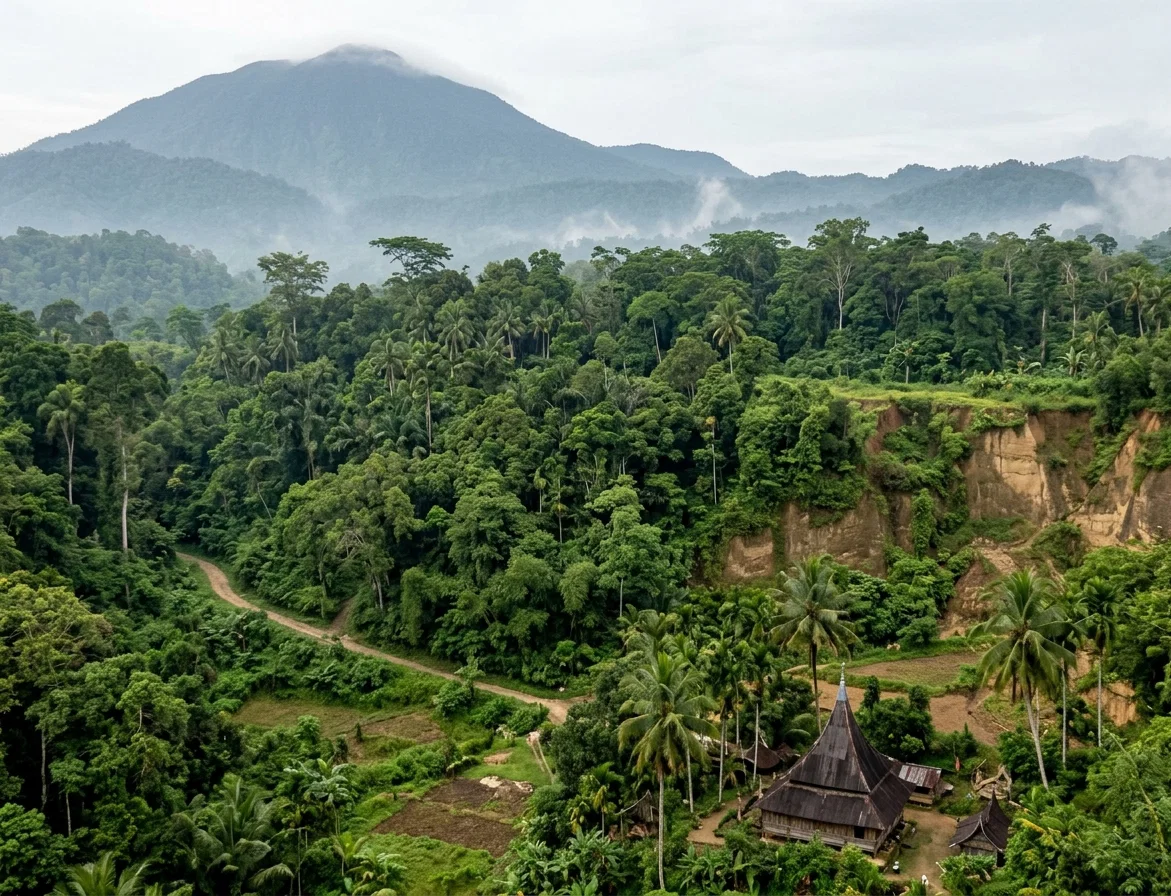
IN THE UPLANDS OF SUMATRA
But the Christian who sees the world just on the verge of the final catastrophe, and realizes the awful moral degradation of the heathen nations at their best, looks at things from a different standpoint. True, it is interesting to see representatives of so many different races, and their various costumes and customs; but when it is realized that of the vast numbers who crowd the streets of these large cities, scarcely one has any experimental knowledge of Christ’s salvation, nor the faintest idea that he is coming back to earth again, one is oppressed with feelings of sadness.
Soon after going ashore at Singapore, I called on the missionaries of the Methodist Mission (Americans), to whom I had a letter of introduction.
They treated me very kindly, and directed me to the rooms of the Singapore Temperance Club, where I obtained board and room. Probably this was the only place in the city where a person could board without being obliged to see liquor drinking almost every moment of his waking hours. These club rooms are kept up by a few men who work every day for a living, and who receive but little if any support or encouragement from the churches as such.
The day after landing was New Year’s day, and all the principal offices and shops were closed. In the afternoon I went out to see the immense crowds of people who were gathering to see the sports on the esplanade. I had before seen a few natives of these Eastern countries, but they were usually of the poorer classes as they appear in Fiji and occasionally in Australia; but they were very commonplace-looking creatures in comparison with these I saw in Singapore. Here were natives from the different parts of India,—Cingalese, Tamils, Bengalese,—dressed in their peculiar garb, though some were hardly dressed at all. Here would be seen a company of men wearing turbans, and dressed almost identically as was the custom when Christ was on earth. Some were dressed entirely in white, others in silk garments richly ornamented. The turban was generally yellow, but others were white, and some red. Next would be seen an Arab, then a Turk, each wearing the garb peculiar to his country. These nationalities usually wear the Turkish fez, which is really a badge of their Mohammedanism. Thousands of Malays were seen on every side, also the prosaic-looking Chinaman. Crowds of Indian children played in the green, most of them bright-eyed, happy-looking little creatures. Occasionally I saw little Indian girls begging, and such little mites they were. But instead of being dressed in rags as I had been accustomed to seeing beggars, they were dressed in purple or green silk, and wore considerable jewelry. Thousands of jinrikishas were dashing about in every direction; beautiful carriages, drawn by prancing horses, and carrying finely dressed pleasure seekers, drove up by the side of the esplanade; while the great, hump-backed Indian bullock plodded slowly along through the crowds, drawing his immense load of merchandise. For the first few hours the sight was fairly bewildering to one who was unaccustomed to such scenes; but I soon became used to them.
But in the midst of these novel and interesting sights I was oppressed with the thought of the dreadful moral condition of the people around me; for almost every one I saw was either a pagan or a Mohammedan. Riding down the street one day, I saw on one street corner a Mohammedan mosque, and on the next an Indian pagoda. Every morning I was awakened by the monotonous prayers chanted by Mohammedan priests in an adjoining mosque, not ten feet from where I lay. In addition to these forms of religion, and worse than all, if possible, is the fact of the spread of Romanism among these heathen, which gives another pagan religion more to be dreaded than the first mentioned, because masked under a Christian name.
Never before as now could I understand the terrible character of heathen idolatry. Before Christ’s first advent the Jews were constantly falling into this sin. At Sinai God’s voice had hardly ceased to sound before his people set up a calf of gold, and worshiped it. There seemed to be a witchery about it that they were not able to resist. When God brought his people to Canaan, he commanded them to destroy all the idols, and not even save the gold or silver on them, nor to bring them into their houses. Marriage with the heathen on the part of the Jews was strictly forbidden, lest their children should be enticed into idolatry. Deut. 7:3, 4, 25, 26. Only by resolutely banishing idols from their houses could they be kept from contamination. From the idolaters all true knowledge and understanding seemed to depart; in their minds all sense of right and wrong was confounded; and they descended to a condition scarcely higher than the gods they adored. Isa. 44:9, 18–20; Rom. 1:21–27; Ps. 115:8. This bewitching character of idol worship can be accounted for when it is considered that it brought the worshiper into communion with demons. 1 Cor. 10:18–21.
Here in the East Indies are millions of men and women who are bound to their idols as with chains of iron; to take away their idols is like taking away their lives. The sins that led ancient Israel13away from God are almost universally practiced among them—sins of unchastity. But, notwithstanding the frightful condition of the heathen of the Eastern nations (and it is not a particle different from some localities in the Western countries, nor any worse), some will yield themselves to the refining power of the Spirit of God; for the “great multitude” seen by John were from “all nations, and kindreds, and people, and tongues.” Rev. 7:9.
While at Singapore, I made a very interesting acquaintance. At my boarding place was a young man from Ceylon, who, like myself, had just arrived. He was half European and half Indian, and spoke good English as well as Cingalese and Tamil. Being an abstainer, he had come to the Temperance Club rooms to escape the sight of constant liquor selling and drinking. Seeing me, he at once recognized me as a minister, and offered assistance. In a short time we had become quite intimately acquainted. He was a Catholic, but seemed quite liberal-minded. Learning that I was a Protestant, he said, “There must be something you are protesting against.” His remark opened the way to hold a long talk with him on the subject of religious liberty, after which I gave him “Christian Patriotism.” This led to talks and studies on the signs of the times. Before he left for Borneo, I placed in his hands several publications on present truth, and, as he was a doctor, I ordered some health publications sent to him. He listened with the deepest interest to what I told him, and seemed to desire my society more than that of others. I am convinced that scattered through these heathen lands are many who are longing for something more than they get from the paganized Christianity about them. Our work should be to search them out.
After finishing my visit in Singapore, I left for Padang, Sumatra, via Java. On the steamer was a young man, a United States soldier, who had been discharged after serving through the entire Philippine war. From him I gained a great many points about the Philippine Islands that will be useful to me in the future. He was on his way to a little island north of New Britain, which he has leased for a term of years. He will be the only white man on the island, and he proposes to conduct his business according to principles of righteousness. I hope that he may be successful, as it will be a rare sight to see a place where natives are regarded as anything better than servants of the whites. I supplied him with a good stock of literature on the truth, which I hope may be as seed in good ground. I have seldom met a man who has such sensible ideas as this man on the way to treat the poor heathen natives. As he will have complete control of the island, he purposes to shut out liquor and Catholicism, but offered to let me go to the island and teach his natives. All these experiences give me new courage to push the knowledge of God’s truth into “the regions beyond.”