SINCE my last report I have had the privilege of attending the conference in Cape Town. It is now three months since I returned to Basutoland. I had to travel through the troubled portion of the Orange River Colony. Of course I had military permit; but it was the Lord who protected me from danger. On my return I spent a few weeks at Bloemfontein, assisting the little company there. One brother and sister donated a cart, a wheelbarrow, and some other useful articles, to the mission. A week after my return one of the four native women whom I had baptized before going to the conference, was taken ill and died. She had been convicted at one of the meetings, and after talking and praying with her at the close of the services, she gave herself to the Lord, and found peace. She was a heathen, the wife of the village chief. When she desired baptism, I advised her to wait until my return from the conference. But she insisted on being baptized, suggesting that something might happen if it were delayed. Even her husband tried to urge her to put off the event, desiring to call his friends together to celebrate it. But after a while I yielded to her wishes, little thinking that one of my first duties on my return would be to lay her away to rest. Up to the evening before she died, she expressed trust and peace in God. I believe she will have a part in the first resurrection.
Through the kindness of brethren and sisters in America, I have been enabled to put up a meetinghouse, which serves as a schoolroom as well. It is twenty-six by fifteen feet, and is sometimes too small to accommodate the people in our Sunday meetings. We have a school of15earnest young natives, from eight to over twenty years of age. Some of them have attended other schools. Education is practically free, even in the higher training schools. Six pounds a year is charged for board, lodging, and tuition. There are many schools all over the country; and although our views are known, and some are opposed to us, still the people have been calling for a school, and have left the others to attend ours. In the beginning, I required all to work two hours a day for their tuition, at any kind of work given them. All agreed, and we began with an enrollment of thirty-three.
On the second day of the school, the girls marched up to my place, to say that they would work only the first hour. I marched them back to the building, and had a talk with them, and told them what rebellion is, and reminded them that they had asked for the school and agreed to the conditions, and that the rule would not be altered. I gave any who desired the opportunity to withdraw. The result was that they expressed themselves sorry for what they had done, and promised not to repeat the offense.
Brother Kalaka, a native young man, who has spent two years at our college in Claremont, is the teacher. Previously to attending Union College he had spent several years in the school at Basutoland. I feel quite sure that if the native schools are conducted according to the light given us, the result will be more satisfactory than other work among these people. Their desire to secure an education is marvelous. True, all may not have the right motive, but certainly the educational work is a means by which we can daily instill principles that will make an impression on souls. We sadly need efficient white persons to oversee the school and take part in the daily routine. Besides this, they could assist the native teacher in his studies, take charge of the place, conduct meetings, and attend to calls from the school. I am compelled to be away frequently, sometimes for a week, or even a month, and the school, the daily morning prayer meeting, and the weekly meeting for seekers, two meetings on Sabbath and one on Sunday, besides the general care of the place, must all be left for the young teacher. It is absolutely necessary for Brother Kalaka or myself to go about among the people, to secure and keep open the opportunities for work, and to place literature in their hands.
We teach the native language, also English to those already able to read their own language. All desire to learn English. As a race the Basutos have received more school advantages than any other tribe. In a manner this prepares the way for our work, although it is also the cause of opposition.
Wherever I go to talk to the people, if any who belong to other missions are present, the question of the Sabbath is introduced almost immediately, and I have to take up the subject without any delay.
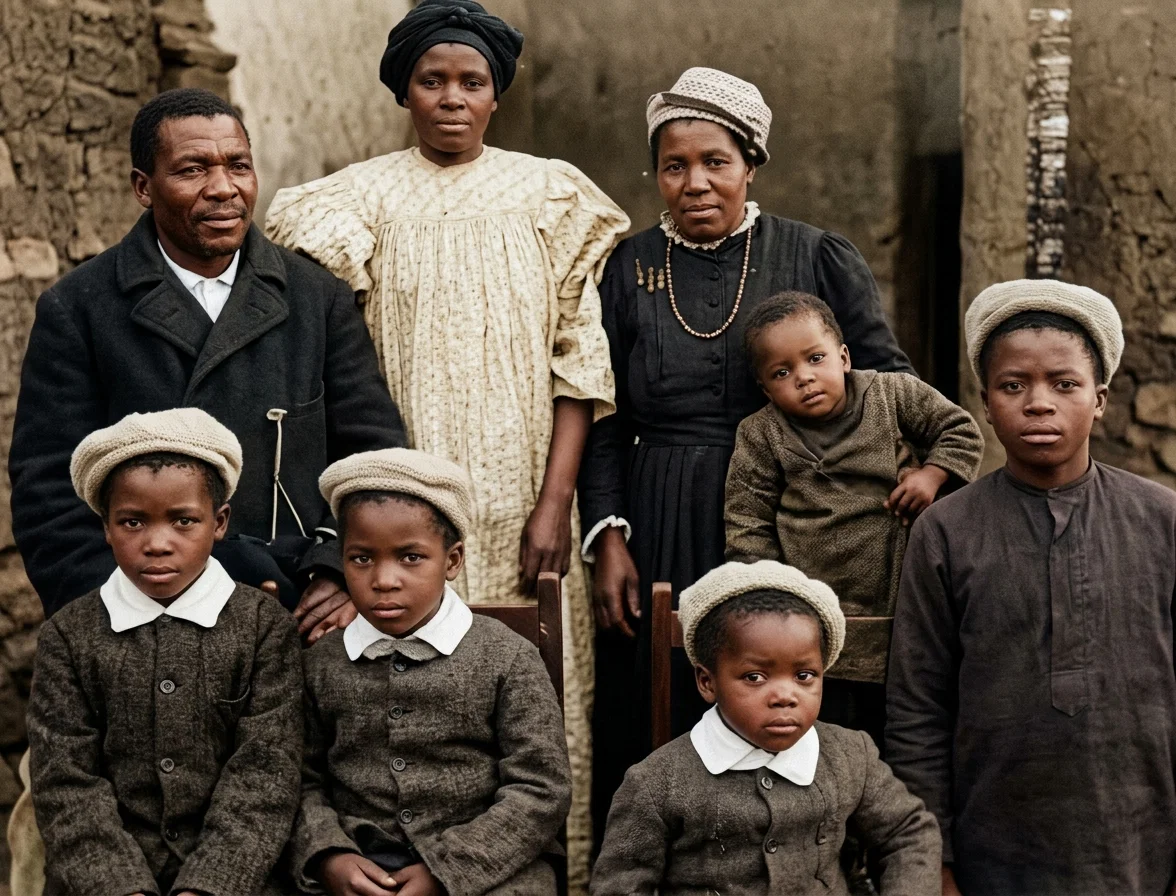
A BASUTO FAMILY
I sent Brother Kalaka to Maseru, the principal English official settlement. A larger number of natives live in this place than in any other, and many come and go from inland villages. Taking “Steps to Christ,” “Coming of the Lord,” and tracts on the Sabbath, he started out to see how they would sell. The demand for the Sabbath tracts was greater than for any other, and he reports that during the week he was there, he had to spend much of his time in conversing on the Sabbath and Sunday question.
Last week we visited a prominent chief. He engaged us in conversation during the whole day. Afterward he did me the honor to introduce me to seven of his wives. The eighth was ill. One of the women is a professed Christian, and has received a liberal education in the native language. As usual, the Sabbath question was introduced. There are people who fully believe that the Bible teaches that the seventh day should be observed, and really think that Sunday is the seventh day. This is natural, as the natives have no names for the days, but count from Monday. Our views seem to be known everywhere.
This is an important field; but like all other native territories, one cannot expect much, if any, return in money or its equivalent to help the work along; for the people generally are poor. Besides Basutoland, there are many other large native tracts that must be entered. But teachers, as well as other workers, must be supported. Some places ought to be entered now, while they are free from martial law restriction. I am sure we are all anxious that this old world, with all its misery, should come to an end, and the glorious kingdom begin. But this means that the gospel of the kingdom must first be proclaimed everywhere. How much of Africa is untouched! A large part of the help for this work must come from our brethren abroad. We need medical missionary help. This work would probably bring some return. Just as soon as the war is over, we shall need a good, serviceable wagon, strong but light, and conveniently constructed, to enable us to go about from farm to farm and from one native kraal to another with books. As we go from place to place, we have free opportunity to teach the truth. I have traveled over this country, and know the habits of the people, and I am confident that this is the work we ought to be ready to engage in at once. What help are the thousands of brethren in America able and willing to give to hasten the work in this field to a finish?