W. D. BURDEN

9%

Seventh-day Adventist Publishing Association · Battle Creek, Mich. · May 20, 1902

FromReview and Herald, Vol. 79, No. 20.

Read the full edition

W. D. BURDEN

Japan

W. D. BURDEN

We are just in the midst of the cherry blossom season. Almost every one who writes about Japan pictures it as though the cherry blossoms lasted all the year round, with the people dressed like butterflies, and as happy as the birds, spending their lives in the enjoyment of nature. It is true that the Japanese as a people do love nature, although some of their ideas of beauty differ quite largely from those of many English-speaking people. For example, a Japanese flower garden is filled with shrubs and trees that have been purposely stunted, dwarfed, and twisted out of all shape, until it would seem that life was a burden to the plants themselves. Then these plants are prized, and are called beautiful. Perhaps the trunk is half or two thirds decayed, but that only adds to its beauty and enhances its value.
A little earlier in the season, the various gardens and flower shows were crowded with dwarfed plum trees. The majority of them would not measure more than sixteen or eighteen inches in height, although they had attained the age of several years, and at that season were so full of blossoms that it would be difficult to find room to put on another one. The Japanese certainly have great skill in producing this style of plants. They always appear to me like the work of sin. Men’s minds have been perverted to such an extent that they love to see things so distorted that they cannot be recognized. This same tendency is seen in their efforts to represent God in carvings and paintings. They do not seek symmetry of form or beauty of expression, but the grotesque, the awful, the hideous. Such figures as are never seen in nature, and of which no mindcould ever have conceived till it had reached the depths of degradation and sin, are set up and worshiped.
But back to the cherry blossoms: they do not last the whole year through. No, by no means! If there is any difference, they fall more quickly than in America. But since there are a number of species of them, and all do not bloom at the same time, the season does last quite a long time after all. The double flowers are the most beautiful. They bloom last, and look just like little roses sticking on the branches. They are so dense that the tree looks like one large ball of blossoms.
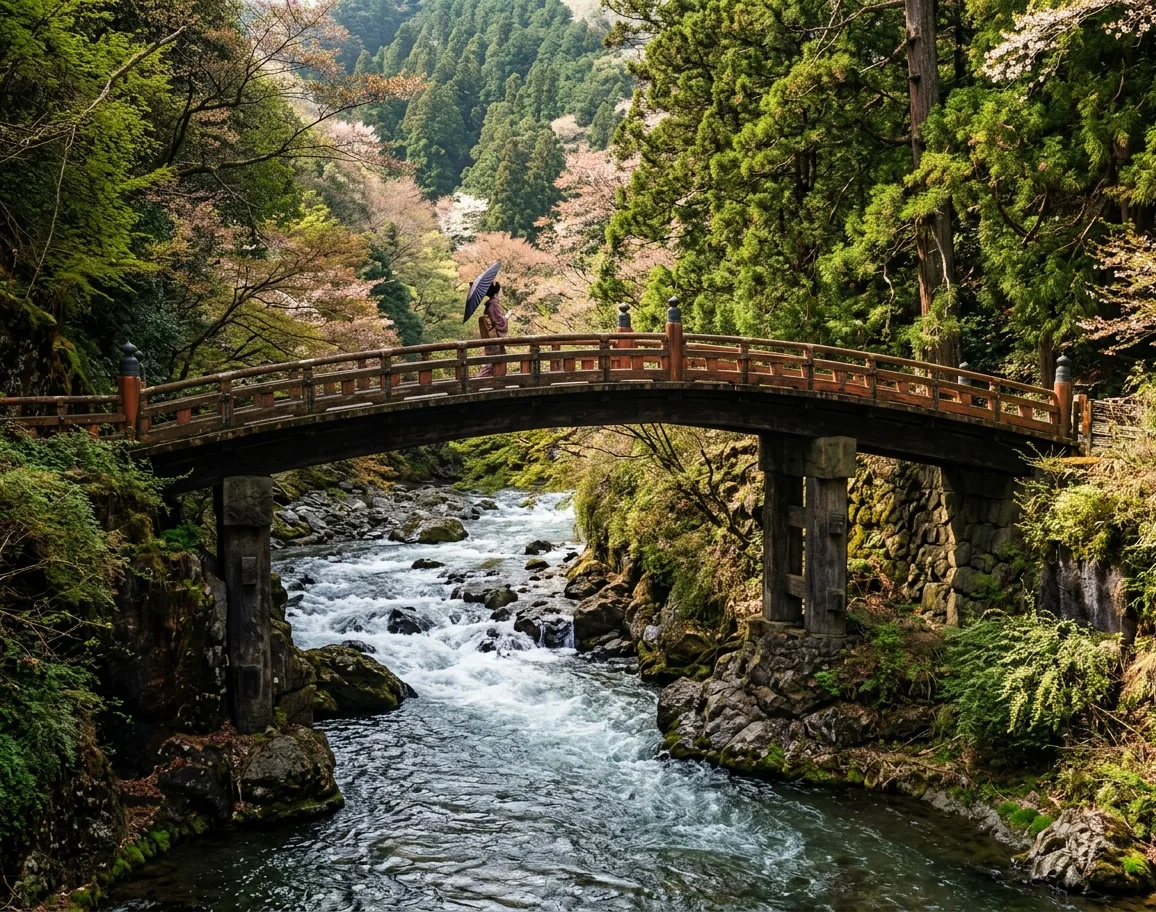
A BRIDGE IN JAPAN
A BRIDGE IN JAPAN
The absence of fragrance in the cherry blossoms of Japan is very noticeable to an American. In this they well represent the heathen religions of the country,—very showy, but entirely destitute of that sweetness that makes the gospel of Jesus so pleasant to the sin-sick heart. It is fear or desire for personal advantage that prompts devotion or reverence in the devotees of heathenism. Again, there are no nice, rich, luscious cherries to form on the branches, and take the place of the blossoms when they fall. Japanese cherries are about the size of peas, and are nearly all seed, the little meat there is being very sour and scarcely fit to eat. In this also they very fittingly represent the emptiness of idolatry.
But though we find the people so degraded in heathendom, still, the very fact that they love nature shows that there is left in them some faint traces of an appreciation for God’s handiwork. Every family, no matter how poor or how small their quarters, have some plants upon which they spend much time and labor. This has always given me hope that there is at least one channel through which God’s love may reach their minds, and open their hearts to the whole truth. We must look for the good in people’s natures. The evil may be seen without looking for it, but the good must be searched out, and then made a medium to lead the heart back to the God of all good and truth. We are thankful to God for the beautiful flowers which brighten this world, cursed as it is with sin. We are thankful also for the beauty and sweetness of the gospel of Jesus. We are glad for an opportunity to tell others of this truth.
Last night a stranger happened into my evening Bible class. Noticing that he was quite familiar with the Bible, I had a conversation with him. He said he was a Christian, a school-teacher, and lived some distance from here. I asked why he came here when there were many mission schools near his home. He said that a copy of our Japanese paper was sent him about three months ago. He liked it, and had since been anxious to learn our views. I told him that we believe in keeping the commandments, and turning to the chart which hung on the wall, we began reading. When it came to, “But the seventh day,” he halted. A new thought had struck him. The word of God was “quick,” and did its work. For another hour we read our Bibles together, then he went away, but his mind was full of new thoughts. I pray that the seed sown may bear fruit.
It is an important work to search out and teach these who are still in darkness, but looking for light. Where are the men and women who are willing to be used by God in these needy fields? There is need of both men and money. We need more literature to circulate among the people, but that requires money. “His Glorious Appearing” has been translated, and is now in the hands of the printer. May God help us all to arouse to a sense of our duties.