THIS group in the South Pacific Ocean contains six principal islands,—Raratonga, Mangaia, Aitutaki, Atiu, Mauki, and Mitiero,—besides three others, which are small and of little importance. The total area is about one hundred and fifty square miles. The population is seven or eight thousand. Our work has been established a little over seven years in the principal island, Raratonga, and is known to our people as the Raratongan Mission.
From Raratonga it is one hundred and sixteen miles to the nearest island, Mangaia; and one hundred and fifty miles to the most distant, Mauki. The language spoken is the same, with the exception of a few words. In all the islands the natives use the Raratongan Bible. Until ten or fifteen years ago, each tribe was governed by its own chief, but the different chiefs had not the same power. In Aitutaki and Mangaia it was only nominal, but in Raratonga the chief’s power was absolute. He owned all the tribal lands, and, in fact, everything. If one of his tribesmen went to another island to work for a season, on his return he had to share his earnings with his chief. This power on the part of the Raratongan chiefs has made it hard for those natives who have desired to keep the Sabbath of Jehovah. On this point we will have more to say later. At the time mentioned above, the chiefs federated, and made the chief of the principal tribe in Raratonga the nominal head of the federation. However, each chief retained his status as far as his own tribe was concerned. In 1900 the whole group was annexed to England, and the chiefs are gradually losing power.
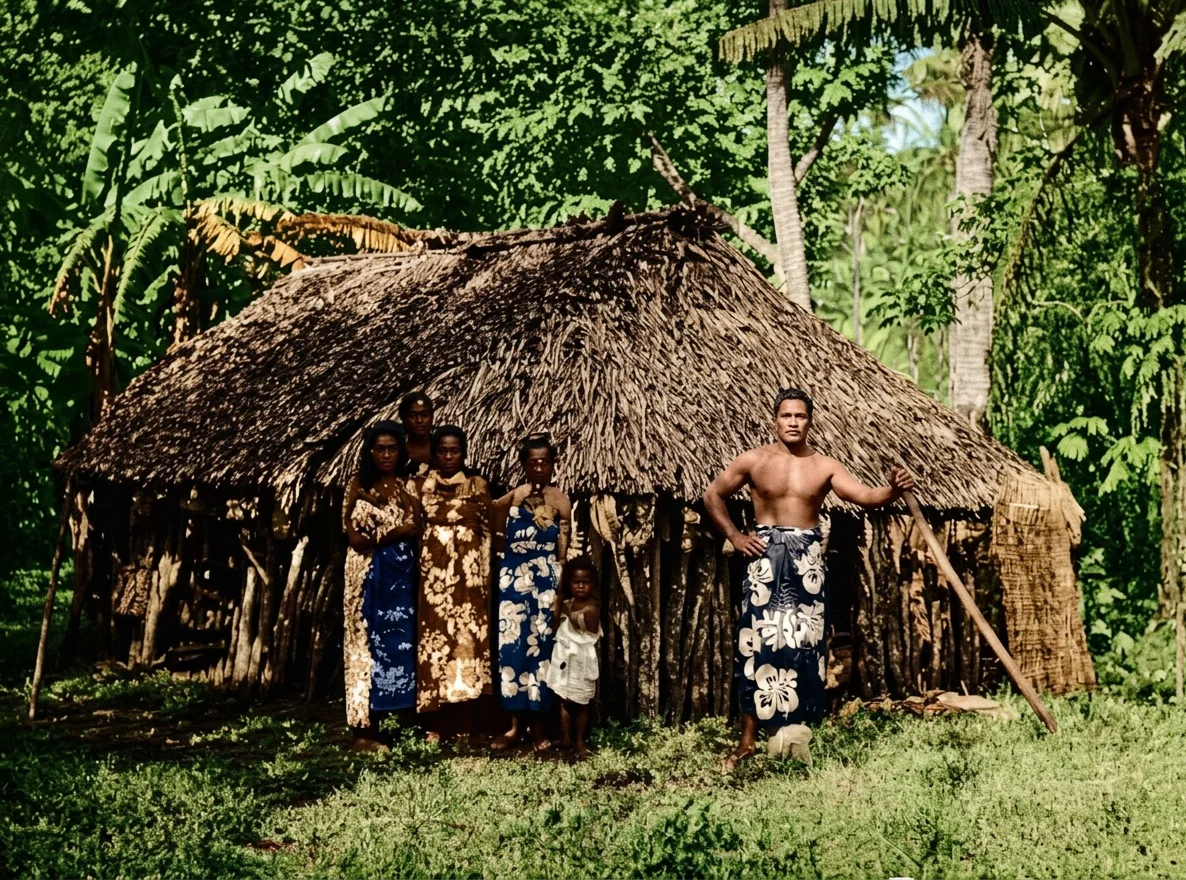
NATIVE FAMILY AND HOUSE, RARATONGA
When first discovered by Europeans, the natives were cannibals, addicted to terrible vices, and living in the depths of degradation. Tribal wars were frequent and sanguinary, and the weak lived in constant terror of the strong. Raratonga is only twenty-two miles in circumference, and on this island there were three tribes more or less hostile to one another. After a fight the conquered could at best put only a few miles between themselves and their conquerors. To be caught meant to be killed and eaten. With this condition the first missionaries had to contend.
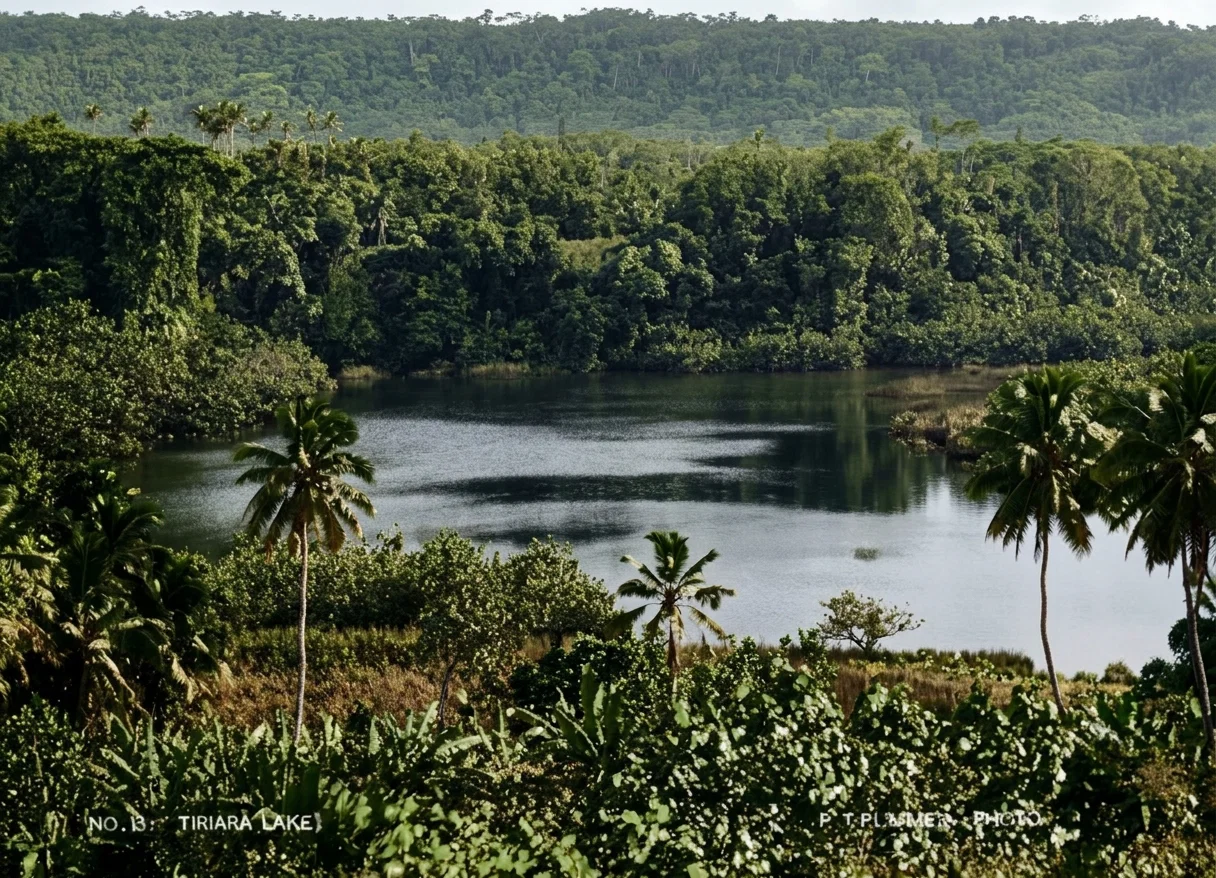
TIRIARA LAKE, MANGAIA ISLAND
Missionary enterprise was first begun in these islands about seventy-five years ago, under the leadership of John Williams. Aitutaki was the first to receive the gospel. At his own request, Papeiha, a native teacher from the Society Islands, and a comrade were landed on this island to preach the gospel. Their reception was not favorable, for they were both seized and carried to a “marai,” a place where victims were offered to the gods, and there given to the gods. However, right on this spot, they besought the people to forsake their idols and turn to the living God. Their lives were spared, and after a year’s hazardous toil the heathen began to accept their teaching. The evangelization of Mangaia was next attempted, but owing to the ferocity of its inhabitants, it was abandoned for some time. After this, John Williams sailed to Raratonga, landed several Tahitian teachers and their wives, and “lay begun off and on” for the night. Next morning the teachers came off to the ship with bruised limbs and torn clothes, and reported that they had experienced a terrible night. In consequence, it was resolved to abandon Raratonga for a time. But as they were about to sail away, Papeiha announced his intention of remaining on the island. He said, “Jehovah is my shield, I am in his hand,” and jumping into the sea with only a portion of the Scriptures in the Tahitian language bound upon his head, he swam ashore. God wonderfully blessed this dark-skinned disciple; for in two and a half years the idols throughout the island were overthrown. He lived many years after this, and was a faithful follower of the Master, and teacher to the Raratongans. European missionaries soon entered into the openings made by the native teachers throughout the Cook Islands.
As in many other heathen lands, the first missionaries found it no small task to reduce the language to written form. After this was done, the Bible was translated. The first book printed was 1 Peter. The first complete edition of the New Testament in Raratongan was printed in England, and reached the island in 1839. The complete Bible was ready in 1852. Since that time it has been revised.
Since the agents of the London Missionary Society were established in these islands, they have trained not a few of the Cook Islanders as teachers to carry the gospel to the inhabitants of other islands in the Pacific that knew not God, and several have in this way laid down their lives for the Master. Good work has been done by this means, and to-day many Raratongans are laboring with the heathen Papuans of New Guinea, where James Chalmers and others were recently massacred.16
The natives of the present day are, on the whole, good-natured, affectionate, and kind. They are not fond of work, and rarely stick to anything that they from time to time take up. In domestic life, the men do most of the cooking. This is done by putting heated stones into a hole in the ground, placing the food upon them, and covering it up with leaves. Many of the men make their own clothes, although considerable clothing is bought from traders. The women usually wash the clothes. This is done by soaking them in cold water, and after soaking, placing them upon a flat stone and pounding them with a stick. Much of the food used grows of itself, and consists of several species of bananas, oranges, mangoes, pineapples, breadfruit, cocoanuts, and yams, taro, and kumera, which require some attention while they are growing.
In times of festivity, at deaths, births, and marriages, it is the custom to have a feast, and on these occasions many pigs are slaughtered, cooked, and eaten. At the opening of a church recently (not a Seventh-day Adventist church) several hundred pigs were consumed by those attending the opening. Drinking is common, and is encouraged by unscrupulous traders, who sell spirits to the natives.
As to their condition spiritually when they first accepted the gospel and turned from their idols, we have nothing to say. At the present time they are sunk deep in the mire of sin. The majority attend church, but it is only a “form of godliness” without the life. Even many of the officers in the churches are not to be trusted. Many have the idea that when they are seen stealing, the act is a wrong one; but should they steal and not be detected, it is all right. Prayer is common among them, and they generally have morning and evening worship. They were taught by the early missionaries to pray, and rightly so, but it has degenerated into a mere habit with them. They pray before entering upon their games, they pray before beginning their dances, which, when held, have a soul-destroying effect upon performers and on-lookers alike. Nevertheless, we do not suppose that they are one whit more wicked than their more enlightened neighbors in civilized lands. Here, sin is open and easily detected, and consequently well-known; there, much is done in secret, but it is just as heinous in the eyes of a pure God.
The local churches endeavor to stem the tide of evil, but are powerless. This is a characteristic condition in all lands in these last days. In the providence of God, there is an agency to arrest individuals in their course of sin, and that is the everlasting gospel as found in the three angels’ messages of Revelation 14.