G. W. REASER

6%

Seventh-day Adventist Publishing Association · Battle Creek, Mich. · May 6, 1902

FromReview and Herald, Vol. 79, No. 18.

Read the full edition

G. W. REASER

Natal

G. W. REASER

A list of the attractive features of Natal would include her sugar-cane industry, her tea, banana, pine-apple, arrowroot, and citrus-fruit plantations; her artificial forests of black wattle (the feathery acacia of California), her wild fruitless banana plants, giant ferns, and massive ant-hills. All of these indicate a semitropical land.
All the industries mentioned, except the wattle growing, are confined to the coast district. The labor connected therewith is performed almost wholly by indentured coolies, or the laboring classes of India, of whom there are more than sixty thousand in Natal. The term “indentured,” as used here, signifies that these natives of India are brought here under contract by the government of Natal, and hired to individuals by the government, for a period of five years; the employers to pay them at the rate of two dollars and a half a week, for the first year, the wages to be increased at the rate of twenty-five cents a week for the second and each succeeding year of the term, so that the last year of the five, the cooly will get three dollars and a half a week. In addition to this the employer must furnish a certain amount of food, and a shelter for his servants. If the man who is thus indentured has a wife, a separate contract is made with her, in case she desires to work for wages. This is said to be much better than the working classes can do in India.
The habits, as regards wearing apparel and house furnishing of these Asiatics, are very simple and inexpensive. As a rule they are hatless and shoeless. The women seem to manufacture but one garment, which is a short sack, reaching down to the waist. Then for the remainder of their covering they take a few yards of thin cloth, light in color, and cleverly winding it about their forms, tuck one end in and fasten it securely; and aside from the great display of jewelry which they all wear, they are attired in the height of Indian fashion. They bedeck their persons with gold, silver, and brass jewelry, in almost every conceivable place where it can be worn. The ears are punctured for massive pendants, the nose is perforated on either side for brass rosettes, numerous rings adorn the fingers and toes, a necklace is added “to give grace and symmetry” to the upper portion of the form, while numerous bands of silver or brass, embracing wrists and ankles, complete the attire and ornamentation of the ordinary cooly woman. These devotees of style seem to think, with many of their fairer sisters in civilized lands, that the Creator has made them greatly out of taste, and hence take much pains to make themselves anew.
The coolies who have completed the terms of their indentures, constitute a numerous class of small merchants and vegetable and fruit peddlers. As yet the vast majority of the Indians are in darkest heathenism, but a few have been Christianized. Nearly all of them speak three languages,—their native tongue, the Zulu, and the English. Great numbers of them come to the shores of Natal on shipboard, but are refused the privilege of landing, as the country would soon be overrun with them if they were allowed to come freely.
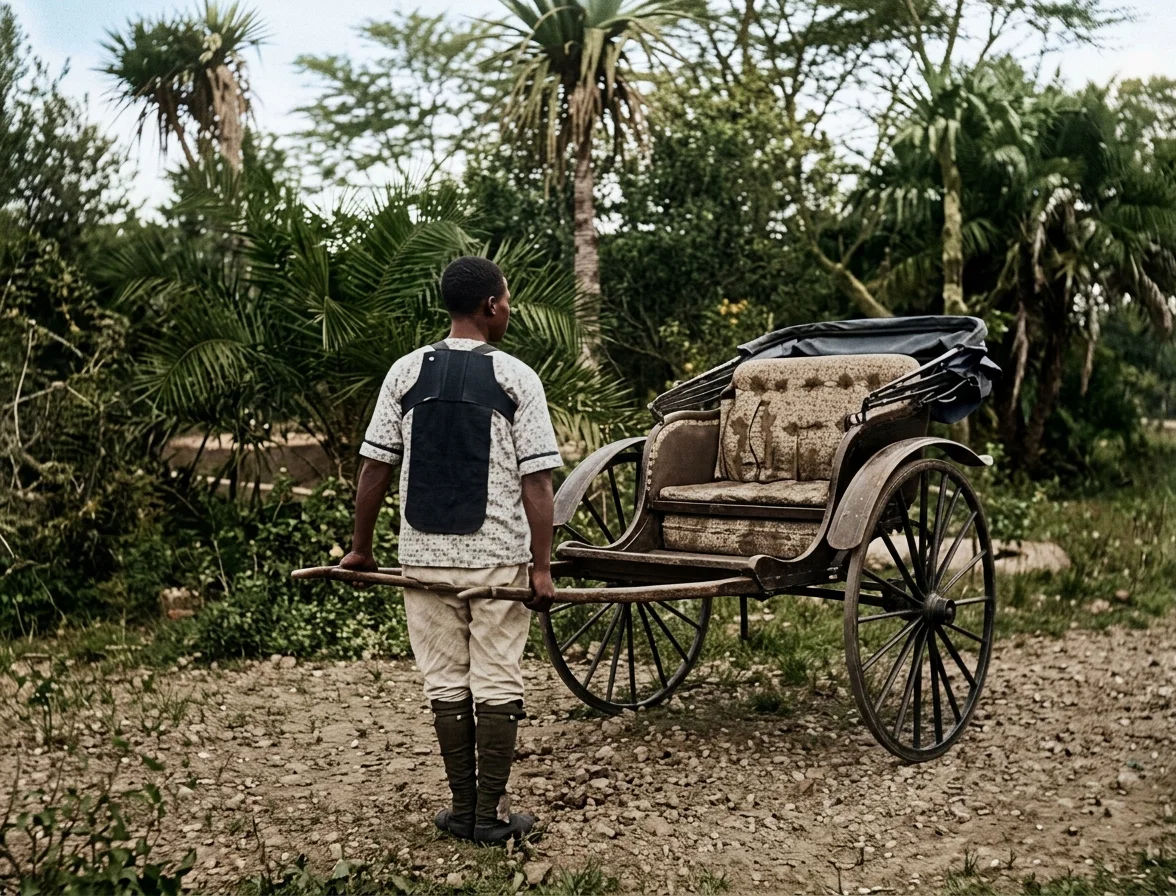
A JINRIKISHA BOY
A JINRIKISHA BOY
The home of an Indian family is a place of the utmost squalor, with an admixture of filth. It sometimes boasts of two small rooms,—one, combining kitchen, dining room, sitting room, and general work room; the other is the family bedroom. There are no bedsteads, no chairs, and no stove. The floors are of packed earth, and the fowls and pigs are at liberty to share the kitchen, at least during the daytime, with the family. The building is of thethatch, or of the cheapest material at hand. When a family of these poor people arrive from India, their effects are all carried from the steamer to the city, by the members of the family, and all together would scarcely fill a trunk of the smallest size.
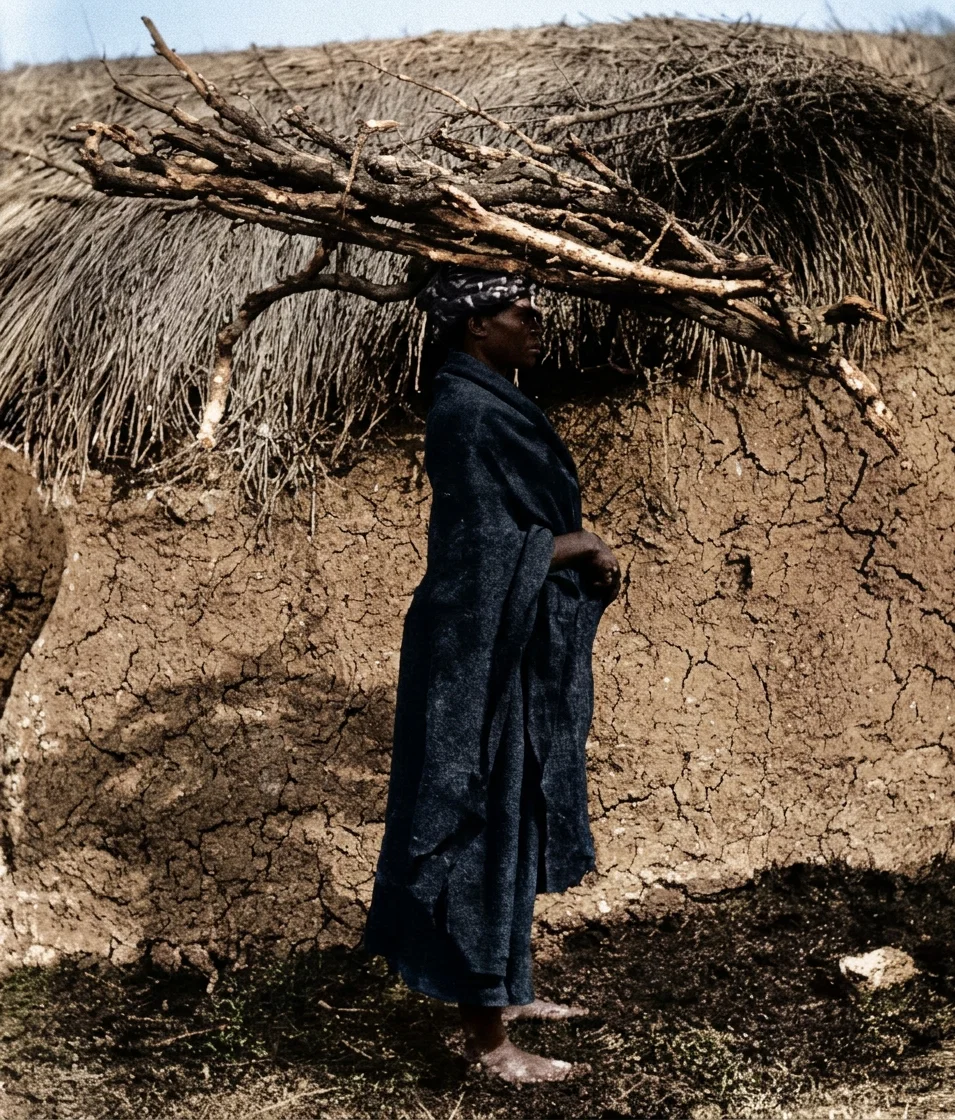
A NATIVE BURDEN BEARER
In Natal the Zulus, who number six hundred thousand, are the most numerous class of inhabitants. They perform the farm labor in the “up-country” districts, are the “jinrikisha boys” of the cities, the servants in almost every household; but the great masses of them are settled on large tracts of land called “native locations,” assigned to them by the government. It seems strange that one fourteenth of the population of Natal should constitute the ruling power, and hold the reins of government entirely in their hands, notwithstanding the fact that not long ago the natives had the supremacy, and were monarchs of all they surveyed. But as a matter of fact, the natives have no voice whatever in governmental affairs, nor even the right of franchise. The whites, about fifty thousand strong, are the governing body, but of course only a few of these hold offices. At present there is some dissatisfaction among the natives because they are not accorded the so-called privilege of the franchise, or vote.
One of the greatest evils among the natives of Natal, is their system of polygamy. One man may have as many wives as he can purchase, the price for each being ten head of cattle to the father of the bride, and one to the mother. They call this purchase price “lobolo.” If a young couple desire to unite in marriage, and the would-be bridegroom cannot pay “lobolo,” occasionally there is an elopement. This is not the end of the matter, however, for the father of the bride has the right, according to Zulu custom, which constitutes their law, to claim all the offspring as his property. Thus by this system the father of every family regards his wives and children as personal property, to work for and support him, and add to his worldly possessions in “cattle and goods.” Perhaps the worst feature of it all is that some husbands will deliberately bargain away some of their wives for a period of time to other men, on one condition only, and that is that the first husband, as the owner of the woman, shall have all children that may be born to her, as his chattels. The Europeans in Natal are agitating the plan of having the matter taken in hand by the government, and thus compel the natives to abandon polygamy. Many think that such a course would cause a general uprising, and a more disastrous war than has ever been waged by the powerful Zulus.
While the coolies wear brass and silver in profusion, the Zulus adorn their persons with a superabundance of beads and dozens of brass rings. The latter are worn about the wrists and ankles and just below the knee. In the country, the wearing of clothing, on the part of the unchristianized natives, is regarded as a matter of small importance. The more scant the wearing apparel, the better they seem to be pleased, provided the adornment of beads is not omitted. When the Zulu women reach a certain age, they wear what was formerly called in America a “chignon.” These projections are from four inches to a foot in length. The differences in length indicate one of three things,—either that the maiden has reached the age when a proposition of marriage would be proper, and presumably agreeable, or that she is betrothed, or that these two periods having passed, she is married. May it not be possible that the autocrats of fashion in Paris, perplexed to find something new for their devotees in the matter of dressing the hair, obtained the “happy idea” from looking over a collection of photos of the styles in “darkest Africa,” and hence gave the chignon to the world of fashion?
The native men puncture their ears, and then expand the opening until a lady’s thimble, in some cases, would drop through the hole. In this orifice they carry a spoon-shaped bone, used by them instead of a kerchief. The laws of the whites forbid the natives the privilege of making their favorite intoxicant—Kaffir beer. But it is not an unusual thing for a sober and industrious native to be seen drawing a drunken white man through the streets, in his jinrikisha.
At present we do not know of a single Zulu who has accepted the third angel’s message. We hope, however, that a work may soon be begun among them, which will result in bringing to many of them a saving knowledge of the truth. They are among the most intelligent natives of Africa. Many of them have really nice features. We are taking steps to have some of our smaller publications translated into the Zulu tongue, which is doubtless the language of two million people. “Steps to Christ” will be the first book that we shall place before them in their mother tongue.
The government employs a number of native policemen to look after the deportment of their own people. These are armed, not with firearms, but with their ancient weapon of war, the assagai; and they do not hesitate to use it on their own race, if occasion requires. Wherever one travels in South Africa, at the present time, he is confronted by soldiers. Only very limited journeys can be taken without a military permit; nor can one leave the country without showing this document. In a journey of a few miles, during the past week, the writer saw soldiers and officers in great numbers, a large hospital camp, a populous Boer refugee camp, also a train load of Boer prisoners, strongly guarded. One of the cars of this train was loaded with cannon, en route to the front. A few days ago a steamer, carrying one thousand four hundred and six Boer prisoners, sailed from Durban for Bermuda.
While thousands of Boers are held in the refugee camps, we hope to be able to supply them with present truth, in their own language. We trust that the Lord will bless this effort to the salvation of many.
An excellent way to give the truth to the natives would be for some consecrated, energetic young farmers to settle in the Transvaal at the close of the war, and arrange for a large number of native families to live on their farms. In this way they could not only be taught in schools, but they could receive a practical illustration of the truth, in the lives of those by whom they were employed.