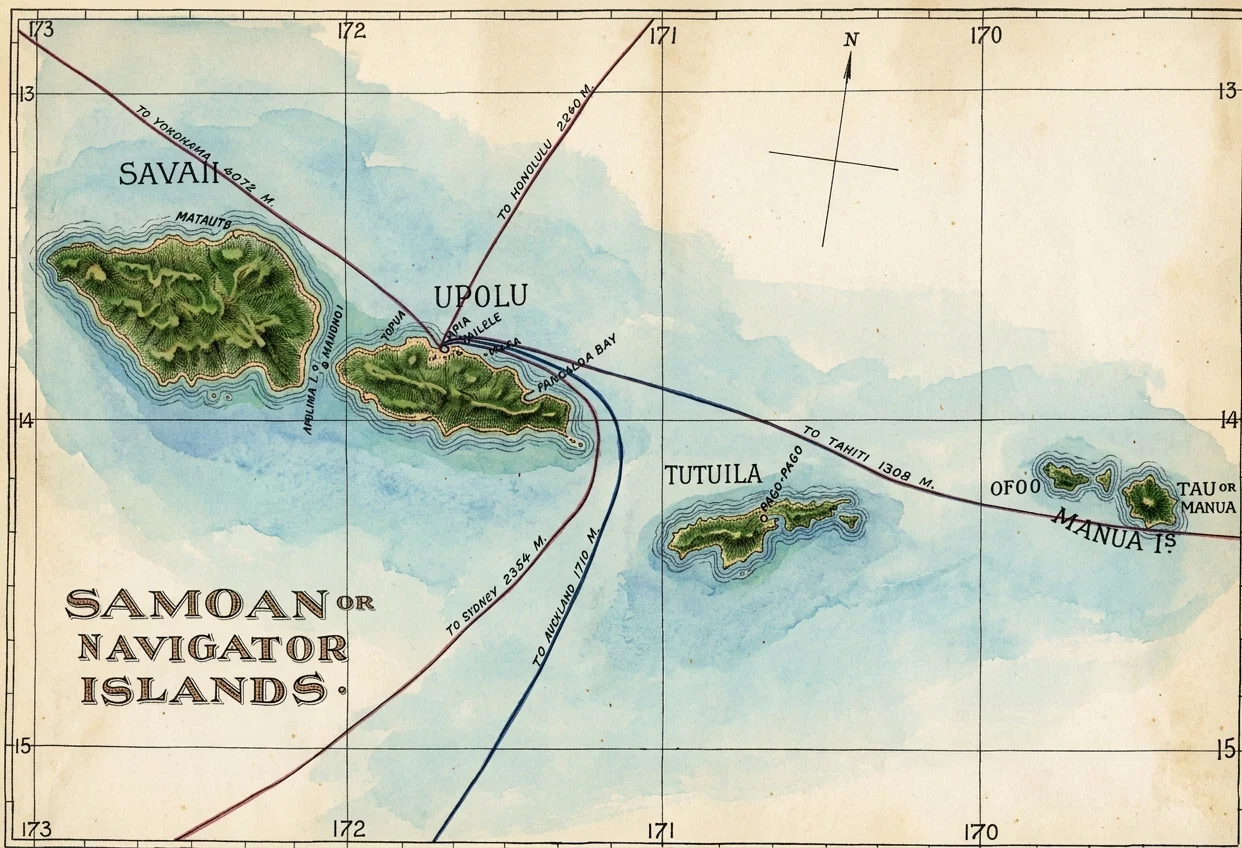
NOTING in a late REVIEW a request for information concerning localities where brethren from Battle Creek might settle, we take the liberty to send in facts regarding Samoa. The request was only for certain parts of the United States, but the “commission” is “unto the uttermost parts of the earth.” Samoa, unlike Gaul, is divided into only two parts, the greater and western belonging to Germany, while all east of 171° W. is under the dominion of the United States. The accompanying map will give the relative proportions and names of the various islands.
CLIMATE.—Tropical, temperature about 80°, very healthful, no malaria, little typhoid; light tropical fever, quite easily handled with water treatments, or better, by proper care, avoided. There are two seasons: the rainy, beginning gradually in September or October, increasing till January or February, then decreasing until April. During this time there are frequent rains, sometimes very hard, but seldom of long duration, generally from a few minutes to an hour. It may rain several times a day, however. From April to September the rains are similar to those in Michigan or the Eastern States, July and August being the dryest and coolest months. In fact, from May to September the climate is almost ideal.
PHYSICAL FEATURES.—The greater part of the group is mountainous; some level land lies near the sea, but most of this is occupied by natives or planters. The mountains are covered with forests, but the land is good. Hundreds of acres have lately been purchased by traders in Apia, and are being developed.
PRODUCTIONS.—Bananas, Paw Paw, taro, arrow-root, pineapples, mangos, avocado pear, yam, etc., are grown for food, but we are too far from large markets to think of exporting them. Copra, dried cocoanut, has been the staple export. It takes seven years to grow the cocoanut, however, and it does best by the sea. Cocoa is considered the great thing now, and hundreds of acres are being planted. So far, it has paid well, at least from one hundred and fifty to two hundred dollars, net, an acre. Vanilla is also receiving much attention, and will probably pay well. Some of our people might object to raising cocoa, as it is often classed with tea and coffee. True, two per cent is theobromine, but fifty per cent is oil, from which cocoa butter is made, the other forty-eight per cent is good and useful. EXPENSES.—Second-cabin fare, from San Francisco to Pago Pago, one hundred dollars; transfer to Apia, German Samoa, five dollars; on landing, a deposit of fifty dollars is required, but this money is subsequently returned. The cost of land is from three to thirty dollars an acre, according to location; or, if rented, twenty-five cents an acre, per annum. Native foods, banana, taro, etc., can be grown in less than a year. It will be three years before either vanilla or cocoa will bear. Vanilla slips cost about a dollar a hundred, should be planted seven by five feet apart. Twenty-five cents’ worth of cocoa seed will plant an acre. Clearing the land is not, or need not, be very expensive, as the method used here is simply to cut down the smaller trees, which are destroyed in a few weeks by the white ants; the larger trees are girdled in the dry season, and the insects bring them down gradually. Plowing or cultivating is not necessary. No one does it here. The weeds are kept down with a big knife, and the soil is loosened around the trees with a hoe.
The best time to come is from June to September. July and August are the best months for clearing the land, but it can be done any time. Planting may be done any time from October to May, but I think the earlier the better. Some English and Americans here seem to think that the Germans cannot colonize, therefore the place will not develop. This is, I believe, due to prejudice. Americans think themselves the champions of liberty and prosperity, while to an Englishman, there is nothing outside of England unless it is found in the colonies. That Germany has the finest and fastest steamers, as well as the largest sailing ships; makes the finest, most powerful lenses; is far in advance of America in agricultural science as well as in other lines of original research, is evidence that when they undertake to plant a self-supporting colony, they have ability to carry it through. I should prefer to see Germans coming in rather than Englishmen or Americans.
WHO SHOULD COME.—Good, stanch Seventh-day Adventists; men not past the prime of life; married, but not having a large family. They should have some experience in agriculture; should have sufficient money to live on till the trees begin to bear. No doubt an energetic man could secure employment in overseeing other plantations, but I would not make positive promise. Such men could be a great help in encouraging and supporting the work and workers here. Elder Gates is382anxious to get farmers out to the islands, and during his last visit here we spent some time in looking over land and plantations.
LIVING EXPENSES.—Freight from San Francisco to Apia is seventeen dollars a ton; that is, forty cubic feet; from Sydney, ten dollars; duty, ten per cent. Sydney is a fairly good place to trade, as good as San Francisco for some lines. Health foods can also be purchased there. Supplies can be bought here, but the trader must have his profit. Clothing is cheap, overalls and a coarse shirt for working, with white duck for dress, is really all one needs.
W. E. Floding, now in Battle Creek College, was here for several years, and will be glad to answer any inquiries. Dr. Braucht and D. A. Owen, of Christchurch, New Zealand, can also speak from experience. Any further information I can give will be gladly furnished.