CONSIDER HIM

5%

Pacific Press Publishing Company · Oakland, California · Nov 26, 1902

FromSigns of the Times, Vol. 28, No. 48.

Read the full edition

CONSIDER HIM

BY PROF. G. W. RINE

INFINITE LOVE MAKES AN INFINITE SACRIFICE.

GOD is love. Love suffereth long and is kind. Love seeketh not its own. Being love, God lives to give. He spoke from the fulness of His own nature and life when he declared that “it is more blessed to give than to receive.” It is only in ministering to the happiness of His creatures that He is happy; it is only in promoting their joy that He can be joyful. Thus it is written, “He DELIGHTETH IN MERCY.” Micah 7:18. Not only does God delight in mercy, but He assures us that He takes pleasure in those who hope in His mercy. In making me happy God is happy; in bringing to me the delights of His life and presence, He is delighted.
Love knows nothing of self-interest, nothing of self-service. “Love seeketh not her own.” Love looks away from self. Love can find no pleasure, no happiness, in self-seeking. Love seeks only to promote the happiness of others, and in so doing, love is happy. Hence, God, who is love, brought into existence angels and men that He might constitute them the objects of His affection, the recipients of His ceaseless benefits. But love knows no compulsion; love can not coerce. Therefore all creatures formed in the image of the Creator were endowed, not only with intelligence that they might apprehend and appreciate the “everlasting kindness” of God, but with the power of choice, with free volition, in order that their service, their homage, and love, might be free, glad, and intelligent.
God being all-wise, almighty, and infinitely good, it necessarily follows that the well-being of His rational creatures—their highest good—could be realized only as they render free, full, loving obedience to His righteous law. Loyalty meant life; disloyalty death. God’s law is love, and love is His law. Love is the law of life; hate is the law of death. Hence to obey was to live, to disobey was to die. But love is free, and can accept no service, no homage, that is not freely, willingly rendered.

Love Does Not Compel.

All created intelligences were left free to choose whom they would serve—God or self. Lucifer was the first to choose self and reject God. He succeeded in seducing a multitude of the heavenly hosts. Through love they were proffered a second probation. They had sinned. “The wages of sin is death.” The Son of God offered to yield His own life in expiation of their sins. They rejected and scorned the offers of love. They definitively refused to renounce self. They could not serve two masters. They were, accordingly, banished from the presence of God and cast into outer darkness, where they are “reserved in everlasting chains under darkness unto the judgment of the great day.” Jude 6.
The reader is doubtless familiar with the woeful story—
“Of man’s first disobedience, and the fruit Of that forbidden tree, whose mortal taste Brought death into the world, and all our woe, With loss of Eden, till one greater Man Restore us, and regain the blissful seat.”
Satan succeeded in compassing what appeared to be the irretrievable defection of the human race from God. Through the father and mother of the race man yielded obedience to, and confidence in, Satan in preference to God. Man sinned, and “sin is the transgression of the law” (1 John 3:4)—of the law of God, and therefore of LIFE. “The soul that sinneth it shall die.” Eze. 18:20. That the penalty for sin should be death was not an arbitrary ruling on the part of God. God, as the supreme Sovereign of the universe, has ordained a law which is an expression of His own character; and, as such, that law is the law of being, the law of life. Sin being the transgression of that law, and that law being the law of life, it inevitably follows that sin must issue in death.

Slavery of Sin.

In yielding to the tempter man sold himself for naught. He became a mental and moral slave to his new master. He shut himself away from the light and presence of God, and was enveloped in the darkness and blackness of sin and despair. He was “without God and without hope in the world.” Left to himself he would be doomed to endless death. But God sits upon a “throne of grace.” “He delighteth in mercy.” His love for the sinner, for the rebel against His own government, constrained Him to give His only-begotten Son as an eternal and all-potent sacrifice for fallen man. The awful pall of darkness in which man was enshrouded was shattered by the promise that the Seed of the woman should bruise the serpent’s head. Satan had overreached himself. He had misread the character of God. He had reasoned that, if he could prevail upon man to renounce his allegiance to God, God would eternally shut man away from Himself. But praise and honor be to the name of our God, for He laid help—help for every sinner—upon One who is mighty, yea, mighty to save even to the uttermost.

“A Curse for Us.”

The law of life can not accept anything less than the life of him who transgressed it. But the blood is the life, as we learn from Leviticus 17. Hence “without shedding of blood is no remission” (Heb. 9:22); that is, no putting away of sin. Hence the sinner must shed his own blood and die eternally, or God must supply a vicarious sacrifice, a Lamb whose blood should not only avail for the putting away of sin, but whose sinlessness would make it impossible that He—the Sacrifice—should be permanently held in the prison-house of death. In Christ, God found such a Lamb; for Christ “through the eternal Spirit OFFERED Himself WITHOUT SPOT to God.” Heb. 9:14. It was in the council chambers of eternity that our blessed Jesus, our Creator, gave “Himself for us an offering and a sacrifice to God for a sweet-smelling savor.” Eph. 5:2. Hence the beloved disciple refers to Jesus as “the Lamb of God slain from the foundation of the world.” Before sin entered God’s universe Christ made provision “to put away sin by the sacrifice of Himself.” Heb. 9:26.
How wondrous the truth that He who knew no sin “was made to be sin for us.” Though He never knew iniquity, yet “upon Him were laid the iniquities of us all.” He made “His soul an offering for sin.” Christ being the living embodiment of the law of life, which man had transgressed, was enabled, by the sacrifice of Himself, to satisfy abundantly all the demands of eternal and inexorable justice embodied in that law. He only could be an adequate sin-offering—an offering that would atone for sin indeed. Hence, by imputation, by love for man, He received into His own innocent breast the “iniquity of us all,” the sins of the whole world. Boundless love constrained Him to receive the curse of sin; for thus it is written: “Christ hath redeemed us from the curse of the law, being made a curse for us.” Gal. 3:13.
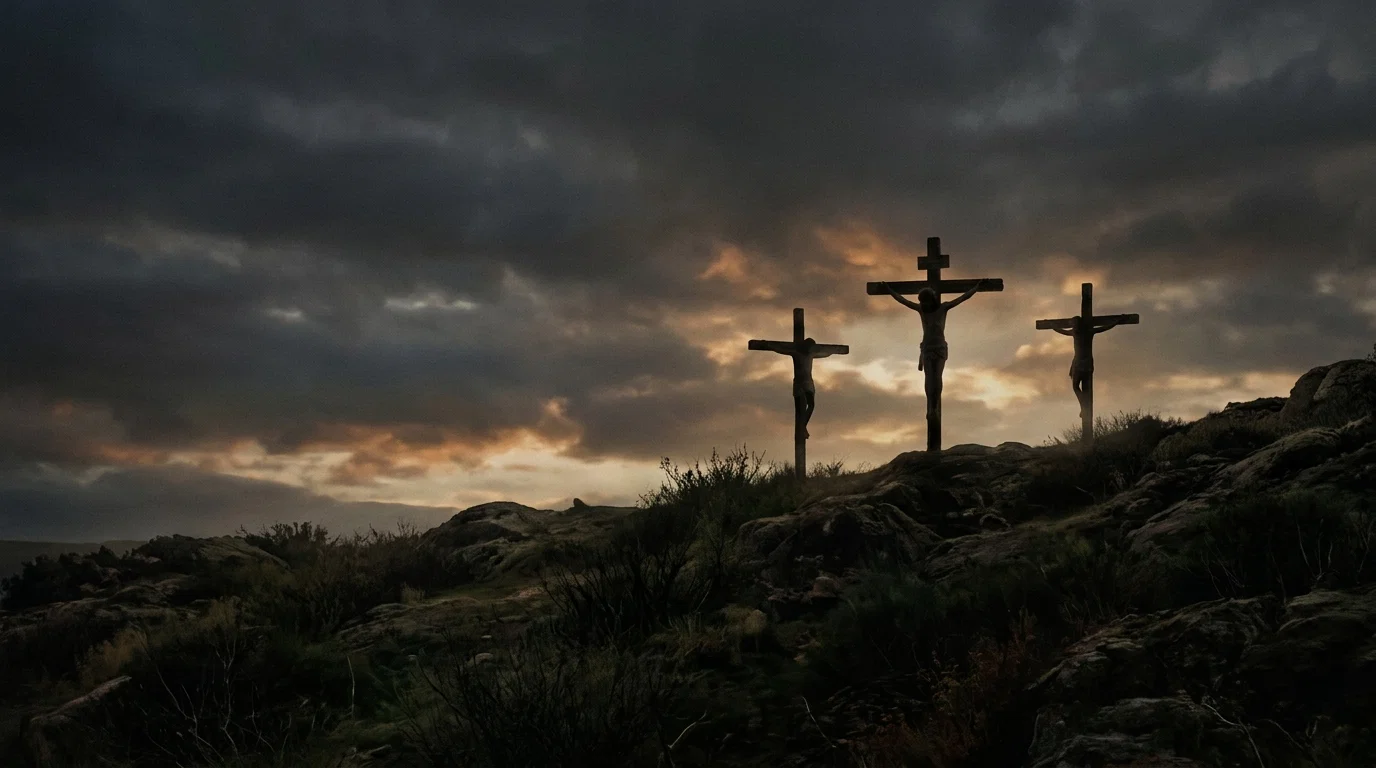
But as the curse, as the sin-offering, He must die, and die “without the camp,”—“without the gate” of Jerusalem. In order that He might die, however, Christ must empty Himself of His essential self—of His exclusive divinity, His immortality. He must remain God, but “GOD MANIFEST IN THE FLESH.” 1 Tim. 3:16. He must become God in man and man in God—the God-man. As man, He could and would die; as God, the sinless One, death could not hold Him, hell (the grave) must yield to Him, and in yielding become His prey. He must be “made in the likeness of men,” if He would die for men. But man was made a little lower than the angels. (See Psalms 8.) And so “we see Jesus, who was made a little lower than the angels for the suffering of death.” Heb. 2:9. We all know the sequel: He did die, the Just for the unjust; the King for the rebel, the Creator for the creature.
This brings us face to face with the most amazing, the most stupendous fact, in the history of the universe. He who from the days of eternity was absolute divinity, was pure Spirit, descends from that awful pinnacle to identify His immaculate and ineffably glorious Person with the person of man;—to become God manifest in the flesh, God manifest in man. God sent “His own Son in the likeness of sinful flesh, that He might condemn sin in the flesh.” Not that He might condemn sin simply in the universal flesh that He assumed when He was born a babe in Bethlehem, but that He, dwelling by His Spirit in the flesh of each individual sinner, might condemn, subdue, and cast out sin from the heart, from the flesh of every such individual. The great fact that the Word became flesh nineteen centuries ago, is the infallible pledge and guaranty that that same Word shall tabernacle in your flesh and in my flesh, and in so doing conquer sin in us, “that the righteousness of the law might be fulfilled in us, who walk not after the flesh, but after the Spirit.” Rom. 8:3. Is there any wonder, then, that Paul declares “Christ in you” to be “the hope of glory”? Paul further assures us that Christ in me, in you, that is, God manifest in the flesh, is the fundamental fact of the Gospel, the “pillar and ground-work” of the redemptive scheme, the great “mystery of godliness.” After His resurrection, Christ attested His identity with humanity by calling the attention of the disciples to His hands and His feet. And that same Jesus—God in the flesh—was “received up into glory.” “This same Jesus,” declared the angel, “shall so come again, in like manner, as ye have seen Him go into heaven.” Remember the prophecy: “Unto us a child is born, unto us a son is given.” Yea, He is GIVEN unto us, not simply loaned. Eternally He is
He hath made Him to be “a curse for us.”