White Robes

3%

Seventh-day Adventist Publishing Association · Battle Creek, Mich. · Aug 19, 1873

FromReview and Herald, Vol. 42, No. 10.

Read the full edition

White Robes.

THE NATURE AND PERPETUITY OF THE DIVINE LAW.
The position taken in previous articles is that the law of the Father, and the gospel of the Son, constitute harmonious parts of the plan of salvation, covering the entire period of human probation.
The divine law, however, dates back before the gospel; hence, the period of its existence is longer than that of the gospel. It existed before the fall, or there could not have been in the justice of God any such thing as the fall. It existed as early as there were created intelligences subject to the government of the Creator, and extends to the future, running parallel with the eternity of God’s moral government. Angels fell; therefore, were on probation. They, being on probation, were consequently amenable to law. In the absence of law, they could not be on probation, therefore, could not fall. The same may be said of Adam and Eve in Eden.
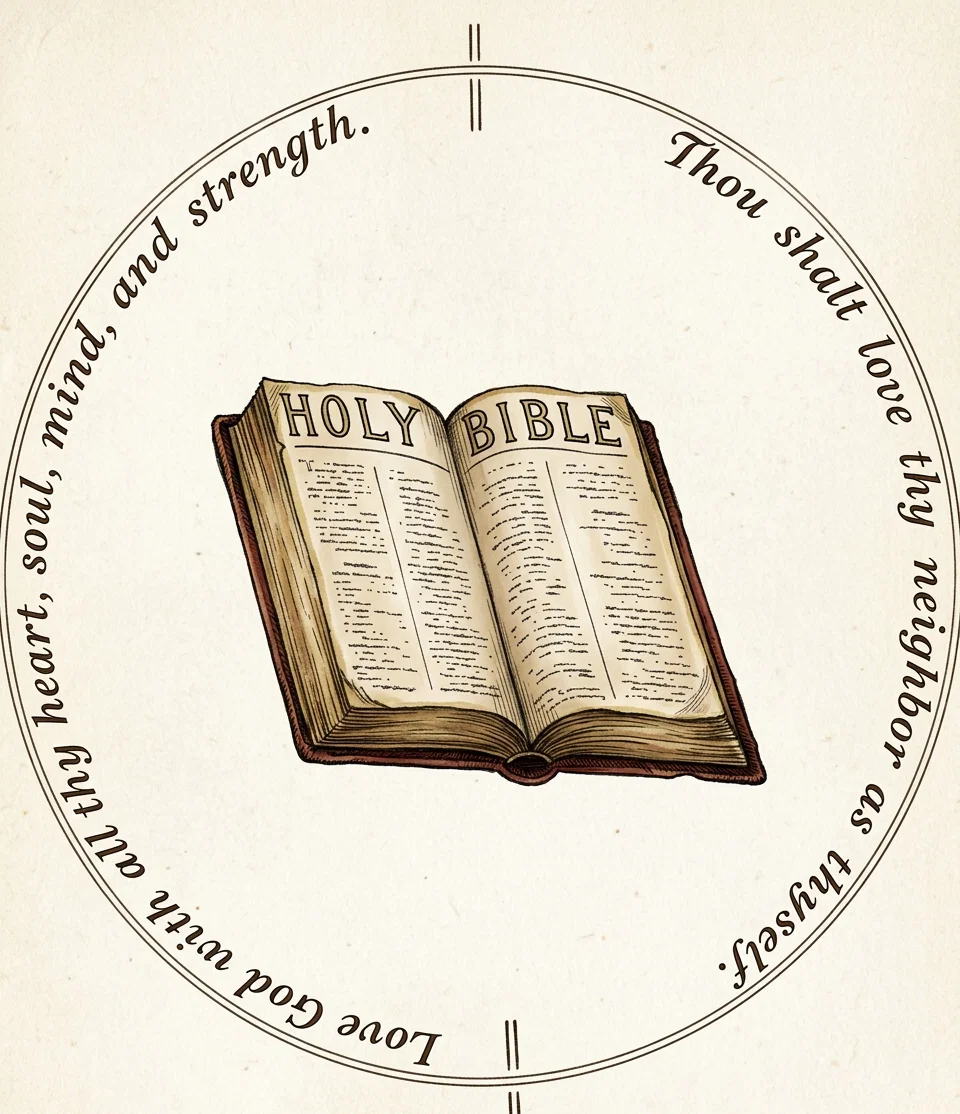
The ten commandments, as worded in the sacred Scriptures, are adapted to fallen beings. As thus worded, they are not adapted to the condition of holy angels, nor to man in his holy estate in Eden. The two grand principles of God’s moral government existed before the fall, in the form of law. These are given in the Old Testament, and are quoted by Christ in the New, as the two great commandments: “Thou shalt love the Lord thy God with all thy heart, and with all thy soul, and with all thy mind. This is the first and great commandment. And the second is like unto it, Thou shalt love thy neighbor as thyself. On these two commandments hang all the law and the prophets.” Matt. 22: 37–40; Deut. 6: 5; Lev. 19: 18.
These two commandments require supreme love to the Creator, and love to fellow-creatures equal to that bestowed upon one’s self. Angels could do no more than these require. Adam, before the fall, could do no more. We can do no more. The two great commandments embrace all that is required by the ten precepts of the decalogue. No precept and no principle of the book of God extends beyond this grand circle , inside of which is comprehended and summed up the will of God to man, concerning his Creator and his fellow-man.
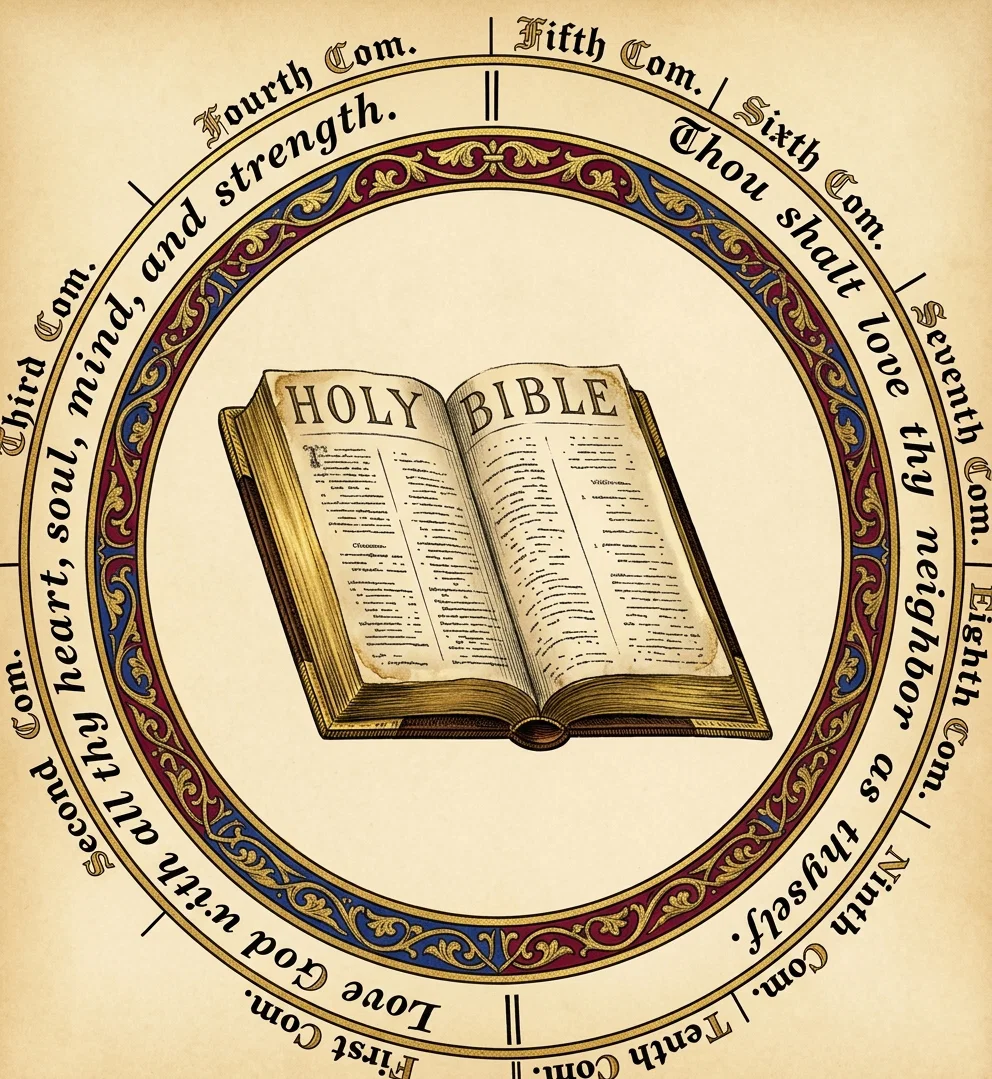
The foregoing circle in two parts is designed to illustrate the two principles of God’s moral government as expressed by the two great commandments; while the following circle represents the same as expressed and guarded by the ten precepts of the divine law.
Soon after the fall, we see the two principles of God’s moral government guarded by ten precepts, worded to meet man’s fallen condition.
Love to God is taught in the first four commandments, and love to our fellow-man is taught in the last six. The prophets of the Lord, the Son of God, and the apostles of Jesus, have all spoken in harmony with the ten precepts of the law of God. The whole duty of man, says Solomon, is to fear God and keep his commandments.
The ten precepts of the decalogue, so worded as to be adapted to man’s fallen condition, were enforced as early as the circumstances demanded them. The first three were applicable to Adam immediately after the fall. And although the Sabbath of the fourth precept was instituted at the close of the first week of time, before the fall, and we have evidence that Adam was directed to observe it as a memorial of creation, yet that portion of the precept adapted to the fallen state, relative to the man-servant, the maid-servant, and the stranger, could not exist till a later period, when such relations existed. The fifth commandment could not be enforced, until applicable to Adam’s children. The sixth, seventh, eighth, ninth, and tenth, were enforced as early as the parties existed to whom they could properly apply.
There is nothing in the moral condition of man in his fallen state, nor in the nature of the ten commandments themselves, to restrict them to any one dispensation more than another. Man’s moral wretchedness is the same, only more deplorable as he advances from the gates of Paradise toward the close of probation. And the law of God, adapted to his fallen state, is applicable and necessary throughout the entire period of his fallen condition, from Paradise lost to Paradise regained.
The reign of sin and that of death run parallel from Adam until sin and sinners shall cease to be. And parallel with them, stretching through all dispensations, there has been the knowledge of the principles of the ten commandments, consequently a knowledge of sin.
The means of this knowledge has been the law of God. “By the law,” says the apostle, “is the knowledge of sin.” Rom. 3: 20. “I had not known sin, but by the law.” Chap. 7: 7. As proof that this knowledge did exist immediately after the fall, see Gen. 4: 7, 23, 24; 6: 5, 11, 12. Also, Noah was righteous before God. Chap. 7: 1. He was a preacher of righteousness. 2 Pet. 2: 5. By his preaching right-doing, reproving the sins of the people of his time, he condemned the world. Heb. 11: 7. The men of Sodom and Gomorrah were great sinners, excepting one man. Abraham interceded, saying, Wilt thou destroy the righteous with the wicked? Gen. 13: 13; 18: 20, 23, 25; 19: 7. The blessing of God came upon Abraham, because he obeyed his voice and kept his commandments. Gen. 26: 5. Those who refused obedience, experienced his wrath for their transgressions. The cities of the plain were condemned for their unlawful deeds. 2 Pet. 2: 6–8.
As an illustration of this subject, we briefly notice the murder of righteous Abel. Cain killed his brother, and, as a sinner, received the mark of God’s displeasure. Sin, says the apostle, is the transgression of the law. 1 John 3: 4. Cain broke the sixth commandment; hence, that precept existed in the time of Cain. Otherwise he did not sin; for where no law is, there is no transgression. Rom. 4: 15.
The foregoing positions relative to the law of God would meet with but little opposition were it not for the Sabbath of the fourth commandment. The proper observance of the Bible Sabbath is not only crossing, but, with many, inconvenient, and not favorable to the successful prosecution of their worldly plans. The fearful and unbelieving shun its claims, brand it as a Jewish institution, and frequently assert that it was unknown to men until the Sabbath law was proclaimed from Sinai. Sacred history, however, proves this statement to be false. It is true that, though the record of setting apart the Sabbath to a holy use is given in Genesis, there is no distinct mention of its observance in that book. But this does not prove that it did not exist during the long period covered by that brief record. The facts connected with the giving of the manna show that the Israelites understood the obligations of the Sabbath, and that some of the people violated them, and were reproved by the Lord, thirty days before they saw Mount Sinai. See Ex. 16–19.
We call attention to three grand events which have taken place in connection with the sad history of fallen man, either one of which is sufficient to establish the perpetuity of the law of God.
First, the fall, with all its terrible consequences. If the law of God was of such a nature that it could, in any particular, be changed at any time, it would have been thus changed when there were but two fallen beings, Adam and Eve, just before leaving Eden. If the plan of God’s moral government could be changed, it would then have been changed, so as to set them free, and save the tide of human wretchedness and agony which has followed. But, no; it could not be changed. The curse must fall on man, and upon the earth for man’s sake. And the blight and mildew of sin must follow everywhere, and moral darkness, like a pall of death, must spread everywhere. Why? Because God’s law that had been transgressed could not be changed—could not be abolished. This is the result of sin and the terrible fall. And this has all come about because of the transgression of that law which is as changeless as the throne of Heaven. Every fading flower and falling leaf, since man left Eden, has proclaimed the law of God changeless.
If that law could ever be changed in any particular, it would have been changed when there were but two fallen beings. It would then have been changed in such a way as to free them from the sentence of death, and raise them from their degradation, and the race from continued sin, crime, and woe. Think of the recent American war, with all its terrible agony. And this is only an item in the vast catalogue. For six thousand years, the tide has been swelling, and creation has been adding groan to groan. Who can compute the amount of moral wretchedness and agony in consequence of the violation of God’s immutable law? The fall, then, with all its accumulated wretchedness, proclaims God’s law changeless.
Second, the announcement of the ten commandments from Sinai with imposing display. It was not left for Moses to proclaim this law. It was not left for an angel to assemble the tribes of Israel, and utter these ten holy precepts in their hearing. The Lord himself descends in awful grandeur, and proclaims the precepts in the hearing of all the people.
Do you say that that was the origin of the law of God? Do you say that God descended on Sinai, and there legislated? And do you say that he has since abolished that code? When did he do this? Where did he do it? Has any prophet foretold that such an event should take place? And has any apostle recorded that such a work was ever done? Certainly not. It is only by confounding the handwriting of ordinances with the royal law, that men infer that the divine law is abrogated.
Congress enacts laws which are published throughout the Union. The people understand them. Some of these laws are afterward repealed or changed. Is this done in secret, and the people permitted to know nothing about it? No; the same law-making body makes the changes, and the people are apprised of the fact. And has not God manifested as much wisdom and benevolence in the management of the affairs of his moral government in which man has so great an interest—affairs which affect his eternal welfare? He came down upon Sinai, and proclaimed his law under such circumstances as to impress the people with its grandeur, dignity, and perpetuity. Who can suppose that he would abolish or alter it, and say nothing about it?
Third, the crucifixion establishes the law of God. If that law was of such a nature that it could be abolished, or any of its precepts changed, why not have this done, and set man free, instead of the Son of God’s laying aside his glory, taking our nature, living the sad life he lived here upon the earth, suffering in Gethsemane, and finally expiring upon the cross? Oh! why should the divine Son of God do all this to save man, if that law which held him as a sinner could be changed, so that he could be set free? But no change could be made in the divine law. Man had sinned, had fallen, and was shut up in the prison-house of sin. His sins were of such a nature that no sacrifice was adequate but the sacrifice of Him to whom the Father had said, “Let us make man.” The death of an angel was not sufficient. He only who engaged with the Father in the formation of man, could constitute a sufficient sacrifice to open the door of hope by which he might find pardon, and be saved. In the language of the hymn we sing, “Come, O my soul, to Calvary,” and there behold love and agony mingled in the death of the Son of God.
Behold him groaning in Gethsemane. His divine soul was in agony as the sins of men were rolled upon him. “My soul,” said he, “is exceeding sorrowful, even unto death.” The weight of man’s sin in transgressing God’s immutable law was such as to press from his pores as it were great drops of blood.
He then bears his cross to Calvary. The nails are driven into his hands and feet. The cross is erected. There the bleeding Lamb hangs six terrible hours. The death of the cross was most agonizing. But there was in his case the additional weight of the sins of the whole world. In his last expiring agony he cries, “My God, my God, why hast thou forsaken me?” and bows his head in death.
The sun, the brightest luminary in heaven, can no longer view the scene, and is vailed as with sackcloth. The vail of the temple, the noblest work of man, is rent in twain. Christ, the noblest being in the universe, save One, is dying in agony. Creation feels the shock, and groaning and heaving, throws open the graves of many of the saints, who come out of their graves after his resurrection. The law must stand as firm as the throne of Heaven, although the earth shakes, and the whole creation trembles, as the Son of God dies in agony.
The law of God was given to man as his saviour. He broke it. Could it then redeem him? It is not in the power of law, either human or divine, to redeem the transgressor. Those who transgress the law of any commonwealth, must suffer the full penalty, unless the governor shall pardon the transgressor. Pardon is the transgressor’s only hope of escaping the full sentence of the law. Some, who do not fully understand our position, say that we trust in the law, and the keeping of the Sabbath, for salvation. No, friends, you may observe all the ten commandments, to the best of your ability, conscientiously; but if you look no farther than the law, you can never find pardon and salvation. Our only hope of eternal life hangs upon Christ. Adam placed his hope there. Abel, Enoch, Noah, Abraham, and the believing Jews, had no other hope. We can do no more. The hope of the next life depends upon Jesus Christ. Faith in his blood can alone free us from our transgressions. And a life of obedience to the commandments of God and the faith of Jesus will be a sufficient passport through the golden gates of the city of God. J. W.
Black Hawk, Colorado, Aug. 12, 1873.