Either the claims of the Church of Rome are just, or they are not.
If they are, she is infallible and indefectible. She is the mother and mistress of churches. Her Pontiff is the universal pastor, the center of unity, the father of the faithful, the supreme head and spiritual judge of Christendom, and (as he himself asserts) it is necessary for every one to be in communion with him and to be in subjection to him. Out of his communion there is no salvation.
Now, we hold in our hand the Apocalypse of St. John, the revelation of Jesus Christ, the voice of the Spirit to the churches, the prophetic history of the church from the apostolic age to the day of doom.
In it St. John places us at Rome; he points to its seven hills; he shows us the city enthroned upon them; he detains us there, while he reveals to us Rome’s future history, even to its total extinction, which he describes.
1. If (as Rome affirms) Christ has instituted a spiritual supremacy and an infallible authority which all men are obliged to acknowledge and to which all must bow and with which all must be in communion on pain of everlasting damnation, it may reasonably be supposed that the Holy Spirit, in revealing the future history of the church (as he does in the Apocalypse) and in providing guidance and comfort for Christians under their trials, which he predicts, would not have failed to give some notice of such spiritual supremacy and infallible authority in the church.
2. If Christ has settled that spiritual pre-eminence and supremacy at Rome, it may reasonably be concluded that the Holy Spirit, when speaking specially and copiously of Rome, and tracing her history (as he does in the Apocalypse), and as he does even to the day when she will be burned with fire and her smoke ascend to heaven, would not have omitted to mention that pre-eminence and supremacy supposed to exist at Rome.
3. If the Church of Rome is—as she herself affirms—the true spouse of Christ, the mother and mistress of all churches in Christendom, and if communion with her is necessary to salvation, assuredly the Holy Spirit would have taken great care that no reasonable man should be able to impute to the Christian Church of Rome what he intended for the heathen city of Rome. And since by the union of the supreme civil authority and the spiritual in the person of the bishop, who is also the sovereign of Rome, and by the consequent incorporation of the city of Rome in the Church of Rome, there was great probability of such a confusion,—which the Holy Spirit could foresee,—he would have guarded against it, and have taken care that the character he draws of the harlot, and the awful description which he gives in the Apocalypse of her future doom, could not possibly be applied by any reasonable man to the Church of Rome.
Now, what is the fact?
1. Not a word does the Holy Spirit say in the Apocalypse, of the existence of any supreme4visible head or infallible authority in the church.
2. Not a word does he say of the Church of Rome as the center of unity, the arbitress of faith, the mother and mistress of churches. Not a word does he speak in her praise. Indeed, the advocates of the Church of Rome (who all allow that, in the Apocalypse, he speaks largely of the Roman city) say that he does not mention the Church of Rome at all!
How unaccountable is all this if, as they affirm, Christ has instituted such a supremacy, and if he has placed it at Rome!
But now let us take the other alternative. Let the claims of the Church of Rome be unfounded; then it must be admitted that they are nothing short of blasphemy, for they are claims to infallibility, indefectibility, and universal dominion, spiritual and temporal, which are attributes of Almighty God.
And now again let us turn to the Apocalypse. What do we find there?
We see there a certain city portrayed, a great city, the great city, the queen of the earth when St. John wrote, the city on seven hills, the city of Rome.
At Rome, then, we are placed by St. John. We stand there by St. John’s side. This city is represented by him as a woman; it is called the harlot. It is contrasted by him with the woman in the wilderness, crowned with the twelve stars, the future bride in heaven, the New Jerusalem; that is, it is contrasted with the faithful apostolic church, now sojourning on earth, and to be glorified hereafter in heaven.
The harlot persecutes with the power of the dragon; the bride is persecuted by the dragon. The harlot is arrayed in scarlet; the bride is attired in white. The harlot sinks to an abyss; the bride mounts to heaven. The bride is the faithful church; the harlot, contrasted with her, is a faithless church.
The great city, then, which is allowed to be living, is called a harlot, and a harlot is a faithless church; therefore that great city is the Church of Rome.
This harlot city is represented as seated upon many waters, which are peoples, and nations, and tongues. Kings give their power to her and commit fornication with her. She boasts that she is a queen forever. She is displayed as claiming a double supremacy.
Now, look at Rome. She, she alone of all the cities that are or ever have been in the world, asserts universal supremacy, spiritual and temporal. She wields two swords. She wears two diadems. And she has claimed this double power for more than a thousand years. “Ruler of the World,” “Universal Pastor,” “Father of Kings and Princes,”—these are the titles of her Pontiff. She boasts that she is the Catholic Church; that she is “alone, and none beside her,” on the earth; she affirms that her light will never be dim, her candlestick never removed. And yet she teaches strange doctrines. She has broken her plighted troth, and forgotten the love of her espousals. She has been untrue to God. She has put on the scarlet robe and gaudy jewels and bold look of a harlot, and gone after other gods. She canonizes men,—as she did the other day (June 8, 1862),—and then worships them. She would make the apostles untrue to their Lord, and constrain the blessed mother of Christ to be a rival of her divine Son. She salutes angels, and thereby dishonors the triune God, before whose glorious majesty they veil their faces. She deifies the creature, and thus defies the Creator.
St. John, when he calls us to see the harlot city, the seven-hilled city, fixed her name on her forehead—Mystery—to be seen and read by all. And he says, “Blessed is he that readeth, and they that hear the words of this prophecy.”
Her title is Mystery, a secret spell bearing a semblance of sanctity, a solemn rite which promises bliss to those who are initiated in it, a prodigy inspiring wonder and awe in the mind of St. John, an intricate enigma requiring for its solution the aid of the Spirit of God.
Heathen Rome doing the work of heathenism in persecuting the church was no mystery. But a Christian church, calling herself the mother of Christendom, and yet drunken with the blood of saints,—this is a mystery. A Christian church boasting herself to be the bride, and yet being the harlot; styling herself Zion, and being Babylon,—this is a mystery. A mystery indeed it is that when she says to all, “Come unto me,” the voice from heaven should cry, “Come out of her, my people.” A mystery indeed it is that she who boasts herself the city of saints should become the habitation of devils; that she who claims to be infallible should be said to corrupt the earth; that a self-named “mother of churches” should be called by the Holy Spirit the “mother of abominations”; that she who boasts to be indefectible should in one day be destroyed, and that apostles should rejoice at her fall; that she who holds, as she says, in her hands the keys of heaven, should be cast into the lake of fire by Him who has the keys of hell. All this, in truth, is a great mystery.
Nearly eighteen centuries have passed away since the Holy Spirit prophesied, by the mouth of St. John, that this mystery would be revealed in that city which was then the queen of the earth, the city on seven hills, the city of Rome.
The mystery was then dark, dark as midnight. Man’s eye could not pierce the gloom.
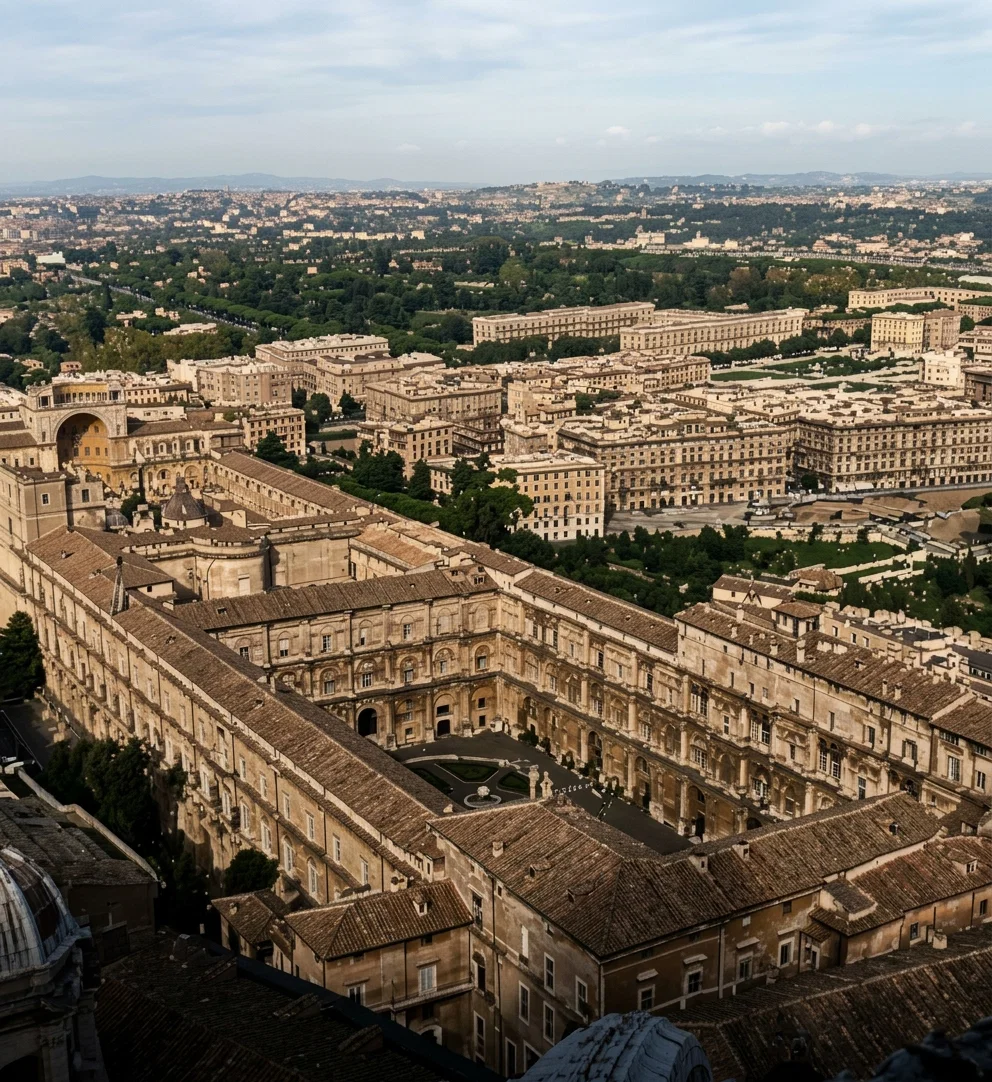
THE VATICAN FROM THE DOME OF ST. PETER'S
The fulfillment of the prophecy seemed improbable, almost impossible. Age after age rolled away. By degrees the mists which hung over it became less thick. The clouds began to break. Some features of the dark mystery began to appear, dimly at first, then more clearly, like mountains at daybreak. Then the form of the mystery became more and more distinct. The seven hills, and the woman sitting upon them, became more and more visible. Her voice was heard. Strange sounds of blasphemy were uttered by her. Then they became louder and louder. And the golden chalice in her hand, her scarlet attire, her pearls and jewels, were seen glittering in the sun. Kings and nations were displayed prostrate at her feet, and drinking her cup. Saints were slain by her sword, and she exulted over them. And now the prophecy becomes clear, clear as noonday; and we tremble at the sight, while we read the inscription, emblazoned in large letters, “Mystery, Babylon the Great,” written by the hand of St. John, guided by the Holy Spirit of God, on the forehead of the Church of Rome.—“Union With Rome,” Chr. Wordsworth, D. D., Longmans, Green & Co., 1909, pages 58-63.