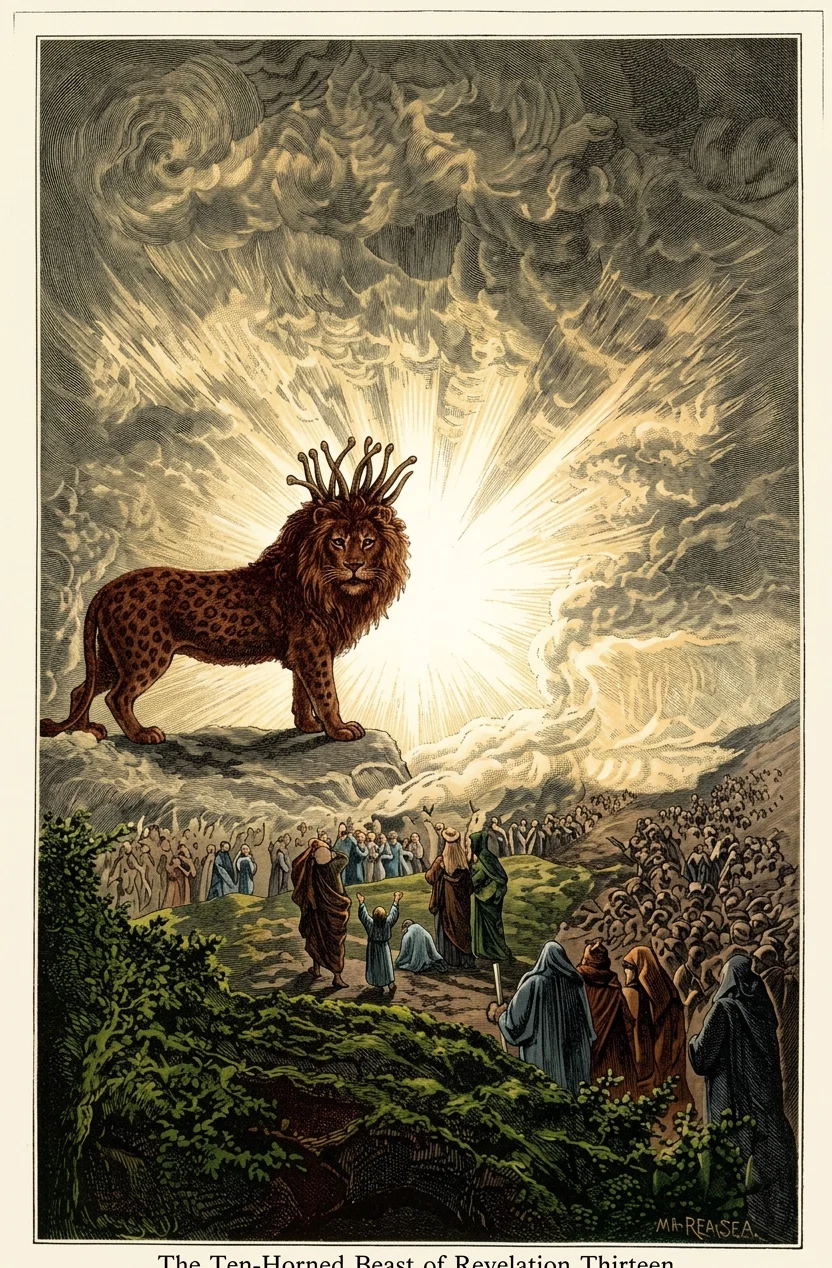
In all the Bible there is no more fearful penalty pronounced than that to be visited upon the worshipers of the beast and his image. See Rev. 14:9, 10. "If any man worship the beast and his image, and receive his mark in his forehead, or in his hand, the same shall drink of the wine of the wrath of God, which is poured out without mixture into the cup of His indignation." In order to understand what is meant by the beast and his image, it will be necessary to consider briefly the prophetic symbols in chapter thirteen.
The Symbol of Persecution.
In the first part of the chapter the prophet beholds a beast rise up out of the sea, making war with the saints, and speaking blasphemies. This prophetic symbol is quite generally understood to represent that condition of affairs which characterized the Middle Ages, during which so many millions of so-called heretics were put to death because they dissented from the teachings of the self-styled orthodox church.
The political rulers of those times conceived it to be their highest duty to enforce the dogmas of the State-church upon all their subjects, and those who refused to subscribe to the established creed were counted heretics and punished as prescribed by law.
A Striking Utterance.
History records the following striking reply of Theodore Beza, a leading heretic, to a persecuting ruler: "Sire, it is the lot of the church of God, which I represent, to receive blows, and not to give them; but may it please you also to remember that it is an anvil that has worn out many hammers."
As we near the close of the medieval night, and behold the gray dawn of the modern age, we find so-called heresy making a desperate struggle for the right to worship according to the dictates of conscience. We also find most of the great nations striking terrific blows on the anvil of heresy, which answers the shock by sending out its ringing impulses for freedom until they echo round the world.
The dawn of the modern age witnessed the old medieval idea of Church and State, with its intolerance and despotism, symbolized by the beast which rose up out of the sea and made war with the saints, gradually on the decline. At the same time the new idea of religious liberty and equality was coming up out of the earth where it had so long been trampled into the dust. What could be more natural than that the prophet should see something to represent the rise and progress of the long-buried principles of religious freedom?
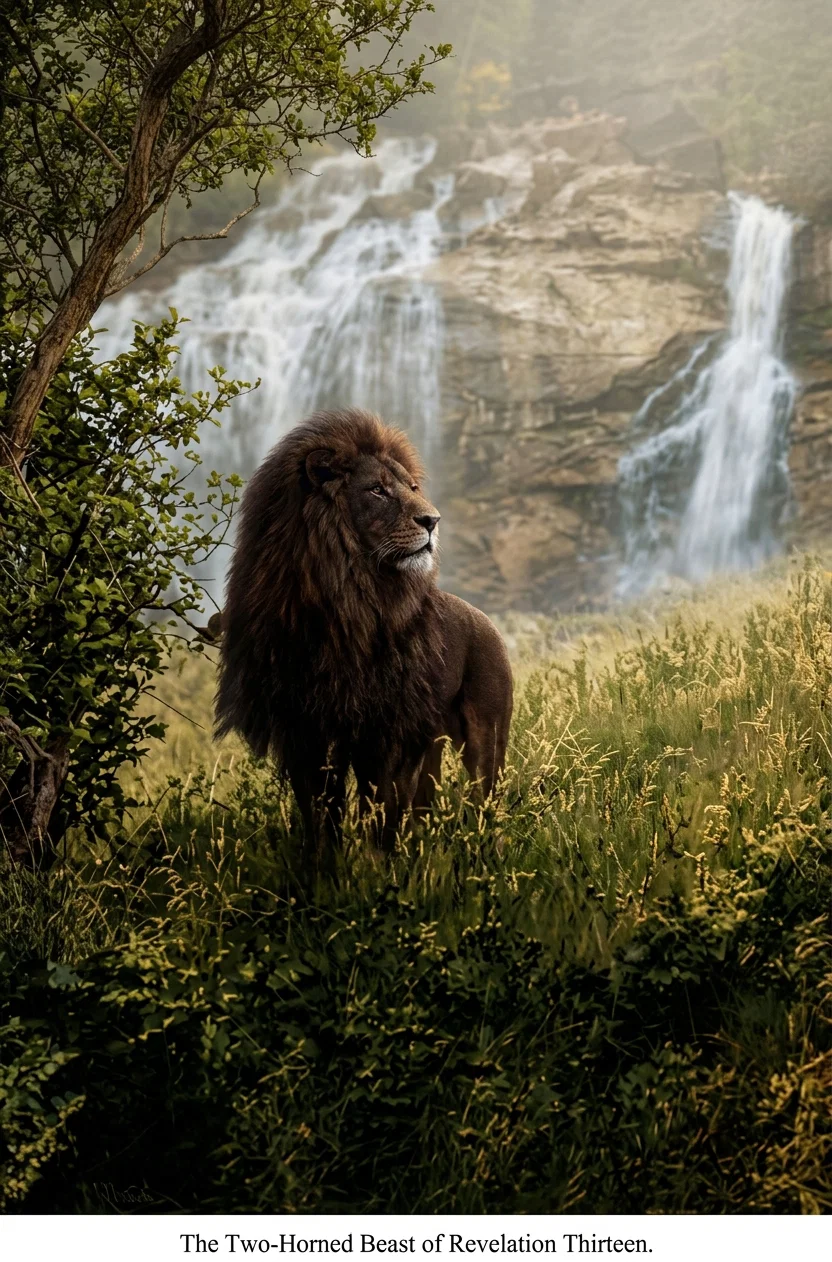
The Two-Horned Beast of Revelation Thirteen.
The Symbol of the Image Power.
Chapter thirteen, beginning with verse 11, supplies the very symbol we should naturally expect to see: "I beheld another beast coming up out of the earth, and he had two horns like a lamb." Nothing could better symbolize the rising power of the principles of civil and religious liberty than this lamb-like beast coming up out of the earth. Just about the time that the rapidly growing spirit of freedom began to need more room for expansion, the New World was discovered, and became first an asylum and then a citadel for the refugees who fled from the intolerance and despotism of the Old World. It was not the opening up of the New World that gave birth to liberty, but rather the expansion of liberty in the Old World that made the opening up of the Western Hemisphere a necessity.
When the Netherlanders, the Puritans, and the Huguenots laid the foundation for a new nation in the New World, they used material which had already been fashioned in the quarry of liberty and tested by the pressure of persecution. When the great American nation started on her track of destiny, the two great rails of civil and religious liberty underneath the train had already been forged in the furnace of affliction. The soundness of the great principles of political and religious freedom, which we have just likened to two great steel rails, has been duly attested by the wonderful progress of the train; but "eternal vigilance is the price of liberty," and if the rails of freedom are unspiked, or warped, or twisted, there is danger of a wreck. That the prophet foresaw just such a danger may be seen by the further description of this second beast.
He Changes His Character.
After noting that this second beast "had two horns like a lamb," the prophet immediately says that "he spake as a dragon;"6and a little further on he says that this same beast says "to them that dwell on the earth, that they should make an image to the [first] beast." To make an image to the first beast would be to repudiate the principles of civil and religious liberty, and return to the dreary paths of intolerance and despotism.
It is a well-known fact that even in this country there is a strong and rapidly growing tendency to make religious observances a subject of State and national legislation. But whenever any government attempts to regulate anything pertaining to religion by human legislation, it thereby commits itself to the old medieval idea of Church and State union, and just to that extent is helping to "make an image to the beast."
The first beast is represented as receiving his power from the dragon, which is a symbol of Satan. See Rev. 12:9. The second beast has two horns like a lamb to represent the principles of liberty which came from Christ, "the Lamb of God." What a contrast! After all the plainly written warnings on the pages of prophecy and history, shall we retrograde from the principles of the Lamb, back to those of the dragon? God forbid!
World-Wide Apostasy and Deliverance.
Let us thank the Lord that while this prophecy clearly points to a world-wide apostasy from the principles of Christian liberty, it also clearly points to the eternal triumphs of a few who choose to remain faithful to those principles while the many are engaged in making "an image to the beast." Returning for a moment to the warning message quoted at the beginning of this article and recorded in Rev. 14:9, 10, we find a little further on in verse 12 a people of whom it is said: "Here is the patience of the saints: here are they that keep the commandments of God, and the faith of Jesus." Just a little further on the prophet beholds "a white cloud" bearing the Son of Man with a sharp sickle in His hand, coming to reap the earth's harvest. Still further on, in chapter 15, he sees the faithful little company on the sea of glass, victorious at last over the beast and his image. God grant that the readers may all meet the writer there where liberty will at last triumph over tyranny.