A BIRD'S EYE VIEW

3%

Seventh-day Adventist Publishing Association · Battle Creek, Mich. · Jan 6, 1876

FromReview and Herald, Vol. 47, No. 1.

Read the full edition

A BIRD'S EYE VIEW

Of the Great Field of Prophecy.
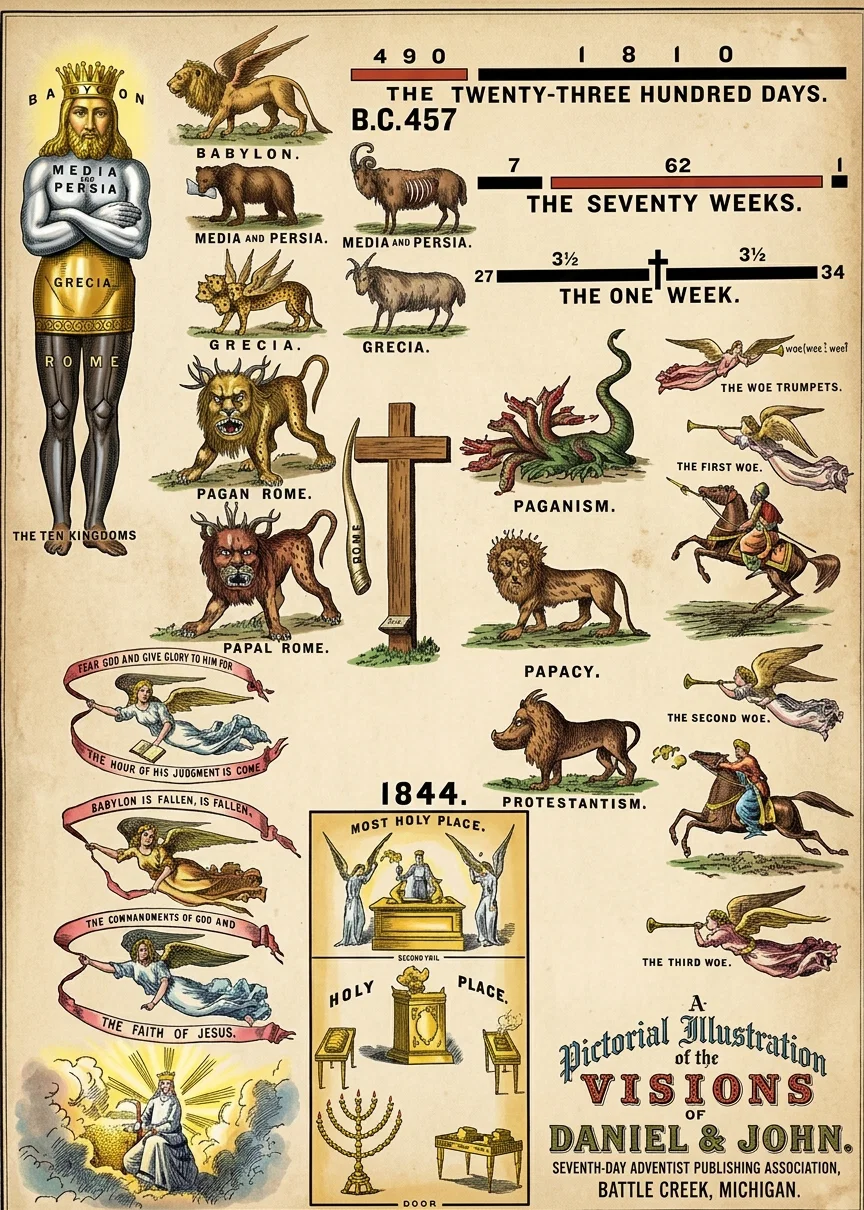
The accompanying illustration is a miniature representation of our chart, upon which are delineated the principal symbols of the Bible. This method of instruction is peculiar to the volume of divine inspiration. It alone occupies this field. As if possessed of an exclusive right, it monopolizes this channel of information. And the method is worthy of the book, and the book the appropriate place for the method; for in no other way can knowledge be imparted in so condensed and vivid a form. The eye thus becomes the handmaid of the mind in the reception of ideas, and a single glance takes in that which many pages of history would be required to describe.
A Pictorial Illustration of the Visions of Daniel & John.
The chart is an attempt to illustrate with the pencil what Daniel and John have delineated with the pen, so that the mind may more easily conceive of the pictures which they describe.
Some would-be wiseacres, while looking at these symbols and seeing united in the same beast the horns of ruminating animals and the teeth and claws of carnivorous ones, have archly imagined they had detected the prophet in a blunder, as such teeth and horns do not belong together; not thinking far enough to consider that inspiration to properly represent the wicked governments of earth had to depart from nature, and combine in one species of animal all those instruments of defense or destruction which in nature are possessed by many. Candidly considered and carefully studied, there will be found a fitness between the symbol and the thing symbolized, which is at once appropriate and instructive.
The symbols of the chart may be in brief described as follows:—

THE GREAT IMAGE.

The image in the upper left hand portion is introduced and partially interpreted in the second chapter of Daniel. It is composed of four different metals, gold, silver, brass, and iron, and represents the succession of earthly governments from the kingdom of Babylon under Nebuchadnezzar till the close of time. Daniel told Nebuchadnezzar plainly, “Thou art this head of gold.” Dan. 2: 38. Or, Thy kingdom is this head of gold. This kingdom was introduced into prophecy at the capture of Manasseh, king of Judah, by the Assyrians, B. C. 677.
After him was to arise another kingdom, the breast and arms of silver, Medo-Persia, which held the position of power from the overthrow of Babylon by Cyrus, B. C. 538, to the defeat of Darius Codomannus, by Alexander the Great, at the battle of Arbela, B. C. 331, having continued 207 years.
A third kingdom was to follow, represented by the sides of brass. This was the Macedonian or Grecian kingdom, the period of its supremacy dating from B. C. 331 to the conquest of Macedonia by the Romans B. C. 168.
And a fourth kingdom, the Roman, is represented by the legs of iron. The ten toes on the feet of this image signify the ten kingdoms into which the old Roman Empire was broken up by the incursions of the Northern barbarians between the years 356 and 483 A. D. This kingdom dates from the famous Jewish league B. C. 161, and continued to its fully divided state 483 A. D., the long period of 644 years. This divided state still continues, and, according to the prophecy, was to continue till the God of Heaven sets up his kingdom on the ruin and overthrow of all earthly governments. This event next follows, and is the one for which we consequently next look, in this line of prophecy.

SYMBOLS OF DAN. VII.

The next line of symbols at the right covers the same ground with additional particulars, described in Daniel, chapter 7. The lion represents Babylon; the bear, Medo-Persia; the leopard, Grecia (the wings denoting rapidity of conquest, and the four heads the division of the empire into four parts after Alexander's death); the fourth, nondescript beast, Rome. The ten horns on the head of this beast are plainly said by the angel to Daniel to be ten kingdoms that would arise out of this fourth or Roman Empire. Verse 24. These correspond to the ten toes of the image, and the kingdoms they represent were the Huns, Ostrogoths, Visigoths, Franks, Vandals, Suevi, Burgundians, Heruli, Anglo-Saxons and Lombards. See Machiavel, Dr. Hales, Bishop Newton, Faber, and Lloyd.

THE PAPACY.

This beast presents a second phase. Another horn arises among the ten, diverse from them all, having eyes like the eyes of a man, and a mouth speaking great things. Such a kingdom was the papacy, which so long held spiritual dominion over the nations of Europe. It was diverse from the others, being a spiritual kingdom. It had eyes like the eyes of man, in the far-seeing sagacity and cunning of the Roman bishops. It had a mouth speaking great things in assuming as it did the titles of the Deity, and in the blasphemous pretensions it has put forth. Respecting this horn, the time of its continu- ance is given: a time, times, and a half; elsewhere spoken of as forty-two months, and 1260 days (years). See Rev. 12: 6, 14; 13: 5. This period dates from the time when Justinian's decree, making the pope the corrector of heretics and the head of all the churches, was carried into effect by the expulsion of the Goths from Rome by Belisarius, A. D. 538. The three kingdoms subdued to make way for this elevation of the papacy were the Vandals, the Heruli, and the Goths. This papal supremacy continued for just 1260 years, to 1798, when the papacy was temporarily overthrown by the French. See Baronius, Croly on the Apocalypse, Bower's History of the Popes, &c. Shortly after this, Daniel saw this power given to the burning flame, which Paul says, 2 Thess. 2: 8, will be accomplished by the brightness of the second coming of Christ, the event which is consequently next to transpire in this line of prophecy.

SYMBOLS OF DAN. VIII.

The third line of symbols is explained in Daniel, chapter 8. It gives the same succession of kingdoms from the time of Persia onward. The angel told Daniel that the ram represented Persia, and the goat, Grecia. Dan. 8: 20, 21. In the little horn arising afterward appears Rome again, as in the other lines of prophecy. In connection with these symbols is given a prophetic period of 2300 days (years, Eze. 4: 6; Num. 14: 34). This is the longest prophetic period given in the Bible, and reaches down to the latest point. Data to establish the commencement of this period are found in Dan. 9: 25, and Ezra 7: 1, 8. The commandment to restore and build Jerusalem, composed of the decrees of Cyrus, Darius, and Artaxerxes, Ezra 6: 14, was completed by the decree of Artaxerxes Longimanus, B. C. 457. Ezra 7: 1, 8. The 2300 days commencing at that point consequently terminated in A. D. 1844. Hence, we are past all prophetic periods, and therefore can set no time for the Lord to come. It is a cardinal point with Seventh-day Adventists in the interpretation of the prophecies that no prophetic period reaches to the coming of Christ, and that it is therefore impossible to set the time for that event, there being no data for any such calculation. This is one difference which we wish to be clearly understood between Seventh-day Ad- ventists and First-day Adventists.

THE SANCTUARY.

By the period of the 2300 days we are brought to the cleansing of the sanctuary, Dan. 8: 14, represented in the lower central portion of the chart. The sanctuary of the Bible consists, first, of the tabernacle erected by Moses (Ex. 25, and onward), and, secondly, of the greater and more perfect tabernacle or temple in Heaven, of which the former was a type, figure, or pattern. Ex. 25: 9; Heb. 8: 1, 2, 5; 9: 1-9, 23, 24. The cleansing of the sanctuary was a brief service performed by the high priest in the most holy place of the sanctuary before the ark, which contained the tables of the ten commandments, to conclude a complete round of service therein. Lev. 16. If the 2300 days above referred to terminated in 1844, of which there can be no doubt, the position of our Lord since that time has been in the most holy place of the heavenly sanctuary, before the ark of the ten commandments, finishing his work as priest and mediator, at the conclusion of which he will take his throne as king, and appear in the clouds of heaven in power and glory. Then he will gather to himself all those members of the human family who, during his priesthood, secured by repentance and faith the forgiveness of their sins, and thus proved themselves worthy to be the subjects of his everlasting kingdom. John 14: 3. For this purpose he will, at his second coming, raise from their graves the righteous dead, and change to immortality the righteous living. 1 Cor. 15: 51-53; 1 Thess. 4: 15-17. Referring to the ancient types, it is reasoned that this period of the cleansing of the sanctuary must be a comparatively very brief, though indefinite, space of time; and as thirty-one years of it have already elapsed, reasoning from analogy, it must very soon terminate; and, therefore, the second advent of Christ must be very near.

SYMBOLS OF REV. XII AND XIII.

The fourth line of symbols on the chart, commencing with the great red dragon, is described in Revelation, chapters 12 and 13. John, living under the sixth, the imperial, form of the Roman government, the seven different forms being indicated by the seven heads of the dragon, and those of the following beast, looks forward simply from his own time.
The dragon symbolizes pagan Rome; Rev. 12: 3-5; the leopard beast, Rev. 13: 1-10, the papacy; and the third symbol, a beast with two horns like a lamb, our own government. Rev. 13: 11-16.
There is the most clear and ample ground for applying this symbol to the United States. This nation, in its location, the time and manner of its rise, its character, mild and lamblike, itsmarvelous progress and development during the last century, most strikingly exhibits the phenomena, religious and scientific, here indicated. The power fulfills the prophecy of the false prophet, Rev. 13: 14; 19: 20, which will be accomplished by means of modern spiritualism, which originated, and has so rapidly developed, in this country. It meets the same fate as the papal power, already referred to. And the fact that it is to be cast alive into the lake of fire, shows that it will never give place to any other government, but will be in the height of its power when the second advent shall occur. Nothing remains to be fulfilled but that which can in a very brief space be accomplished. It must, therefore, be near the end of its career; and the conclusion recurs again, that the coming of Christ must be at hand.

THE WOE TRUMPETS.

The last line of symbols at the right of the chart represents the last three of the series of seven trumpets of Rev., chapters 8 and 9. There is, perhaps, no point upon which commentators are more generally agreed than upon the view that the fifth and sixth of these trumpets, as described in Rev. 9, were fulfilled in the rise and progress of Mohammedanism under the Saracens and Turks. The prophetic periods of verses 10 and 15 reach from the invasion of Nicomedia by Othman, July 27, 1299, to the virtual surrender of his dominion by the Sultan of Turkey into the hands of the Christian powers of Europe, Aug. 11, 1840. Shortly after this the seventh trumpet was to sound, and the “kingdoms of this world become the kingdom of our Lord, and of his Christ.” Rev. 11: 14, 15.

THE THREE MESSAGES.

The three angels in the lower left hand portion of the chart represent the three messages of Rev. 14: 6-14, followed by one like unto the Son of man seated upon a white cloud, representing the second advent. These messages are the prophecy of a special proclamation and warning, to go to the world just before the coming of Christ, and in reference to that event. There has been no movement in the gospel dispensation to fulfill this prophecy except the proclamation which has gone forth in our own generation in reference to the soon coming of Christ. It commenced with the movement of 1840-44 and culminates in the work in which Seventh-day Adventists are now engaged. This involves a reform on the commandments of God, as brought to view in verse 12, or a change from the first day of the week, as the Sabbath, to the seventh, the day which the fourth commandment enjoins.
This movement fulfills the prophecy, by filling full every specification presented. God does not fulfill his word twice; and a false fulfillment never precedes a true. After a prophecy is uttered, the first time we find the specifications fully met, then and there we find the fulfillment of the prophecy. The present Advent movement thus answers to the three messages of Rev. 14. When mankind shall have been sufficiently warned and tested by this message, and this must soon be accomplished, the Son of man will appear.
Thus it will be seen that in all this prophetic field, every line of prophecy, so far as represented by the symbols, is either already wholly fulfilled, or in the very last outlines of fulfillment. And they take us to the close of this dispensation. Therefore the end of all things, the second coming of Christ, and the Judgment, events the magnitude and importance of which language is tame and powerless to describe, are now at our very doors. U. S.