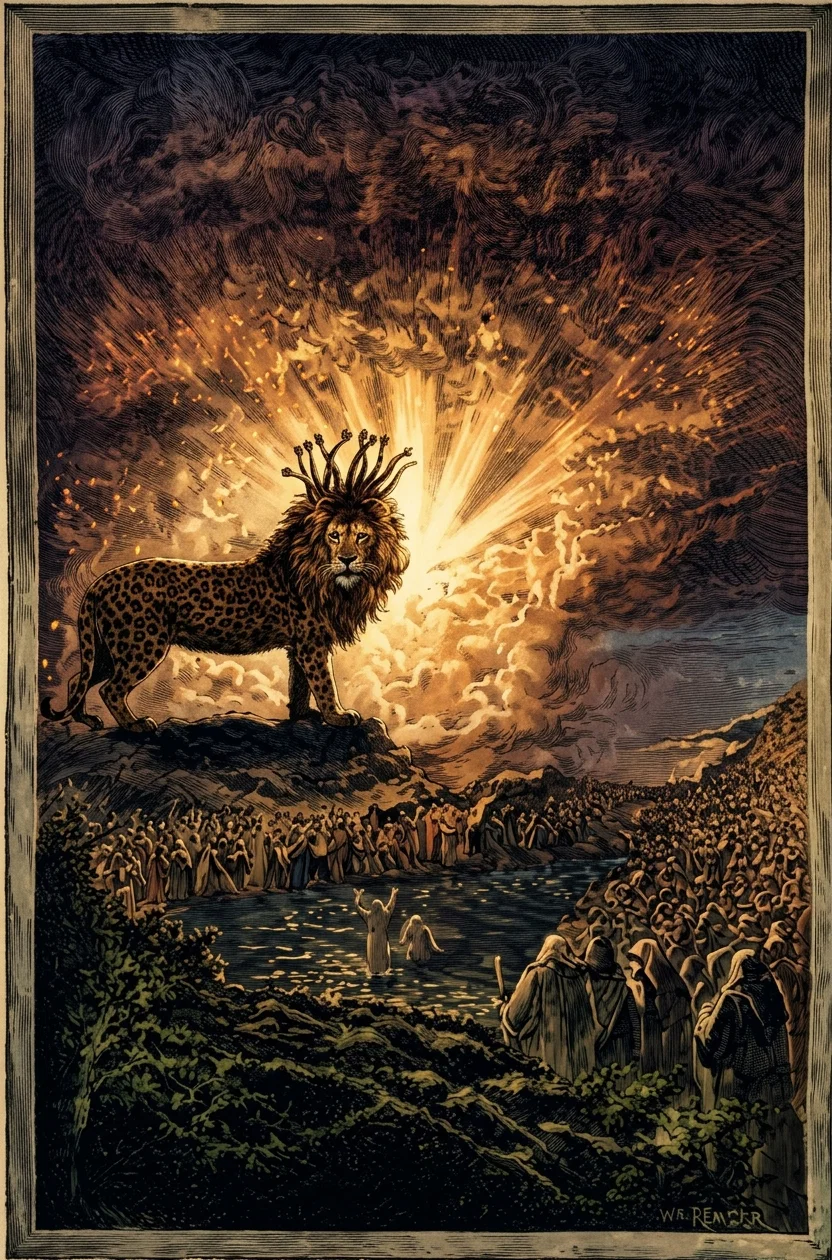
WHAT is the meaning of the beast of Rev. 13:1-10? What does it symbolize? What is the meaning of “the image to the beast”? These are questions of importance.
A “beast” in prophecy represents a kingdom, empire, government. This is seen in the visions of the seventh and eighth chapters of Daniel. Dan. 7:17, 18; 8:20, 21. But a beast represents more than a mere kingdom or power; it is the symbol of a power antagonistic to God and His people. For when mere kingdoms or powers are to be symbolized, as in Daniel 2, different metals are used in the figure of a man. These different metals—gold, silver, brass, and iron—in the image of Nebuchadnezzar’s dream, represented Babylon, Medo-Persia, Grecia, and Rome. But when the true character of these powers is to be revealed as opposed to the work and people of God, they are represented by fierce and cruel wild beasts of prey, the lion, the bear, the leopard, the combination of them all and more, the terrible nondescript with ten horns. The ten-horned, composite beast of Revelation 13 covers the same ground as the four beasts of Daniel 7. It has the mouth of the lion, the body of the leopard, the feet of the bear, and the ten horns of the terrible nondescript.
It has an additional feature; namely, seven heads; but each head has the lion’s mouth, and upon all heads were the “names of blasphemies.”
Essential Elements of a Persecuting Power
No power is antagonistic to the government of God or a persecutor of His people which does not combine in its scheme of government church and state, or religious dogma enforced by civil statute. A government purely civil will not persecute; a government purely religious or ecclesiastical can not persecute, or visit upon the dissenter civil penalties. In the first—the purely civil—all religionists are equal before the law; in the second—the ecclesiastical—its jurisdiction is limited to its own body and the voluntary submission of its adherents. Therefore we repeat again: A purely civil government will not persecute; a purely ecclesiastical body can not persecute. The combination of these constitutes the power which combines them in the light of the prophecy, a “beast.” “Religion” is the personal relationship between man and his conception of God. Conscience is the voice of God in the soul.
Whenever the creature—man or government—assumes authority over religion and conscience, it assumes the place and authority of God, and writes blasphemy upon its pretensions. The logic of such action is to deem the laws which demand such assumption the highest and most important of the realm; and therefore follows prosecution and punishment of all dissenters to these dogmas. Therefore the prophecy places upon the heads the “names of blasphemies,” declares the beast to be an object of worship and the blasphemer and persecutor of the people of God.
This beast power is not of God; for it receives its power, throne, and authority from the dragon, and the dragon is the symbol of God’s great adversary Satan, the world’s great deceiver the Devil. Rev. 12:9. He has led many good men to erroneously believe that religion could be preserved only by embodying it in civil statute, a curse to the state, a tyrannous engine in the hand of a backslidden church.
The beast and the dragon are synchronous in their work; that is, they cover the same time and do the same work.
The Dragon
In the twelfth chapter is revealed this dragon or serpent, the great spiritual foe of God’s church. He may not exercise physical power through his invisible angels of evil; but through them he deceives and influences men to do evil, to mold governments, to issue decrees, ostensibly for the good of state and church and society, but always resulting in the persecution of the children of God. The seven-headed serpent was a symbol of ancient, apostate Babylon; and the dragon, the serpent, is used to show that the system is Babylonian all through. So Satan, once Lucifer, is called the king of Babylon. See Isa. 14:4, 12-14. Satan, the invisible, evil one can not issue laws; his will must be uttered through the governments he influences, and these are represented by the heads, which are successive, not contemporaneous. (See Rev. 17:10.) The speaking mouths of these heads are symbolical of the persecuting, law-making power of the dynasties typified by the heads. These began with Babylon and Nimrod. When our Lord was born of the flesh, it was Pagan Rome speaking through Herod and Pilate, and later, through emperors. Rev. 12:4, 12, 13.
In chapter 13 the dragon is in the background, and there is revealed his direct persecuting agency, the beast, acting by the authority of the devil, and doing his work. Still the power is Babylonian, for it is the lion’s mouth throughout which utters the laws, and the lion is the symbol of Babylon. Dan. 7:4; Jer. 4:7. Do not misunderstand,—civil government is right and necessary; and proper civil government is not a cruel beast, but a broad over-sheltering tree. The beast is the union-of-church-and-state element,5which, entering in, vitiates the whole. There were many excellent things about Babylon, the first of these heads; but the beast came in when Nebuchadnezzar demanded the worship of his apotheosis of patriotism. See Daniel 3. There were admirable things among the ten kingdoms which composed the Papal-Roman dynasty; but the evil thing was the union of church and state which exalted man to the place of God and enforced his decrees by statute law.
The Roman governments—the ten horns—of themselves were not that beast; the Roman Catholic Church—ecclesiastical—was not the beast, nor a head of the beast. But the Papacy dominating civil authority was the fifth head which dominated that beast; and for the time that head was dominant, it was the beast, for it is the head which gives character to the beast.
The heads began with Babylon, as did the beast; and the beast is essentially Babylonian throughout its career, in character and in the abnormal form or forms of body, representing the confusion consequent upon sin or departure from God’s plan. The heads represent so many distinct and characteristic forms of government, or dynasties, which Satan has endeavored to use to bring the whole world into subjection to himself and to hold it in rebellion to God. Hence the Babylonian spirit of self-exaltation and assumed authority, hence also the Babylonian condition of confusion, persists from the beginning.
The Heads
The beast’s body of Revelation 13 is Babylonian—abnormal and confused; its various phases of government are Babylonian—they speak through the lion’s mouth. Down to the chronological application of verses 4-10 of the prophecy, there have been five of these heads in existence; namely, Babylon, Medo-Persia, Greece, Pagan Rome, Papal Rome.
Papal Rome exercised domination over the divisions of the Roman empire, represented by the horns, from the days when Justinian made the bishop of Rome “head over all the churches,” and “true and only corrector of heretics,” in A.D. 533, a decree made more effective by the subjection of the Ostrogoths in 538. From that period to the period of 1793 to 1798, the bishop of Rome held tremendous sway; and that system of church and state—the beast under its fifth head, Papal Rome—put to death its awful sacrifices of thousands upon thousands, estimated by some at fifty millions. Fitly is that period, stretching from the days of Justinian to the French Revolution, the direct outgrowth of papal intolerance, called the Dark Ages. The saints of God were persecuted to the death, and were driven to mountain fastnesses and deserted places, while the great majority witnessed for their faith at the stake, the rack, and in other inhuman ways of torture. The men who did that work for the devil believed they were doing God service. Men had become wedded to an evil principle, which deceived and made them demons, and which if made operative to-day and perpetuated, will do the same again.
That period of time, 1,260 years, is symbolized by the “forty and two months,” 1,260 days, each day standing for a year. Eze. 4:6; Num. 14:34.
The Reformation
As the end of that time drew near, Europe wakened from its awful night. The Reformation had touched the consciences of its jaded and satiated governments. They saw their most upright subjects either dying for a faith which did not injure either government or society, or leaving their country for the new world opening beyond the sea. In 1776 Maria Theresa issued laws of toleration in her realm, and the awful reign of intolerance ended even in name in the captivity of Pope Pius VI in 1798. After that time the Roman church still lived and flourished, but with no power to persecute save in the little territory of the States of the Church, and her temporal power there was abolished in 1870 by Victor Emmanuel. That church still lives, and is prospering as never before in her history. If forever she would renounce all desire, all right, all prerogative to control the faith of men, or the laws of states in the matters of religion, it would be well for the world. But her inclinations, her assumptions, her claims, her demands, are the same as when Henry the Fourth of Germany walked as a penitent barefoot in the snow suing for clemency, pleading the papal pardon, or when John Huss of Bohemia was burned at the stake. That same ambition to rule for God, the same principles dominating men, will result in the same evil effects now if voiced in civil law, that they did in Pagan or Papal Rome. We plead with our readers to reject forever the evil principles.
Yet out of these principles will grow the image to the beast, the essential likeness in respect to the union of those two things, church and state, or religious dogma enforced by civil law. Would we save ourselves from the awful result?—Heed then the divine protest and warning embodied in the third angel’s message of Rev. 14:9-11: “If any man worshipeth the beast and his image, and receiveth a mark on his forehead, or upon his hand, he also shall drink of the wine of the wrath of God, which is prepared unmixed in the cup of His anger”—God’s just wrath against persistent, implacable rebellion.