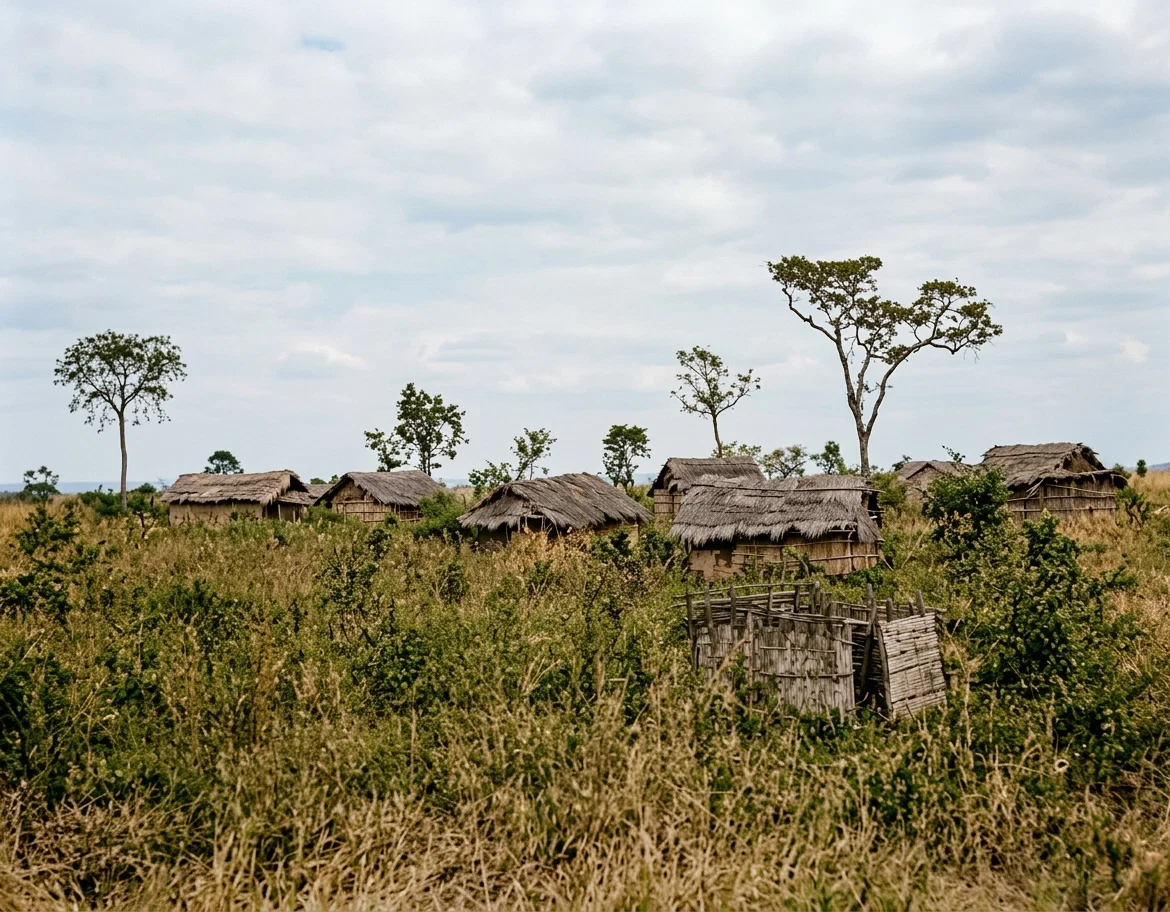
It would seem that the missionary efforts in past years in Nyassaland would have had more influence on the natives in the building of their huts. Many of them are satisfied with a mere hovel of grass held together with a few bamboos. Others have a better class of huts, the walls of which are made of bamboo poles set in the ground with some measure of order, and the roof is made of a network of bamboo rods, covered with a thatch of the long native grass. Some of them plaster the inside of the walls with mud, which in this country is used instead of mortar even in brick houses built by Europeans.
The huts are grouped together in villages, without any attempt at uniformity or orderly arrangement. Some villages are enclosed by a wall made of tall reeds for protection against wild beasts and marauders. The necessity for such protection is not so urgent now as in former years. Occasionally, however, we hear of some one being mauled by a lion or a leopard. We have been having some visits from leopards at our mission, causing considerable alarm among our boys. As they were quite bold in their attempts to get at our goats, we deemed it necessary to try to end their nightly visits. After watching in vain for several nights, we made an effort to outwit them, and in a specially prepared trap we caught a fine large leopard, fierce, but beautiful.
No provision is made for admitting light into the huts, or for allowing smoke to escape. The doorway serves both purposes. The houses are not much used during the day, but in the evening, whether the weather is warm or cool, a fire — their one luxury — is made on the floor, and the members of the household gather around, and seem to enjoy the smoke as they sit or lie on the ground, or perhaps on a mat made of reeds or rushes. This mat also does service as bed and bedding. When used to sleep on, the mat is folded, one half covering the sleeper, while he lies on the other half.
It is not safe for a European to live near a native village on account of the extremely unhealthful conditions. From an article giving a “Summary of Researches on Native Malaria and Malarial Prophylaxis” by two medical specialists, officially published in the British Central Africa Gazette, the official organ of the administration, I quote the following: “The condition of extreme unhealthfulness found in West Africa is not determined by the ‘climate.’ The reason is largely to be found in the conditions under which Europeans live in Africa. Even on general grounds, it would be well to avoid native huts and hovels with all their dirt and unsanitary surroundings, conditions which may be likened to the worst slums of our large towns. When, however, we realize that these huts are veritable hotbeds of malaria, it is evident that the very first sanitary law for Europeans in Africa is to avoid their neighborhood.”
NATIVE VILLAGE, BRITISH CENTRAL AFRICA
The reason for the European planter or trader avoiding the vicinity of the native villages is obvious, but the missionary can not wholly avoid coming into close contact with the people of the country. While taking all reasonable precautions, he must be willing to go where the people are, and even where the conditions are the worst, in order that he may seek out the souls that would perish in the darkness of heathen superstition unless he risked something to carry the gospel to them.
But perhaps worse than the unfavorable physical features in connection with the villages is the moral aspect. The natives have no regular work or work hours. Many of them do not work more than one month in the year; they are compelled by the government of the protectorate to work at least one month. The men expect their women and children to prepare the food, and to do most of the work in the garden, while they lie around day after day in a condition of listlessness. At any hour of the day one may find in the villages a group of men lying on the ground, perhaps listening to some one telling stories of questionable veracity, and passing around from one to another a peculiar sort of pipe, of which each one takes only one or two inhalations at a time. Usually a group of women may be found in another place, evidently occupied in about the same way, the pipe not excepted.
Dancing, accompanied by the drinking of native-made beer, is indulged in regularly. We frequently hear the beat of the weird-sounding drums begin late in the evening and continue through the night and the following day, and sometimes two nights and two days. The scenes in connection with this revelry are quite exciting, and require endurance worthy of a better cause.
The missions that have been established by the different denominations have done a good work in educating some of the young people to turn away from some of these corrupting influences.