SINCE the Civil War there have been consolidations, organizations, formations, combinations, and federations—a banding together of the community of interests, influence, and power, alike in the social, civic, and religious worlds, upon a scale so vast and a rapidity so startling as to be absolutely unequaled in history. The colossal growth and power of modern combinations of wealth and influence and identical interests have amazed the thoughtful student of political economy and events, and arrested the attention of the whole people of the republic. And the questions that tend to continually disturb the public mind are: Whither are we drifting? and, Shall the government of the people control the gigantic combinations that threaten the stability and perpetuity of national institutions, or shall the monopolies of wealth, labor, and religion, finally control the government?
A Few of These Combines.
Not to speak of Standard Oil, American Steel, American Railway, Amalgamated Copper, the “Beef Trust,” and the thousand-and-one combinations in the financial and commercial realm, or American Federation of Labor, Western Federation of Miners, United Miners, Railway Trainmen’s Union, and the multitude of other organizations of power and influence in the labor and social world, we may well be concerned in, and allowed to consider, that latest creation of the federation spirit, that last acquisition to the federation “powers that be”—
The Church Trust.
Such Dr. Newell Dwight Hillis, of the famed Plymouth Church, characterizes the modern movement of the federation of societies of church interests and church influences to be. Some five years ago Doctor Hillis predicted that the “church trust,” in this age of trusts and combines, was “soon to come;” and in the formation of the Inter-Church organization at the notable conference of the leading churches of the land, New York, 1905, his prediction was speedily realized. Once realized, and viewing its first work, Doctor Hillis said: “The movement means the speedy union of all the Protestant churches.”
Last, but not at all least, of all these multifarious organizations, and particularly in the religions, comes
The American Federation of Catholic Societies.
In the last analysis of its operations, this latter federation, numbering its loyal votaries by the millions, will, perhaps,—I may say beyond doubt,—exert an influence and a power upon the body politic second to none, probably first of all in importance.
Born in a first convention at Cincinnati, Ohio, in 1901, and hardly receiving any attention from the secular press, quietly making its way from convention to convention to public sentiment and influence, it has arisen from an humble inception to a very high plane of power and public estimation—a power that has been felt in Church and State, and in the nation. The deliberations of its later conventions are telegraphed to the press of a nation, to the leading journals of the world.
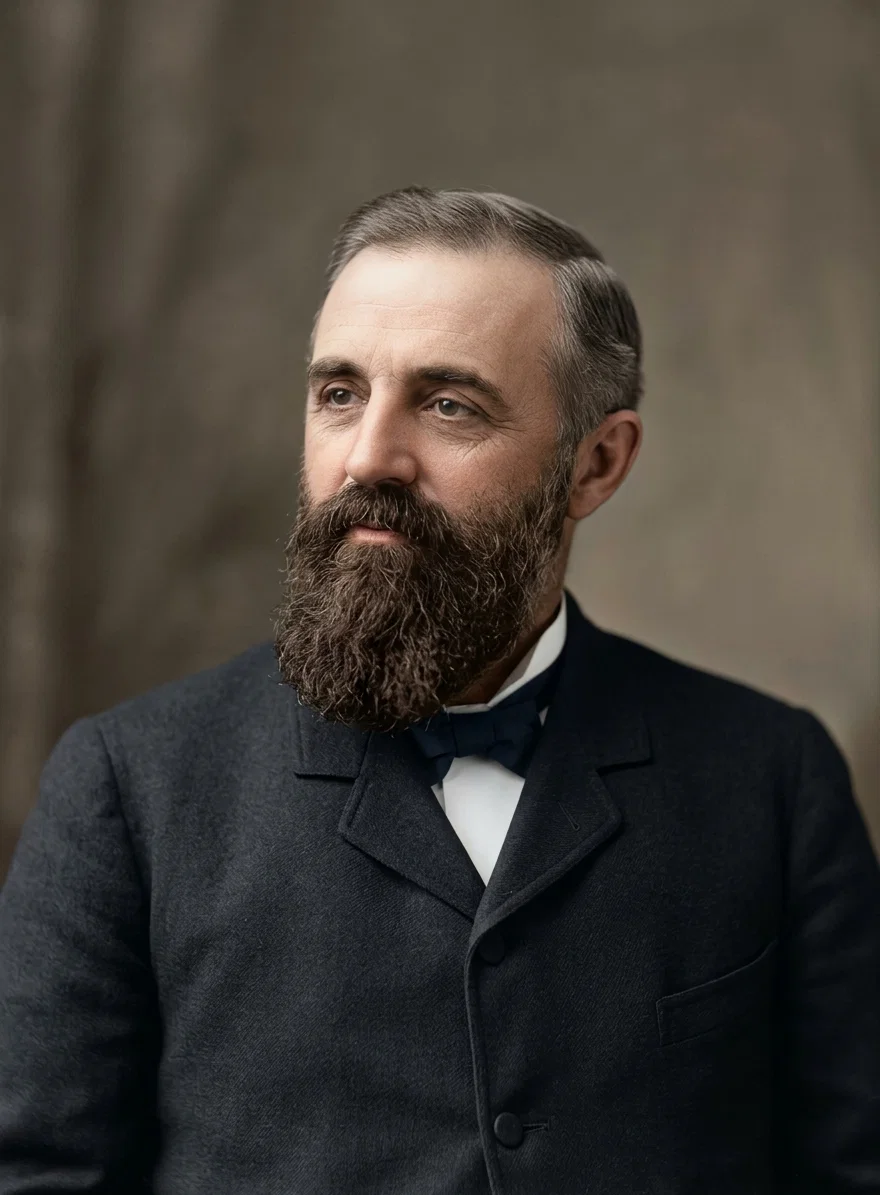
J. B. Oelkers, First Vice-Pres. Catholic Federation.
The Meaning of It.
American Federation of Catholic Societies means the union of all the Catholic societies of the United States and the world “for Christ and the church;” “to advance the civil, religious, and social interests of Catholics in the United States and its dependencies;” to “rise,” when needs be, “like an impregnable wall against the fierce violence of the enemies of God.”
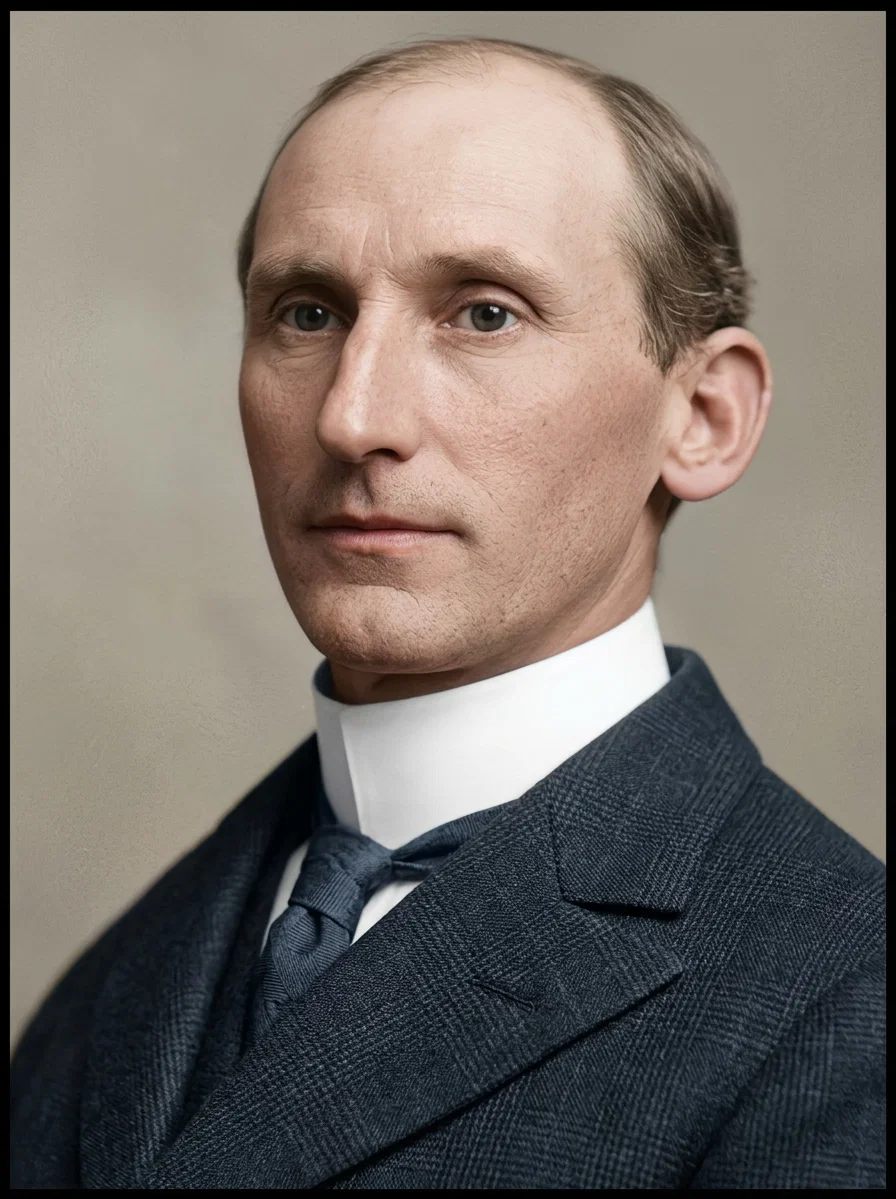
Anthony Matre, Secretary Catholic Federation.
One of the oldest of the American hierarchy has recently stated that “a federation of all the Catholic societies of the entire United States would mean righting every wrong; for those who would do wrong would not dare face such an array of numbers.”
As a Renovator.
Pope Pius X, sending the apostolic blessing to the convention at Buffalo in 1906, states that the object of Catholic federation must be “to endeavor to renovate public and private life in conformity with the teachings of Jesus Christ.”
Writing upon the subject, Cardinal Merry Del Val says that federation and its design give joy to the sovereign pontiff, for “you are aware that he has federations of this kind very much at heart because of the abundant blessings that accrue from them to civil society.” American Federation of Catholic Societies pleads for the restoration of “the temporal power of the church” (“Public Proceedings Detroit Convention,” p. 95), and reaffirms a public “protest against the violation of the rights of the holy See, and trusts that the day is not far distant when these rights will be restored.” This kind of sentiment and thought must result not alone from primary teaching long extant in the church, but it may be traced quite directly to the world-wide encyclical from Pope Leo XIII, delivered June, 1906. That encyclical was on “Christian Unity”—“the reunion of all the Christian churches”—and in it we find:
“The fathers of the church are unanimous in considering as outside the Catholic communion any one who in the least degree deviates from even one point of the doctrine proposed by the authoritative magisterium of the church. . . . For the due preservation of unity of the faith it is not sufficient that the head should have been charged merely with the office of superintendent or should have been invested solely with the power of direction; but IT IS ABSOLUTELY NECESSARY THAT HE SHOULD HAVE RECEIVED REAL AND SOVEREIGN AUTHORITY WHICH THE WHOLE COMMUNITY IS BOUND TO OBEY.”
The Papal Plan for the United States.
Still further back, in 1892, it was reported by the Rome correspondent of the New York Sun, as to the aim of the Papacy in the United States, that “what the church has done in the past for others, she will now do for the United States. That is the reason why the holy See encourages the American clergy to guard zealously the solidarity, and to labor for the fusion of all the foreign and heterogeneous elements in one vast national family. The American church furnishes and must furnish at the present time the proof that Christianity is the school of patriotism and of national sentiment. By continuing to favor this work of unification, it will form the grandeur of the United States, and5will demonstrate the degree to which religion and the church are the generators of political and patriotic independence. Like all intuitive souls, he [Pope Leo] hails in the united American States and in their young and flourishing church, the source of a new life for Europeans. He wants America to be powerful in order that Europe may regain strength from borrowing a rejuvenated type."
These are fateful words. The American destiny of greatness and development is to furnish a renewing power, a renewed greatness and vigor for the church. It is to be made the source of a new and quickening influence in the fast-waning influence and power of Catholicism in Europe. The destiny of the one must be the destiny of the other. Like barnacles clinging to the hull of a great leviathan of the sea, both must sink or swim together.
To Be a Great Fighting Machine.
The conclusion is unavoidable. American Federation of Catholic Societies was, in fact, the apex of the wish of Leo XIII and the church—a powerful educational and political fighting machine to be used in the arena of the political and social worlds, in order that Catholic principles and will might dominate and receive recognition, become the “real and sovereign authority,” and to the end that both the “public” and the “private life” may be “renovated” and changed in “conformity with the teachings of Jesus Christ,” as such teachings are held and taught by the Roman Catholic Church.
Says former President T. B. Minahan: “Among the advantages to be gained by federation, the most desirable and important is the development of a Catholic public sentiment. Public opinion in America is the power behind the throne. To have a share in it, either in locality or nation, is to wield a power. Millions of Catholics, united and prudently asserting themselves by this means, can not fail of recognition.”
To assist in winning America to “the religion most consistent with the naturally broad and logical trend of the American mind,” is the aim of Catholic federation; and the soul-stirring acclamation of other times is as applicable now to federation as it was in the crusades of old: “God wills it” is the spontaneous voice of almost the entire Catholic press and people. Who can fail to recollect that “A Roman Catholic Nation and a Roman Catholic King” was the real cry of the crusaders in the “world’s moral midnight” times, or fail to understand that “A Roman Catholic Nation and a Roman Catholic Ruler” is the real animus of the consolidated Catholic societies of to-day?
It was President Roosevelt who recently said: “I expect to see Roman Catholic presidents in this country.” And his expressed anticipation is well within the range of near possibilities. “For this [the American Catholic interests in the Philippines] the demand of fifteen millions of Catholics is somewhat of a guarantee. It is one which no administration will dare ignore.”—Church Progress, St. Louis, Mo.
It is apparent, then, that Catholic federation will bring its influence to bear upon administrations, and the civil power.
An Instance to the Point.
As to the kind of politics in federation, Bishop McFaul relates an instance that occurred in the New Jersey Legislature. Roman Catholic individuals were opposed to the phraseology of a certain bill before the House. They appeared and demanded a change. The reply was: “The bill is right and proper and no change will be made.”
Then representatives of American Catholic societies called upon the House leaders and peremptorily demanded the change desired to be made, or “we will go back and report to our societies.” What was the result and the reply?—“Gentlemen, . . . don’t stir up a hornet’s nest on this question. What changes do you want? We will be very glad to make them.”
That which did not appear at all right to the lawmakers was made to seem expedient by the threat of a return of their refusal to the confederated power of Catholic societies. Principle gave way to policy. “This,” said McFane, “is the kind of politics in federation.”
A Real Danger.
And now appears a real danger in our land. It hardly could have been foreseen. In the American States, the decision of the ballot is final and public opinion is irresistible. The Catholic Church recognizes each of these facts; it proposes to make use of these agencies. The church teaches: “Religion is the corner-stone of order in every State. Destroy religion and you will annihilate the State. ‘The nation that will not serve God shall perish.’” Therefore, America, that it may not perish from the earth, the American system of government, must recognize in the See of Rome “a real and sovereign authority which the whole community is bound to obey.” And, further, as to the danger, Protestantism is fast drifting to the bosom of Rome. Rome sees this, too, and welcomes the change in the trend of thought.
Edward Feeney, national president of the federation, says: “There was a time when Catholic opinion was lightly held in this country. Not so to-day. Now the views of Catholics, especially on large public questions, are considered of importance.” Rev. Father Campbell says: “The real thoughtful patriotism of the country courts Catholic assistance in solving the solemn problems fraught with threatening dangers for the future.” Ah, only too true!
Yet “Rome never changes.” Steadily, with increasing power, she marches to “manifest destiny.” A little while, and all the world shall wonder after the beast; a little while, and Rome, once more clothed with the pomp and power of medieval days, shall “sit a queen,” and be able to exclaim: “I am no widow.” Is it not time that the voice of Luther may once more be heard, not alone in Germany, but in all the world?